

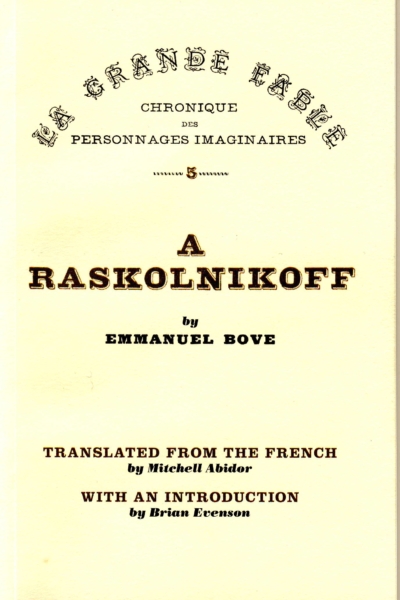
A Raskolnikoff – Emmanuel Bove
There are crucial realities here the writing is doing its utmost to convey, realities our realisms can’t confront, realities that require other aesthetics.
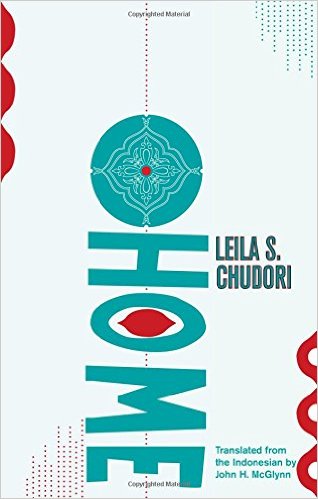
The figure of the flâneur is generally a de-politicized one; it is typically a man who observes the world from a safe, distanced, detached perspective.
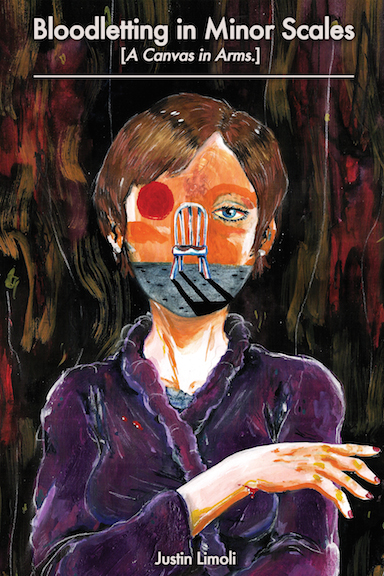
Bloodletting in Minor Scales – Justin Limoli
The dismissal of “heaviness” from experimental or mainstream quarters alike is an evasion.
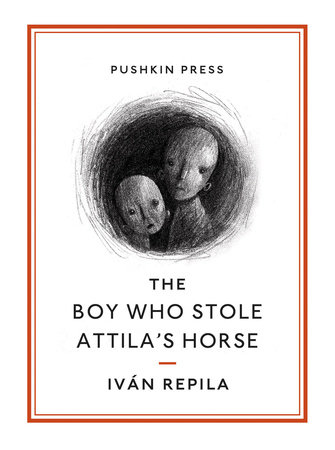
The Boy Who Stole Attila’s Horse – Iván Repila
“Small goes on dying for days, and his brother goes on keeping him alive. As if they were playing.” This is Repila’s game, and he’s good at it.
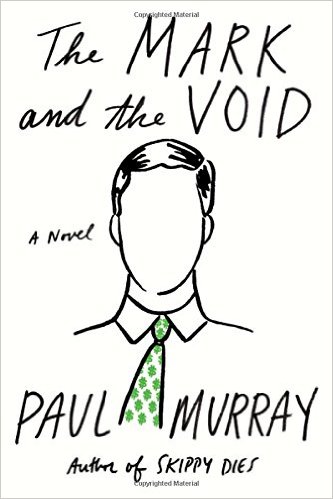
The Mark and the Void – Paul Murray
Murray pulls off the impossible. He writes a funny, poignant, human, and philosophical novel about an investment banker.
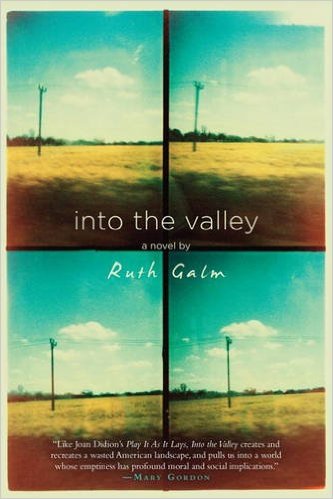
B., like many other white members of her zeitgeist, cannot embrace her cultural present, so she tries to pilgrimage back in time.

Gold Fame Citrus – Claire Vaye Watkins
[Gold Fame Citrus] speaks to the part of me that sees a drained lake as more than a localized crisis affecting only a handful of fish, and wonders about the texture and shape of the greater crisis that an event like this portends.

In this short but expansive book which reads sometimes like poetry, sometimes like philosophy, and always like resistance, Berkowitz encourages us to become authoritative about our own experiences.
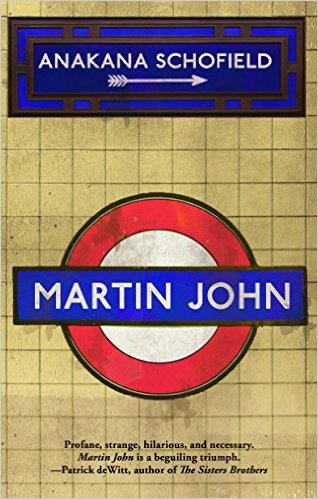
Martin John – Anakana Schofield
Martin John is not so much a character as a caricature of masculinity, a figure that, though, granted a privileged position in meaning’s labyrinth, is, nevertheless, caught in his own circuit, fumbling with his zipper.

The Roar of Morning – Tip Marugg
The Roar of Morning is quite anti-climactic — in a digressive and descriptive mode it falls well short of self-knowledge or it fails to intimate truths, those buried umbilical cords, that an apocalyptic event is waiting to disinter.