


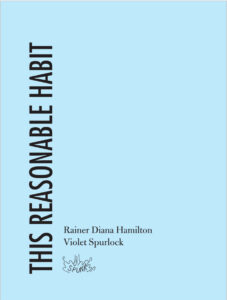
[Spunk Editions; 2026]
Art resonates when it is specific. When an artist tries to make their art universally appealing, they jeopardize its potential to mean much to anyone. Rainer Diana Hamilton and Violet Spurlock’s This Reasonable Habit will not speak to everyone, but those it does draw in—likely other writers or linguists, people sufficiently familiar with fashion, who have read if not formally studied art history and philosophy, and who at least know what Letterboxd is—will get the delicious feeling that the book was written for them in particular. Parts of this book felt directed at me. Other parts I took as educational avenues to explore before returning to the book.
I felt most personally targeted as a reader not by the content of the book but by its structure. The book begins with Rainer’s assertion to Violet that “We should say in public whatever we say in private.” After this first section, titled “Proposal,” the structure is interrupted by the conceit of the rest of the book: a schedule for an imagined literary summit, a sort of role playing game occurring in the minds—and words—of the fictional Rainer and Violet, and, likely, between the real Hamilton and Spurlock. What leads them to the imaginary summit is Violet’s fear that conversation is a futile, or at least useless, exercise:
This reasonable habit of conversation was their way
of letting other people do the living, Violet
worried, before, converting worry into dream,
she chose to be vicarious on purpose, playing
with rhetorical dolls or friendly projections who
would happily cooperate in answering her
questions, so far unsatisfied by talking
one-to-one—how many would they need?
This is how we end up with twenty-six characters labeled A through Z attending the literary summit. We follow these characters through their weekend as they try to answer such pressing questions as “What does it mean to be well-dressed?,” “Can we say what we mean?,” “Is shyness a moral failing?,” and “What constitutes a good reason to dislike someone?” The schedule is split into three days, titled “Accidents,” “Relations,” and “Pleasures.” Each features a combination of panels, discussions, and workshops, as well as less expected events like “2AM sex” on day one and a “5pm bar fight” on day three. Reading this schedule reawakened what I believe is a central part of me, which has lain mostly dormant in my adulthood: the part that likes to make imaginary schedules, to turn every piece of information into some sort of chart or graph. Midway through my first read of This Reasonable Habit, I went back to the beginning in order to properly chart details about and interactions between characters A through Z. Reading their conversations in a vacuum was less satisfying than hearing words from someone with a context, however small. Some of these characters remained fairly elusive, but others took shape. F was my favorite; we were bonded from the first panel—“What does it mean to be well dressed?”—in which E accuses F of “hiding something under their giant Vetements hoodie”; I hide under mine a price tag that surely evidences a shopping addiction.
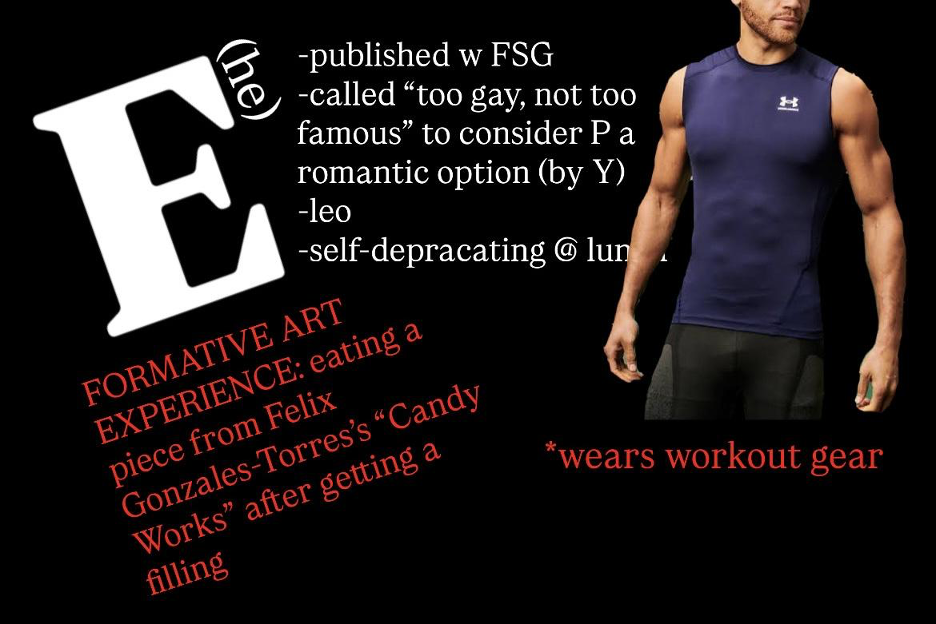
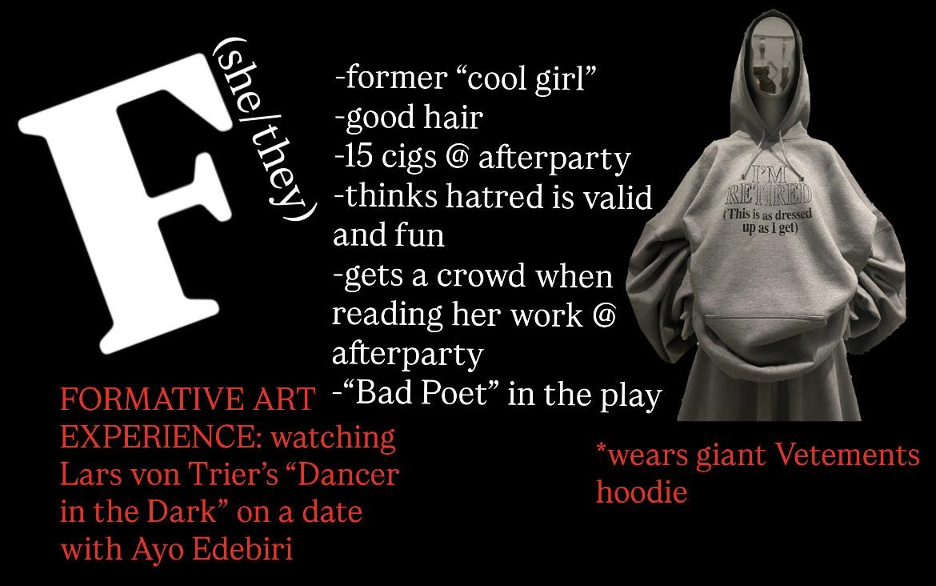
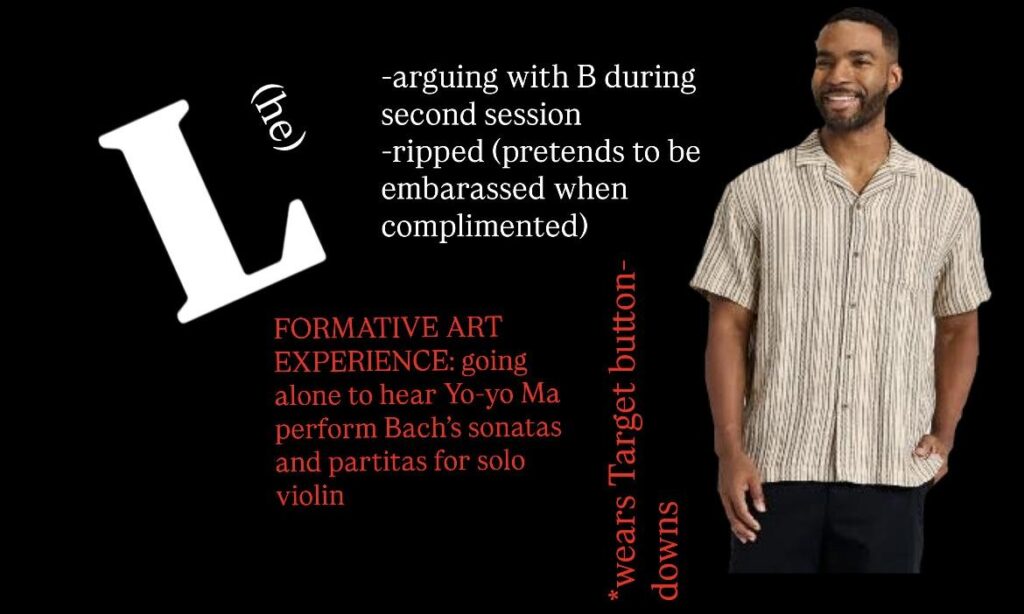
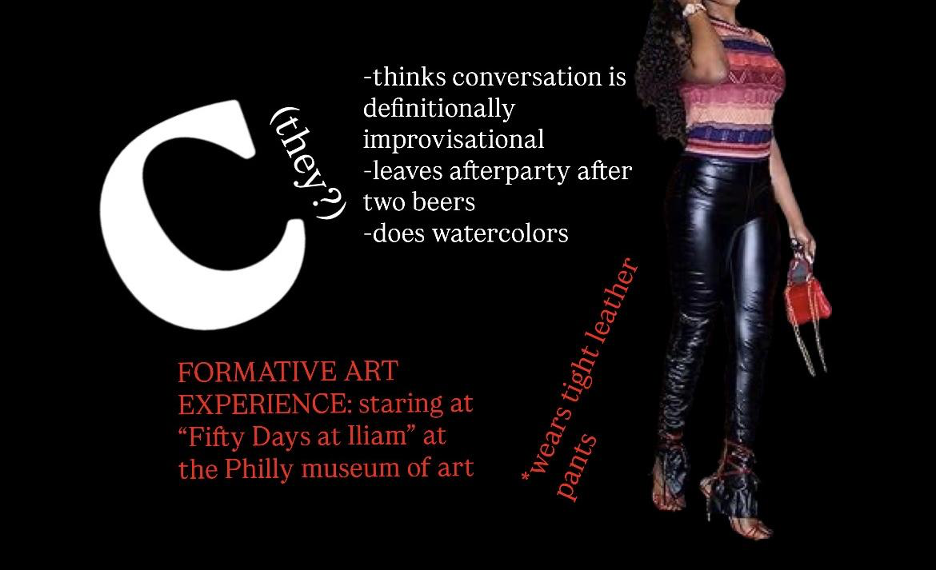
I took notes in a separate document from my review notes on these characters, then made the character profiles as Instagram stories that I saved instead of posting (this is my photo editing software of choice because it is free and lets me slap words and images together however I want). I considered putting all the characters and notes on a wall with red yarn strung between them to note interactions, or perhaps color-coded yarn to denote during which section of the book an interaction occurred. Unfortunately, I had already reached my limit for how side-tracked I was allowed to become. The character charts were worthwhile, though. When, during my second reading, I watched E say at the afterparty that it was “so absurd, elitist really, to prize some kind of abstract ‘transcendental style’ over the real matter of poetry, the poet’s life,” I checked my chart and thought A Leo in workout gear who probably self-depracates to fish for compliments would prioritize the idea of an artist’s life over the work itself. And he would probably publish with big five, not indie, as we learn he has done.
Within its framing as a summit, This Reasonable Habit does not hold a consistent structure. At first, it appeared to be a long prose poem, and many sections are written as complete sentences with proper punctuation but broken into stanzas with line breaks. Other sections are written as scripts, stripping away everything but the characters’ discussion. An occasional bullet-pointed or numbered list appears when necessary. Stage directions are infrequent, but the afterparty on day two is noted to have “[Sexual tension, dim lighting, ample couches].”
In the “Bar Fight” section, the speakers are not identified, and the text is separated into stanzas in different justifications across the page. Each justification seems to represent a different speaker, as the justifications alternate, almost like a script. Sometimes you get a whole back and forth from the same conversation, but often only partial sentences. I read this section from top to bottom, first, then tried reading it in other ways, in case it revealed a more logical progression of ideas—only the text that was fully left-justified, for example; maybe that would be a complete conversation of its own. It was not. The bar fight is instead meant to be “observed,” as if you stepped into this bar with a blindfold on and were simply told to listen, picking up on and paying attention to one voice at a time. The voices don’t converge into a continued, logical interaction until near the end, when two of them get into the prophesied fight and the other voices stop, presumably turned onlookers.
The book’s characters do not come to solid conclusions to most of their questions. Instead, it seems the participants of these discussions were tricked into discussing questions that were simply enjoyable to talk about at great length. The book does a lot more to present for observation the way that people talk about these questions than it does to answer the questions themselves. It depicts good conversation. The central question of the summit, and the book itself, comes during the “7PM Plenary” on day two: is conversation art? As readers, we are asked to determine this about the conversations we have observed in the book. Of course, being fictional and written down and, as part of a published work, surely extensively edited, this is perhaps a different question altogether. The book could be read entirely as a conversation between lightly fictionalized versions of its authors, and my own need to turn placeholders into recognizable characters before hearing what they had to say points toward an artistic understanding of this conversation, as I needed an “artist,” so to speak, to feel that what they were saying—be it art or not—held weight.
By writing their conversations, and the imagined conversations within their original one, Hamilton and Spurlock turn a conversation into art. Then the question, also discussed in the book, is whether it is still conversation once it is written down. Is spontaneity a requirement for conversation, and is spontaneous art possible? This is a relevant question because the state of conversation has changed: when deciding what to say, we often treat conversation as if it is permanent, simply because it is so likely to be recorded. Hamilton and Spurlock write that “they’d entered the age of sidebars, of I would never say this in public, buts, a time when a few dozen young would-be-communists were always ready to hit the wrong target, to try converting their private situations into ones with social weight.” Conversation is no longer inherently fleeting, spontaneous, and confined to the space where it originated. We have to distinguish, now, between “public” and “private” conversation, the difference being that public conversation perhaps should be scripted, planned in advance, because its effects will likely stick around. Whether this makes certain conversations art, while others remain only “habit” or “practice,” is up for debate. In the book’s first section, Violet fears that Rainer will start “making rigid maxims out of thought’s bendy reeds.” If conversation is only art when given the consideration of something its speaker put significant thought into, something they put forth to represent a part of them, as an artist, we may have forced it into that artistic status, and perhaps it should have remained lower stakes. Hamilton and Spurlock seem to know they cannot ask their central question without partially undermining their own simulation. They have a sense of humor about this. The whole book, in fact, is quite funny. The part of the book in which the characters discuss whether conversation is art is presented as a conversation between L. and C. L. argues that conversation is not art and only appears to be “because art often represents conversation.” C. disagrees, convinced that art does not aim to represent conversation at all. They question together whether conversation is inherently improvisational and whether that changes its status as art, realize that answering their initial question requires better defining both “art” and “conversation,” and eventually agree that conversation is “only possible under a rare set of circumstances.”
Of course, the conversation between C. and L. cannot necessarily be described as a conversation because it was authored by Hamilton and Spurlock, in the creation of this book, which is arguably a piece of narrative art. The question they present is whether conversation is art, but the question actually presented by this section is whether this art is conversation. To create an additional tension, and note this dissonance between the intended question and the one we arrived at, C. says, during this “conversation,” that “the obsession with the overly polished simulation of conversation is a dark sign of degraded times.”
The summit ends when an unspecified speaker declares, “I hate collaboration, but I love to disagree.” Perhaps conversation is one of the only forms in which these are not mutually exclusive. The book’s final section, titled “Acceptance,” returns to our fictional Violet and Rainer who conclude, in similar but more optimistic language, “It’s always so good to talk.”
Erin Evans is a writer from Michigan, now living in New York. She studied Creative Writing and Literature at the University of Michigan, where she also worked as an arts writer and editor for The Michigan Daily. Her essays and criticism have appeared there and in Vestoj.
This post may contain affiliate links.