


[World Poetry Books; 2026)
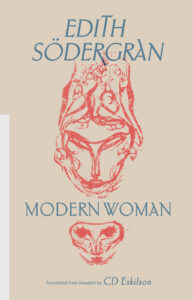
Although few contemporary Anglophone readers would be familiar with Edith Södergran’s (1892-1923) poetry, her status as one of the preeminent Scandinavian modernists has recently been revived by republication of her debut collection, Dikter (Poems), in an elegant bilingual edition by World Poetry Books. Originally published in 1916 when the author was twenty-four years old, the collection has been retitled Modern Woman by the translator, C.D. Eskilson, in order to suggest Södergran’s feminist consciousness and the multifaceted identities embodied by her poems. As a Finnish poet born in Saint Petersburg, Russia to a Swedish-speaking family, Södergran was uniquely positioned to draw upon the emerging transnational network of literary modernism. Fluent in Swedish, Finnish, German, French, English and Russian, she was inspired by a diverse range of avant-garde movements including French Symbolism, German expressionism, and Russian futurism. Before dying of tuberculosis at the age of thirty-one, Södergran released four volumes of poetry over the course of her short lifetime and is recognized today as one of the first and most influential modern Swedish-language poets.
According to Eskilson’s introduction, Södergran began writing as a child, composing her earliest poems in German, and it was only in 1908 that she began to transition to writing in Swedish. Her linguistic evolution reveals the complex interplay of language and national identity: Södergran was never formally educated in Swedish and spoke finlandssvensk, a dialect of the language influenced by the seven-hundred-year Swedish occupation of Finland before it was annexed by Russia. Although Swedish was still the primary literary language in Finland in the early twentieth century, Södergran eschewed a distinct national identity, enabling her to introduce the innovative techniques of European modernist poetry to a Scandinavian audience. Scholar Ursula Lindqvist observes that “[Södergran] sought to liberate the Swedish soul from the decadence of previous generations and infuse it with a new revolutionary spirit.”
Södergran’s poetry revolutionized the Swedish literary tradition in several ways. She largely rejected formal standards of rhyme and meter for the associative logic of free verse and a preoccupation with sensory details. Furthermore, she gave voice to a distinctly feminist consciousness and explored controversial subjects such as gender roles and women’s sexuality in poems such as “Dagen Svalnar…” (“The Day Cools…”) and “Vierge Moderne” (“Modern Lady”). One of her most explicitly radical poems, “Vierge Moderne,” investigates the experience of the emancipated “New Woman” at the turn of the twentieth century, deconstructing traditional gender roles and foregrounding female subjectivity:
I am not a woman. I am neutrois.
I am a child, a tomboy, a bold decision,
I am a laughing streak of scarlet sun;
I am a net for all voracious fish,
I am a toast to women’s glory,
I am a step toward luck and toward ruin,
I am a leap to freedom and toward myself…
Boldly embracing an androgynous identity and the idea of individual liberation, Södergran’s poetry was revolutionary for its time. Critics, however, often failed to grasp her prescient poetic vision, and reviews of the collection were initially negative. Although the reviewer Ture Janson praised the collection as embodying a sadness too vast for the constraints of formal verse, one critic opined in the Swedish-language Finnish newspaper Kaskö Tidning that he hadn’t seen “as much ‘rubbish’ in print as [in] Edith Södergran’s Dikter.” Another renamed the collection Dårddikter, or “mad poems.” When she published the manifesto “Individual Art” in 1918, one of the first avant-garde manifestos written by a woman, her poetry was once again attacked in the press. Södergran’s proclamation that “I urge individuals to work only for immortality… to make the most of themselves—to place themselves at the service of the future” proved too radical for the conservative Finnish literary establishment. It was only in the 1940s, two decades after her death, that critics began to reconsider Södergran as a significant trailblazer in modern Swedish-language poetry.
As an ambitious young woman who existed at the periphery of several languages and national cultures, Södergran’s work often reflects an alienated and divided self. Her poem “I” opens with a palpable sense of otherness:
I am a stranger in this land
Set deep beneath the pressing sea:
The sun spies down with curling rays
While currents rush between my hands.
They told me I was born in shackles,
That there were no friendly faces here.
While her poetry gives voice to the emancipated women attempting to break free of patriarchal constraints, it also subverts the uncritical celebration of the Finnish landscape by Romantic poets. Although Södergran’s poems frequently incorporate natural imagery, she rejects the romanticized perspective representative of the national poetic tradition. Instead, she homes in on specific sensory details and their emotive qualities, investigating broader philosophic ideas and individual struggles. She applies simplistic and sparse language to complex concepts while engaging with a wider transnational literary tradition. The poem “There’s a Candle in the Window,” for instance, is reminiscent of the form of haiku in its spareness and evocation of specific natural imagery:
There’s a candle in the window
slowly burning
to say someone’s died inside.
The spruces stand quietly
along a path that stops
at a foggy graveyard.
A lone bird whistles—
who’s inside?
The poem’s vivid, haunting imagery seems to eerily presage Södergran’s own premature death from tuberculosis. Yet its apparent simplicity belies the complexity of her engagement with language. In their introduction, Eskilson writes that they “have worked to retain the rhyme found throughout several poems, which, when presented alongside more free verse pieces, highlights the transgressive elements in Södergran’s approach. The choice to rhyme without any formal pattern becomes a defiant act, something I have mirrored by employing slant and near rhymes that approach but never arrive at tame or standardized poems.” Accordingly, the partial end rhyme of brinner (burning) and därinne (inside) in the original Swedish version are mirrored by the internal rhyme of “died inside” in the translation. Södergran’s lack of adherence to traditional rhyme schemes lends itself aptly to these considered stylistic choices. Eskilson also notes that they have attempted to preserve Södergran’s reliance on alliteration and consonance, evident in the translation’s repetition of the “w” sound (window, whistles, who’s) and the “s” sound (slowly, say someone’s, spruces stand). The sibilance of the “s” alliteration creates a shushing sound that suggests a candle snuffed out by the wind to symbolize the end of a life, an effect that is enhanced in the translated version.
Eskilson’s fluid and elegant translation illuminates the linguistic and political complexities of Södergran’s poems, which are poised to introduce her to a new audience of Anglophone readers nearly a century after her death. Although widely studied in Scandinavia, her poetry is still underrecognized within the modernist canon despite her deep engagement with European and American literary traditions. Södergran’s legacy should be examined alongside early innovators of modernist poetic style, including contemporary influences like Apollinaire and pioneering feminist experimental poets such as Mina Loy, whose 1914 “Feminist Manifesto” can be read in conversation with Södergran’s “Individual Art” (1918), widely considered the first avant-garde European manifesto written by a woman. Most powerfully, her poetry presents an enduring vision of a peaceful and unified future, influenced by her view of the creative process as a vessel for spiritual liberation and the revolutionary potential of collective artistic collaboration. In her 1920 poem Den stora trädgården (“The Big Garden”), she declares the shared mission of artists in a new age of humanity:
If I had a big garden
I would invite all my brothers and sisters there.
Each one would bring a large treasure.
We own nothing, thus we could become one people.
We shall build bars around our garden
letting no sound from the world reach us.
Out of our silent garden
we shall bring the world a new life.
Eliza Browning is an English PhD student at Princeton University, where her research focuses on modernist poetry, print culture, and literary networks. She previously edited the Oxonian Review and COUNTERCLOCK, and her criticism has appeared in the Cleveland Review of Books, Chicago Review, Asymptote, Full Stop, Cambridge Review of Books, Oxford Review of Books, and Boston Art Review, among others.
This post may contain affiliate links.