


[Rab-Rab Press; 2026]
Tr. from the Russian by Cathy Porter
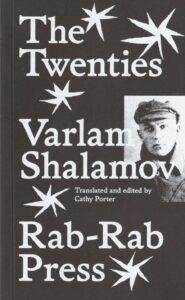
We are taught not to judge a book by its cover, but in the case of Varlam Shalamov’s The Twenties, recently translated by Cathy Porter for Rab-Rab Press, the cover takes us right into the text and the history behind it. A young man looking at us from the black-and-white cover is Shalamov himself. The photo was taken in 1926, two years after Shalamov came to Moscow to participate in what he would later call, quoting Karl Marx, the “storming of the heavens.” Born in 1907 in the provincial city of Vologda, Shalamov was too young to take part in the political upheaval of 1917 that led to the October Revolution, but he was just in time to engage in the cultural revolution that followed. While multiple artistic groups and movements offered competing visions of revolutionary art, the Bolshevik state was busy reforming an educational system to make schools and universities accessible to the underclasses, thus producing new socialist forms of subjectivity. Shalamov, studying law at the Moscow State University (the photo on the cover is from his student ID), was deeply involved in the Moscow literary scene. In this photo, he is wearing a hat reminiscent of the budenovka worn by Red Army fighters during the Civil War and a jacket resembling an altered soldier’s overcoat. Valerii Osipov, an author of Shalamov’s biography, suggests that this choice of clothes for a student ID photo could be a symbolic gesture signaling that a person wearing it “supports the revolution and supports those who won the Civil War.”
However, this period of revolutionary enthusiasm and radical experimentation did not last long and largely ended in the late 1920s-early 1930s, as the Stalinist regime became increasingly oppressive. In February 1928, Shalamov was expelled from university “for concealing his social background” (his father was an Orthodox priest, a fact he was careful not to publicize). A year later, he was arrested for printing leaflets of Lenin’s testament and sentenced to three years in a concentration camp. In 1932, Shalamov returned to Moscow only to be arrested again in 1937 during the Great Terror. This time, he spent seventeen years in the Kolyma region in the Russian Far North, infamous for its severe climate and inhuman working conditions. Shalamov returned to Moscow in 1953 to find out that the cultural and political milieu he once was a part of had ceased to exist, destroyed by Stalinist terror and the Second World War. One may speculate that Shalamov, writing his memoirs in 1962, during a period of relative liberalization, aimed to restore the world of his youth and to do justice to the figures erased from the Soviet cultural canon.
Given this, it is hardly surprising that Shalmov populates his memoir with an enormous number of people. Among those who make brief appearances are Formalist critic Viktor Shklovsky, Bolshevik theorist, polymath and Sci-Fi writer Alexander Bogdanov, Symbolist writer and poet Andrei Belyi, theater director Vsevolod Meyerhold, and a Master and Margarita’s author Mikhail Bulgakov. He also writes more substantial portraits of People’s Commissar of Education Anatoly Lunacharsky, whose “handkerchief was always snow-white and perfumed, that his suit was always immaculately pressed,” the writer and Communist revolutionary Larisa Reisner, “a young woman, the hope of literature, a beauty, a heroine of the Civil War, [who] died of typhoid fever at the age of twenty-nine,” the Futurist poet Vladimir Mayakovsky, “a speaker of a special kind, unlike any other,” and Mayakovsky’s fellow Left Front of Art (LEF) comrade Sergei Tretyakov, “a purist and a fanatic, versatile, exceptionally well educated, highly principled and a ‘fact-finder,’ a knight-errant propagandist of documents, facts and newspaper columns.” As Franziska Thun-Hohenstein notes in her biography of Shalamov, The Twenties often looks like a set of lecture notes rather than a proper memoir or essay, as if Shalamov’s intent was to “list all the people, events, and places that he associated with the vibrant atmosphere of the 1920s.”
It is hard not to see The Twenties as a monument to a bygone era, especially considering that most of the people Shalamov mentions have already died and a significant number of them have perished during the Stalinist terror. Of all the people named above, only Shkovsky was alive in 1962 when Shalamov wrote his memoir (Shkovsky died in 1984, having outlived Shalamov by two years). Reisner contracted a deadly disease in 1926; Lunacharsky, Belyi, and Bulgakov died of natural causes over the course of the 1930s-early 1940s; Mayakovsky shot himself in 1930; Tretyakov and Meyerhold were executed by the NKVD in 1937 and 1940, respectively. Shalamov himself, who was a generation or two younger than most of the major cultural figures of the 1920s, miraculously survived the camps but had lost many of his friends in the Stalinist purges.
Shalamov conveys a sense of lost collectivity by constantly switching between the first person singular and the plural. At first, it seems that Shalamov uses “I” and “we” interchangeably, but then a pattern begins to emerge. He primarily uses “I” when referring to the acts of remembrance in the present (“I remember”) or to singular occurrences in the past (“All I saw was a tall weeping man holding a black hat in his hands,” when describing Maxim Gorky’s return to the USSR). “We” is primarily reserved for the repeated actions in the past: an appreciation of Reisner’s writing (“her somewhat flowery style seemed an indisputable virtue to us in those days, when we were young, and hadn’t yet learnt to appreciate simplicity”), engagement with contemporary poetry (“we wanted poetry to explain to us what it meant in our lives, and would mean in the future”), or participation in amateur student productions (“we used to act out scenes in our student dormitory”). Even though Shalamov never identifies this “we,” the very vagueness suggests that he is referring not to a specific group of friends but rather to his generation.
Even though Shalamov aims to reconnect with the culture of the 1920s, his memoir paradoxically ends up emphasizing the gap between the postrevolutionary period and the present, i.e., the early 1960s. Shalamov repeatedly refers to the 1920s as “the age of orators” or simply “those days,” as if to remind readers of the distance separating them from that historical period. He further enhances this sense of distance through comparisons between “then” and “now.” At one point, he contrasts Mayakovsky and Boris Pasternak—perhaps the two biggest Soviet poets of the 1920s—with one of the most popular poets of the Khrushchev Thaw, Yevgeny Yevtushenko. Recognizing Yevtushenko’s importance as a poet born out of the spirit of de-Stalinization, Shalamov writes that “much of his poetry is spoilt by his crude ‘root rhymes’—rhyming the syllables before or after the stressed ones.” He goes on to compare the audiences Pasternak and Mayakovsky attracted with those who attended Yevtushenko’s readings: “Pasternak’s audiences were writers, actors, artists, musicians, scientists—anyone in the audience could have joined him on the stage. Mayakovsky’s audiences [were] divided into two—the young, mainly students, his friends, and the old, leading lights of the intelligentsia, his enemies. Yevtushenko, by contrast, has only friends and young people.” Shalamov refrains from drawing a final conclusion, but his tone suggests that he does not consider Yevtushenko to be on par with the poets of the past. Elsewhere, Shalamov notes how technological development changed the relationships between writers and readers. If in the 1920s, “prose-writers still read their works from the stage,” now, with the expansion of radio, television, and gramophone records, there is almost no room left for unmediated communication between authors and their audiences. Shalamov presents a dichotomy between the 1920s, a period of unbound and democratic creativity, and the 1960s, which attempts to recreate the experience of the first post-revolutionary decade but clearly lacks its drive.
While one may feel like dismissing these observations as mere nostalgic lamentations, it is worth remembering that the historical break that Shalamov implicitly describes was brought by Stalinist terror: a series of arrests, trials, executions, and long-term incarcerations that effectively destroyed Soviet avant-garde culture of the 1920s. I say “implicitly” because Shalamov mentions Stalin here only twice (and only one of these mentions is explicitly negative) and repressions are referred to only briefly—as, for instance, in the discussion of Tretyakov, who was shot as a Japanese spy in 1937 and then rehabilitated in 1956. Writing his memoirs in 1962 for Soviet journal Znamya, Shalamov was perfectly aware that there are limits to what one can publicly say about Stalin’s crimes. But, as Thun-Hohenstein suggests, the very act of listing poets, writers, artists, and cultural workers who were persecuted in the 1930s-1950s was an act of subversion. And indeed, Shalamov’s rather cautious piece turned out to be too subversive for the Soviet press of that time: even in an abridged version, it was published only after Shalamov’s death during the Perestroika, a period of political reforms that eventually led to the dissolution of the USSR.
When Shalamov wrote The Twenties, he was composing a work that would define his posthumous reputation both in Russia and abroad. I am referring to his Kolyma Stories, a collection of masterfully crafted short stories based on Shalamov’s experience in Kolyma and blending facts with fiction. Even though The Twenties and Kolyma Stories seem to differ in their subject matter, there are a few links between them. As Shalamov’s scholars Elena Mikhailik and Pavel Arsenev argue, Shalamov in Kolyma Stories draws,among other things, on the ideas of “literature of the fact,” formulated by Tretyakov, Shklovsky, and other LEF theorists in the late 1920s. Tretyakov, this “knight-errant propagandist of documents,” as Shalamov described him, argued that in the modern age conventional literature with fictional plots and characters would give way to documentary genres. Even though Shalamov invented plots and characters, he consistently referred to his stories as “documents,” emphasizing that they are informed by immediate experience of the camp. In The Twenties, Shalamov discusses Tretyakov’s ideas at some length, both appreciating his innovative approach to writing and criticizing him for his dogmatism. One can also notice a textual overlap between The Twenties and Shalamov’s writings on Kolyma. In The Twenties, Shalamov describes his eventual disappointment with Tretyakov who argued that one need only acquire a number of technical skills to become a poet. “But then it turned out skill wasn’t enough for poetry. For real poetry, your own blood was needed. If your blood wasn’t in the lines, you weren’t a poet, just a versifier. Poetry was fate, not a craft.” In the essay “On Prose” (1965), Shalamov reflects on Kolyma Stories and his approach to writing: “One’s own blood, one’s own fate—these are the demands of today’s literature. If the author writes with his blood, then there is no need to collect material while visiting the Butyrka prison or ‘transit’ stations, no need for research trips to regions like Tambov.” Note the mention of collecting “material” and “research trips.” One might suggest, as Shalamov’s scholars often do, that he engages in a dialogue with Tretyakov, who propagated working with factual sources and perished in the Soviet prison system.
Shalamov’s recollections of Tretyakov as well as many other parts of The Twenties are filled with a sense of disasters looming on the horizon: not only Stalinist terror but also war with Nazi Germany that began in June 1941 and took the lives of around twenty-seven million Soviet citizens. Shalamov’s unwillingness to dwell on these events is informed not only by the persistence of censorship (in the case of references to Stalin’s crimes) but also by the fact that the audience for which he aimed knew perfectly well what would happen next. In some cases, the lack of direct explanations intensifies the effect. At the very end of his notes, Shalamov mentions Musa Jalil (Musa Cälil), his roommate in the Moscow State University dorm, who would later become a famous Soviet Tatar poet writing in his native Tatar language. What Shalamov does not say and what would have been clear to any of his readers in the early 1960s, had his piece been published at that time, is that Jalil was captured by the German troops during the Second World War and sent to a concentration camp. In the camp, Jalil joined an underground resistance group that the Nazis later uncovered. Jalil was guillotined in Plötzensee prison in Berlin in August 1944. Shalamov does not mention any of that but instead informs us that, as a university student, Jalil would read to his roommates Alexander Pushkin’s poem “The Prisoner,” which begins with a line “I sit behind bars in a damp blackened dungeon…,” a detail that seems absolutely trivial and random unless one knows what later happened to Jalil.
A few sentences later, Shalamov refers to the future, noting that “in the twenties, it was impossible to say what trials each of us would face.” In this particular instance, I use my own translation. Cathy Porter, who translated Shalamov’s memoir into English, rendered this sentence slightly differently: “In the twenties, none of us knew what awaited us in the future.” What is missing in Porter’s version is a noun “trials” (“испытания” in Russian; another possible translation is “ordeals”). This omission could be written off as insignificant if it were not for the fact that “trials” is a very charged word that, in this context, most likely refers to Shalamov’s camp experience. By omitting it, Porter makes the sentence sound as if it refers to some abstract notion of the unforeseen future rather than to particular historical events, even if they are not mentioned directly. To make matters even more confusing, Porter omits the whole sentence in the paragraph that follows. In the original text, Shalamov ends his memoir with two laconic yet striking sentences: “We didn’t just want to read poetry. We wanted to act, to live.” (“Нам хотелось не только читать стихи. Нам хотелось действовать, жить.”). It seems strange, to put it mildly, to omit the first sentence that states that literary activities cannot fully replace real-life action and clearly reads as Shalamov’s motto.
These and some other minor inaccuracies and omissions are regrettable given that overall Porter’s translation works very well, providing a suitable English equivalent for Shalamov’s concise, at times even dry, right-on-the-mark prose. There is something defamiliarizing about Shalamov’s habit, visible in The Twenties as well as in Kolyma Stories, of presenting life-changing events in a very matter-of-fact way and achieving a higher level of expressiveness by omitting the most dramatic parts of the story. Porter preserves the peculiarities of Shalamov’s style and makes his text accessible to English-speaking audiences by supplementing it with an informative preface, historical commentary, and a glossary of the Soviet cultural figures Shalamov discusses. Due to the substantial framing, this edition may serve as a good entry point not merely into Shalamov’s oeuvre but also into Soviet cultural history. The Twenties has every chance to accomplish for Anglophone readers what the Russian original, hampered by censorship, could not do to their Soviet counterparts: to introduce them to a vibrant cultural period that offers multiple surprises and insights for those willing to brush history against the grain.
Konstantin Mitroshenkov is a historian, literary scholar, and translator. He is currently pursuing a PhD in Slavic Languages at Columbia University.
This post may contain affiliate links.