


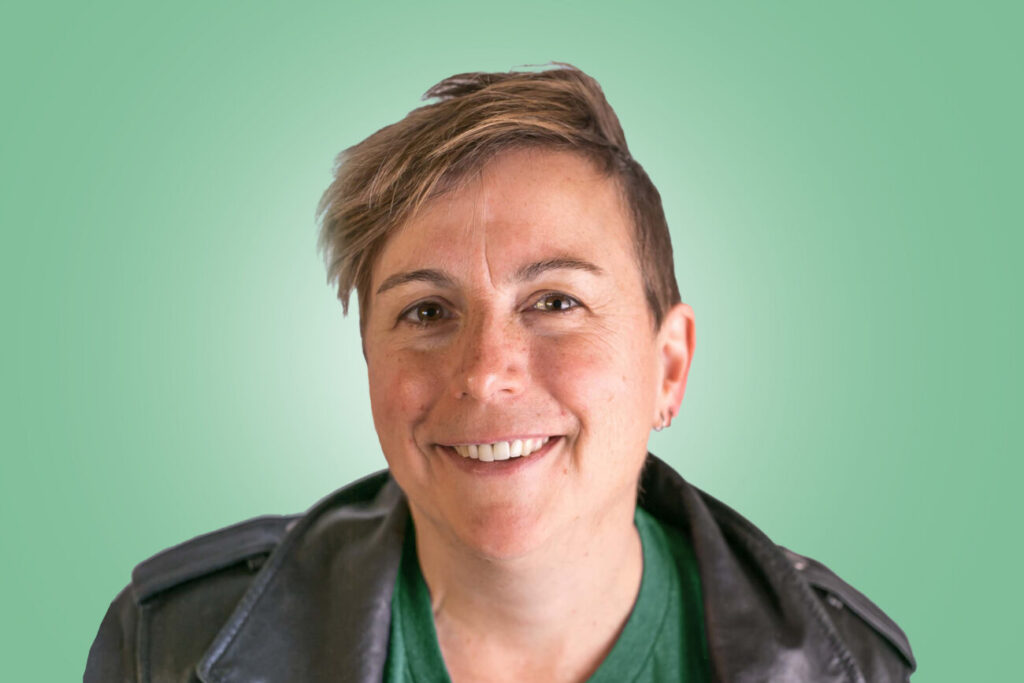
Molly McCloy’s new memoir, Nine Grudges: The Spiteful Origins of the Happiest Dyke on Earth, won the 2023 Book Pipeline “Unpublished” Award and the 2023 Quill Prose Award from Red Hen Press. Red Hen will publish her book this month. The story recounts a letter Molly composed to her father, outlining nine times he failed her and nine times she struggled to forgive. Though she didn’t know how he’d respond, Molly soon received a letter back in which her father acknowledged and took responsibility for hurting her. Unsparing and often very funny, each grudge provides an episode from Molly’s childhood told with care by an insightful adult version of the same person.
A four-time MothSLAM winner, Molly has been featured in O Magazine and on NPR. Her writing has appeared in the Huffington Post, Foglifter, and Blue Mesa Review, and she holds an MFA from the New School.
In this interview, I pose some questions to Molly about Nine Grudges to better understand how she turned childhood wounds into a letter to her father, and that letter into a memoir. A working-class kid navigating a rich-kid school, a middle sibling, and a survivor who names herself the happiest dyke on earth, Molly reflects on power, class, and family with humor and insight. Molly’s responses add background, depth, and context to the memoir, and she was even kind enough to build a nine-song mixtape, one track per grudge.
Eric Aldrich Let’s discuss your subtitle. I understand the main title, Nine Grudges, as your story is organized around nine grudges you held against your father, the act of enumerating them in a letter to him, and his apologetic response. The subtitle is “The Spiteful Origins of the Happiest Dyke on Earth.” Your grudges make clear the “spiteful origins,” but can you explain why you declare yourself “the happiest dyke on earth?”
Molly McCloy: When I was reworking the book draft for Nine Grudges in 2021 a well-meaning straight editor said, “Why don’t you bring out the queer element more?”
I thought, “This straight lady has no idea what she’s asking me to do.”
Because there is a ridiculous amount of translation that queer writers have to do for straight audiences. One time in a college workshop, a Christian student thought a sex scene I’d written was a scene with a mother breastfeeding a child. Weird shit like that.
So, my first response to that editor’s idea of queering my book was… hell no.
What I wanted to avoid was the usual stigma: the straight-world notion that I am queer because my dad had traumatized me.
I knew that if I tied childhood trauma to my queerness, I’d have to answer to that stigma, that assumption, you know, that constant negative messaging from the 90s that says if you’re queer something must have gone horribly wrong.
When considering how to bring my queerness into my book, I thought, Well, what if I confront this stigma head-on?
I wrote the subtitle to answer shitty straight-world assumptions with a smartass quip.
I wanted to say right away in my title, okay, sure, maybe my dad’s substandard fathering caused my queerness, probably not, but, hey, if it did, I should do nothing but thank the bastard. In fact, I should send him a Father’s Day card that says, “Hey Dad, thank you for fucking it all up and making me the happy queer I am today.”
Here’s the way I see the world: queerness is a gift.
Loving women has brought me the most incredible joy I’ve experienced in my life.
Being a dyke has infused me with every type of happiness from steady contentment to wild, electric bliss.
This is true for me and a lot of the queer women I know.
I positioned “happiest” in front of “dyke,” which I think makes the reclaimed insult even more provocative. Because, according to straight-world conventional wisdom, dykes are really not happy. Look at the way non-Lesbian writers portray queer women. Even in 2026. As lonely. Dour. Angry. Unfashionable. White Lotus and Mindhunter with both really well-written shows, and, at the same time, for both shows, the only Lesbian character is a lonely woman feeding stray cats from tuna cans. Go ahead and interpret that symbolism.
I knew putting “dyke” in my title would piss people off. And adding “happiest” in front of “dyke”? Now I was really fucking with the shamers. Instead of moping around, I was having fun playing with straight assumptions.
And maybe that’s the short answer to your question: I wrote that subtitle because I am done with straight-world shame. I took on that shame for way too long and I am just… done. And my book is done with it too.
It’s been good fun for me to claim the title of Happiest Dyke on Earth. To call myself the champ. You’ll see in the book that to claim happiness in any form after my shitty childhood has been a huge struggle for me. So why not go big?
I’ll announce it right here, right now: I’m willing to take on all Happiest Dyke challengers and contenders. It’ll be fun to see how we determine a winner. How I defend my title. Stay tuned for the big Happiest Dyke contest!
Ultimately with this subtitle, I want to let the reader know in my title that this book has a happy ending. That survivors of childhood trauma are not doomed. I want my book title to indicate an element of hope.
What is a grudge? Some of the grudges you address in your letter to your father are clearly traumatic experiences, while others seem less so. Why, other than trauma, do people hold grudges? Can you explain the relationship between grudges and trauma based on the experiences you describe in the book?
Actually, I’d say all nine of my grudges were traumatic.
It’s pretty clear that my Grudge #4, which was getting dragged down a hall and then kicked in the chest by my own dad when I was 10, was traumatic. It was disturbing as hell and it fucked me up…for years. It sucks to be constantly scared of your own dad. And then, my dad’s violence made me fearful of the world, because if that’s what was cooked up by the people who are supposed to care for me, well then everyone else must be even worse, right? But here’s the thing: Grudge #4 wasn’t my most traumatic grudge.
The worst one was Grudge #3, when my dad mocked me for signing his birthday card with “your loving daughter, Molly.” It’s the one that made me cry the most when I wrote the letter asking for the apologies. Combined with the other shitty events, this one really inhibited my ability to express emotions, to express romantic interest, to be vulnerable in the way you have to be in order to have any kind of relationship with other people. And sure, I’m not saying it was this sole event that did ALL of this to me on its own. Maybe this event really was a kind of stand-in for a lot of daily interactions that were similar or unspoken, this idea that I was not allowed to even ask for an explicit expression of love from my own dad, so it definitely wasn’t an isolated, one-time anomaly, but a kind of clarifier, the incident that spelled out my usual DESPAIR in capital letters. This event caused me to lose my sense of ease with other people, especially future love interests, so, out of all my grudges, it hurt the most.
When I was crying my eyes out at age 22, trying to write Grudge #3 for the letter, I was grieving the loss of my innocence, the loss of my expectation of unconditional love from a parent. The loss of confidence and security. But if I were to tell you, “My dad made fun of my birthday card one time,” you’d say, “that doesn’t sound traumatic.” So my job, in the book, is to show you why that was even worse than being kicked and dragged. I mean, if you can even rank such things.
For me, the trauma is the intrusiveness of the memory and the way it sticks with you and impedes you in the future. And I think it sticks with you because you were powerless in the moment. And there’s this anger about that abuse of power. So, I think a grudge is an empowering reframing of trauma.
Instead of hanging onto the event with myself as a victim, I put the blame where it belonged and hung onto that instead. After all, I wasn’t the one who was wrong, and this other fucker was the real problem, so, hey, I won’t let that person or someone like that hurt me again. Sure, I’ll own the problems that come adjacent to anger, my withdrawal, my avoidance, my inability to let down my guard, but my best guess is that there is a protective element to anger—and to grudges– which is vital to someone recovering from childhood trauma.
Memoir readers and writers often talk about the “other” characters in a book – the family, friends, neighbors, coworkers, and so on who get dragged into a story by association with a writer. In your case, this is your family, and particularly your father. Talk a little bit about what decisions you made when choosing to write about your family. It’s not a new question about memoir, but it’s different for every writer, and I’m interested in your thoughts.
It’s hard to talk to my family about the book. Because my making very private family stories public freaks them out. My mom goes back and forth between “Write anything you want” and “Everyone is going to think I’m a terrible mother. Wait until I’m dead.” My dad is actually the easiest. Because he’s a fundamentally honest person. I had to get his permission to publish a Father’s Day article about him this past June in HuffPost. He read the piece and called it, “fair, generous even.”
The most important part for me is that I tried my best to go back to each one of these nine events, some of which are really fucking painful, and describe them with 100% emotional honesty. Since so many people have told me they wished they’d written their dad a letter like this, or that they did write that letter and got an unsatisfying response, well, all that feedback really motivated me to get this story right, because kids with backgrounds like mine are shamed out of telling our stories, not just by our families, but by society as a whole, this whole system that turns a blind eye to intergenerational violence. I want to tell the story of the challenge of the dysfunctional family.
I mean, my grandfather killed my dad’s dog with a hammer. A brutal act. I didn’t even put that in a book because violence against animals is such a taboo. So then, my dad, as an adult, has his own kids and tries to parent, coming out of that nightmare of a background. Of course he’s going to fail to some degree. But is he doomed? Is he to be written off as this hopeless, damaged person who will never get anything right? Or is he expected to just suddenly be perfect and undo all that was done to him? The truth is always somewhere in the middle. So, here’s what’s important to me about putting my family in a book: that I tell this story of my dad and I taking a pretty good crack at breaking the cycle of intergeneration violence. Not prevailing 100%, but finding these moments of striving for that in the story. To me what’s important is that I get the emotional honesty of the nine events right, and that I convey my flawed self and the other four flawed people in this story, my parents and two brothers, with complexity and deep love. It might take my family a moment to accept my point of view. I hope they will eventually. I love them all, deeply. They are vitally important to me, but it’s also vitally important to me to tell this story, to make it public.
As a follow-up, I’m particularly interested in your thoughts on publishing your father’s apologies. Why do it? I mean that without judgment, of course, but there has to be an interesting story around that choice. Does the story of that choice live outside the book, or do you intend for the book to explain it?
I didn’t actually consider the #1 advantage of publishing my dad’s full letter, which is the legal protection. Once I’d won the Quill at Red Hen, their editors mentioned how important it was that I had the full letter because there was no way my dad could come forward and question my account of events. He’d copped to it all in this letter. So, there’s that reason for doing it, which I hadn’t even considered.
At first, I wasn’t going to include the whole letter. It took me a good six months to write the book’s ending, and I tried out a lot of techniques, different ways of including partial bits of the letter. I had a version where I’m sitting at my kitchen table reading the letter and doing some analysis and tangential riffs from certain paragraphs of it. There’s a version, some of which is still in the book, in which my dad and I are taking a walk together at Christmas and talking about the letters, and I splice in paragraphs from my dad’s apologies.
And then, at some point, I realized that the only way to convey how it felt to sit and read this startling letter from my dad was to show it in full. Which was exactly the way I read his letter. Immediately. From beginning to end.
And then I realized that including my dad’s full letter serves as the climax of that section, and the whole book, really. I realized, hey, I don’t have to overwrite this part. It’s already written. Luckily, my dad was a journalist by trade, so he’s a good writer.
I put the whole letter in. Once I did that, I read through Grudge #9 with the full letter included, and thought, yep, this is the way this book is supposed to end, with this satisfying experience of reading everything my dad had to say.
When you were in middle school, your family moved from a working-class neighborhood in Phoenix to a more affluent area. In a sense, they were following a good parenting playbook – get your kids to the area with the best school to give them more opportunities. Without giving too much away, this does not go as expected. How did that move impact your understanding of class and affect how you address class in your memoir?
Yeah. In middle school, we moved to the suburbs. In the working-class neighborhood, I had a lot of white privilege, I realize now. I was the weird white girl, but I didn’t get hassled too much. And then when we moved to the 90% white, rich-kid school when I was in seventh grade, I became the weird poor girl, and I got hassled all the time. You know, TV and movies had already tipped me off to the idea that rich people are cruel snobs. Caddy Shack. Animal House. Nelly on Little House on the Prairie. I knew it was going to be bad, but I didn’t understand how bad.
I think of the story of Benjamin Franklin who, because he was white was able to hide his class status by changing his clothes, stripped off his leather apron printer uniform and bought some suits so he could move in upper-class circles.
Some kids around me at Royal Palm Junior High were able and willing to do the Ben Franklin. If a kid was white and skinny and good looking and able to buy a few Izods with, say babysitting money, or fast food wages, that kid could pass. To me, anyway. I was really bad at reading class markers, and looking back, I thought a lot of people were rich, and they were just passing. Now, the rich kids, the upper middle-class children of doctors and lawyers—these kids were experts at figuring out who had money and who didn’t. And they were real dicks about it.
I showed up to this rich kid school on the first day of seventh grade, wearing a white girl’s version of what the Chicanas in my old neighborhood wore, a baseball shirt with decals on it. I was very careful not to use Old English lettering or a lowrider decal, because that kind of cultural appropriation would have gotten me mocked in the old neighborhood. And wearing that shirt got me clocked at Royal Palm as low income or working class or just weird when all these kids were wearing their polos and Izods, brands that I didn’t even know the names of, like I thought of Izods as those alligator shirts I’d seen the honors program kids wear.
And then there were my heavy metal shirts.
As a seventh grader, I was drawn to the power and anger of heavy metal music, without realizing the fans were mostly blue-collar workers, plenty of long-haired construction worker dudes. And when the other unsupervised kids and I wore our black Judas Priest and Ozzy concert shirts to school the day after the concert, we’d get surrounded and mocked by these kids in Izods and Topsider boat shoes. I’ll always wonder if they were actually jealous of our freedom. Because their parents were dropping them off at any kind of concert, much less heavy metal. They didn’t get to have the wild fun of an early Motley Crue show. Anyway, the rich kid harassment got so bad that eventually I just wanted to blend in and be left alone, so I broke down and bought the Izods even though I never really liked those shirts.
So, what I learned about class is: even if your parents are making that climb into the middle class and doing everything “right,” even if they are making barely enough money to move to one of these neighborhoods, the kids that are already comfortably middle class don’t want you around. You are not welcomed into the fold. I mean maybe you are welcomed, if you are smooth and not weird and can really pass and you don’t like heavy metal. But that wasn’t my experience.
What was conflated a lot about Royal Palm Junior High and Sunnyslope High School was that being surrounded by other white kids meant we were getting a quality education. This assumption was patently false. But people believed strongly that these white public schools were good. All the realtors told my parents these were better schools than the ones in the old neighborhood, which would have been North, (which eventually became a kick ass magnet school, a massive irony). People believed the racist hype so deeply that every year we had a bunch of red-shirted athletes who couldn’t play on our sports teams for a full year because they were attending our school out of district. Parents were making a point of sending their kids to my white public school.
Meanwhile, Royal Palm had 2400 seventh and eighth graders running wild, dropping acid and having sex, launching full jars of mayonnaise out of school bus windows in rush hour traffic, just total chaos. At Sunnyslope, our biology teacher would leave us alone to smoke and drink coffee in his office all class hour. We didn’t have Freshman science textbooks and would have to copy the textbook text off of overhead projector slides all hour. In English class, we read nothing and played Trivial Pursuit all hour. The history teacher would leave us alone in the classroom while he roamed the campus selling lollipops for football boosters. This was the Arizona good education, I guess. I didn’t know what I was missing until I went to college and met kids from other places.
Eventually, I had to learn to tolerate the rich kids and their mean, selfish ways because they were everywhere I wanted to go: college, the arts and literature world, and good jobs. I guess the teen hazing paid off, because I have studied my enemy well. I have learned their language. And eventually the rich kids had to modify their behavior somewhat in order to function socially as adults or maybe they finally experienced enough personal tragedies to discover their humanity and empathy and, so, they finally became decent people.
Still, I see the Democrats making huge mistakes over and over again when it comes to class consciousness; people I consider friends share memes that lampoon dumb, toothless people standing on the front step of a double-wide. That was what always drove me crazy about dealing with the upper middle class: the assumption that my class markers indicate I’m stupid. I guess that’s the biggest lesson my middle school taught me about class: these fuckers will always underestimate me, but that just motivates me to kick their asses over and over.
I really love how metal and rock factor into your book and how the music evolves from Iron Maiden in middle school to grunge in college. If you were to create a 9-song mixtape by picking one song for each grudge, what songs would you choose and why?
This is probably an awful progression, but here it is:
1. Stealers Wheel, “Stuck in the Middle,” because the section was about loyalty and I’m the middle kid and the three of us, me and my two brothers, were always looking at each other like “How the hell did we get stuck in the middle of this madness.”
2. Little Richard, “Good Golly Miss Molly,” because this is the section about my body and I loved dancing with my brother and my mom in the living room to this, back when I trusted and loved my own body without question.
3. Pat Benatar, “Hell Is for Children,” because this section is about vulnerability and she released this song about child abuse about the same time as the chapter and I’d listen to it with Adine and with my brothers and finally someone was talking about what was happening to us and calling out the shitty parents and for little grade school kids this was pretty badass.
4. David Bowie, “Heroes,” because my older brother is my hero in this chapter and it is his favorite song.
5. “Always Look on the Bright Side,” because this is the chapter with the stress positions, so it’s a funny take on being crucified, the two characters from Life of Brian singing it from their crosses.
6. Mötley Crüe, “Live Wire,” because this song gets mentioned in the chapter and it changed my life.
7. Blatz, “Fuk Shit Up,” because this is the chapter where I start liking punk rock and breaking rules.
8. Bad Religion, “Land of Competition,” because my younger brother always loved that band and this chapter is about what happened to other members of my family and about us teenagers being on the outs with the high school rich kids.
9. Dinosaur Jr., “Just Like Heaven,” because a big part of this chapter is about falling in love for the first time and having that person marry someone else.
Eric Aldrich’s recent work has appeared or is forthcoming in Orion, Terrain.org, and DIAGRAM. He lives in Tucson, Arizona. More at ericaldrich.net
This post may contain affiliate links.