


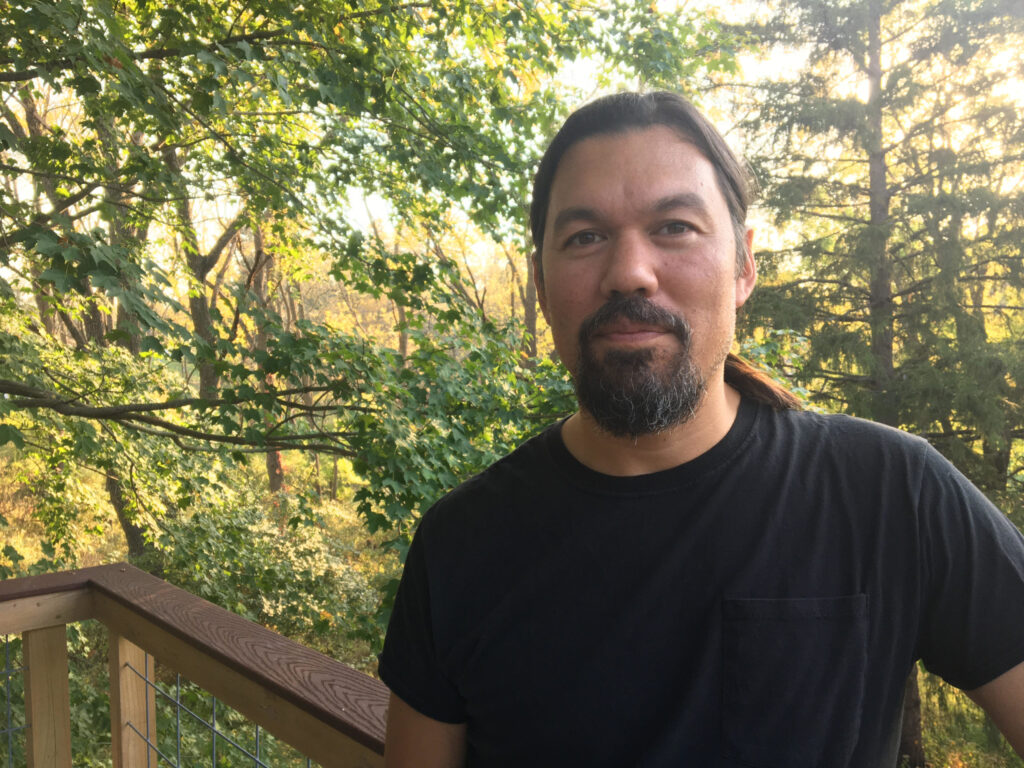
The stories in Keith Pilapil Lesmeister’s new collection, Ask Me About the Money, provide a deep dive into the ways money and class shape the lives of the Midwestern characters who fill these pages. The stories in this collection are full of surprises that feel both impossible and inevitable; the dialogue is wonderfully sharp and memorable; the characters are drawn with such care. Months after reading, I can’t shake the hilarious image of a man dressed in a clown costume sneaking into an assisted living home to collect on a decade’s old debt. Lesmeister pushes beyond the surface level engagement with money, getting at something more fundamental in these stories about the way forces beyond a character’s control can shape their life—and how a character can wrestle back that control and to regain a sense of agency. Lesmeister is the author of We Could’ve Been Happy Here and Mississippi River Museum. A graduate of the Bennington Writing Seminars, his work has received support from the Anderson Center, Iowa Arts Council, and Springboard for the Arts. His fiction has appeared in American Short Fiction, december magazine, Gettysburg Review, New Stories from the Midwest, North American Review, Redivider, Terrain, and elsewhere. He’s a founding editor of Cutleaf, an editor at Eastover Press, and a teacher at Northeast Iowa Community College. In this interview, which took place over several months by email, we talked about titles, basketball, money, and revision.
Amber Caron: Can we start with the title? It’s such a great one, and I’m curious how you landed on it. I noticed the line (or some variation of it) appeared in many of the stories (though not all of them): In “Fighting for Scraps” and “You think I’m Made of Money?” the line appears as it is written in the title of the collection: “Ask me about the money.” In “Fargo,” it’s “…don’t ask me about the money.” In “Copper Nugget,” it’s “My father never asked about the two dollars either.” In “Gnomes,” it’s “I asked her about the money.” It makes me wonder if you have the line in mind before you wrote the collection or whether you named the collection after you wrote all the stories?
Keith Pilapil Lesmeister: Thank you for saying so. Yes, I considered several titles for the collection prior to landing on what it is now. I’d had that line—ask me about the money—helicoptering around my head for a while and it found its way into the first story, “Fighting for Scraps.” After that, while in the revision process, I wrote the line into other stories. I was conscious of where it might fit appropriately and naturally. I’ve played enough basketball to know that you can’t force a shot.
I’m wondering if you can say a little more about how you know when the inclusion of the line into the stories is appropriate and natural. When you felt yourself “forcing the shot” so to speak, how did you know?
I think revision is some combination of trusting your instinct and spending time with the characters. It’s difficult to pinpoint where or when a revision might feel forced, but if I’m spending enough time with the characters on the page, I hope to develop a feel, an instinct, for where and how to implement a revision such as a refrain that echoes through multiple stories throughout the collection.
That makes total sense. Speaking of characters: while the characters in these stories are preoccupied with money—how they will get it, how they will keep it—there is often an undercurrent of an even larger concern running through the stories. It’s maybe best summed up with a line from “I’d Help if I Could,” where a character named Liz steals earplugs from the store where she works. She knows it’s stupid and she shouldn’t do it, but she does it “to feel some sense of ownership over her own life.” Liz then goes on, later in the story, to take control of her life in such a surprising way, where she stays in a motel. I don’t want to give away how that story ends, but I do wonder if you can talk a little about how you see the relationship between money and control/ownership of a life.
I think our relationship with money—how we get, how we save it—is itself an attempt at control/ownership over our own lives. Unless we’re independently wealthy—I’m not—then most of us live our lives in such a way as to account for almost every penny. This accounting of sorts is a way to order our lives in such a way as to avoid something: the bouncing of a check, the loss of savings, or, worse, bankruptcy. On the flip side of that coin [intended], we see this type of control give way to desired outcomes. If one saves or has the appropriate amount of money needed, they might purchase a desired good or experience, like a new bike or a vacation. When people are in tough financial spots, little victories, like getting/taking/stealing something allows the perpetrator of the act to feel some semblance of control over their own lives, despite that control coming at the cost of their own personal integrity. Or that the victim of the theft will suffer a financial loss. I think a person in Liz’s situation justifies her behavior because a) her thievery is minor in a financial sense (beer, sandwiches, and ear plugs), and b) she’s been the brunt of so much bad luck all her life, and this is one way she feels she can take back control, despite some of that bad luck being the product of her own past decisions.
I’ve been thinking a lot about your depiction of families in these stories, and especially the real range of relationships between fathers and sons. Specifically, I’m thinking of “Fighting for Scraps,” which is arguably the funniest story in the collection, and “Fish & Rice,” which is perhaps the most devastating. Also “Elements of the Body,” which is about, among other things, an absent father. Can you talk a little about the depiction of fathers and sons throughout the collection?
I didn’t set out to write about fathers and sons specifically, but I did notice that trend. Even the protagonists in “Fargo” or “Take What You Can, Come Back for the Rest” or “Fire Drill” are fathers estranged from their own families. This interest, I think, harkens back to my grad school days when one of my faculty mentors suggested I write away from what I know, as opposed to the oft-given advice of writing what you know. My faculty mentor suggested starting with my “worst case scenario.” At the time, my version of that was being riddled with addictions and estranged from family, thus the result was the writing of those stories. As for the others you mentioned, I didn’t intend to do this, but there is within all of those stories, an undercurrent of unrest and miscommunication between those fathers and their families. What those fathers want, in other words, often competes with what is best for the family.
I’m always interested in how a writer sees a current project in conversation with previous projects. Can you talk a little about how this book is in conversation with your other collection, We Could Have Been Happy Here, as well as your long story “Mississippi River Museum”?
I’ve been playing a lot of basketball as of late: 5v5, 4v4, 3v3, 21, knockout, or just shooting around the driveway or playground. Some of these games are played full court, some half court. Sometimes indoors, sometimes outdoors. Regardless of the scenario, each game showcases my many weaknesses and very few strengths. I know, for instance, my best shot is on the left baseline at around fifteen feet, preferably delivered to me by a point guard from the top of the key. I know how to come off picks well, use my body to create space, and hit midrange jump shots. Those strengths remain the same regardless of any changes in mode, location, or number of players. I think that’s true of my writing as well. I have my writerly obsessions and strengths which manifest in some way in most or all of my stories: working class characters, Iowa or the Midwest as setting, family struggles, class struggles, relational disputes, and probably more. I think a reader will find a crossover in many thematic (and craft) elements from one story or book to the next.
I love the specificity of this answer, and especially how you know your best shot—where it is on the court, how the ball is delivered from the point guard. I’m not sure where this question will take us, but this is the second time you’ve mentioned basketball and I’m just curious if there is a connection between the sport and your writing. A lot of writers talk about the connection between running and writing. Or gardening and writing. Hiking and writing. Anything there for you with basketball and writing?
I’ll try to talk toward some semblance of an answer. I enjoy sports and sports metaphors, and I do think there’s something elegant, even poetic, about the game of basketball. And I’m referring here to pickup hoops in particular which is its own kind of game. Much different than an “organized” hoops game with referees and coaches. I say “organized” because there is a kind of logic that organizes a pickup game, but it’s different at every playground in every city.
So much of what I’ve learned on the court can be applied to the page. Basketball is all about finding a rhythm and flow with your teammates, who are sometimes complete strangers. The rhythm and flow are also dependent on the opposing team. What kind of defense do they play? Are they big and tall? Short and quick? Do they like to push the ball up the court, or do they settle into a halfcourt offense? When I’m writing a story, I try to work within what the story is giving me. If a story presents itself as a flash piece, I know I have around a thousand words to work with. Sometimes I’ll write a flash piece, but it’s radiating something more, so it becomes more expansive in terms of word count. Of course, none of this can be forced. In the same way, I’d never try to post up against a seven-footer (I’m not even six feet tall), but I would try to come off a pick or take him off the dribble. I think writing is learning how to proceed within the logic of the story and to find a rhythm and flow with the characters that feels natural and not forced.
This all feels related to what you were saying earlier about knowing the story and its characters so well that you can feel, on an instinctual level, when something is being forced. It seems like such a good description of where we might all write from when we’re revising, and yet that can sometimes be a really difficult place to inhabit, especially when so many of us are being pulled in multiple directions—with family, friends, teaching, and editing. It makes me think about the good work you’re doing at EastOver Press as an editor. You’ve been at that for several years now and I wonder how that work has changed or shifted your writing, or your relationship to publishing your own work and sending it out into the world. How do you think about your role as a writer and an editor? How has editing changed your relationship to your own work (if it has)?
Thank you for that. Yes, it’s a privilege and an honor to work with other writers on their stories and books. Editing has greatly changed my relationship to my own writing. First of all, I’m more hesitant to deem a short story “finished,” and I think this is a good thing. If I think a piece is finished, I’ll let it sit in a drawer for a good month or so before I revise it. Still, it’s much easier to edit and revise other people’s work. But if I can put enough time and distance between me and my own work, I think I’m better able to make the tough editorial choices.
Amber Caron is the author of the story collection Call Up the Waters (Milkweed Editions) and the recipient of the O’Henry Prize, the PEN/Robert J. Dau Short Story Prize for Emerging Writers, Southwest Review’s McGinnis-Ritchie Award for fiction, and grants from the Elizabeth George Foundation and the Barbara Deming Memorial Fund. A 2026 Utah Artist Fellowship recipient, her stories and essays have appeared in The Best Short Stories 2024: The O’Henry Prize Winners, PEN America Best Debut Short Stories, The Threepenny Review, AGNI, Bennington Review, Southwest Review, Longreads, Writer’s Chronicle, and elsewhere. She is an Associate Professor of English at Utah State University.
This post may contain affiliate links.