


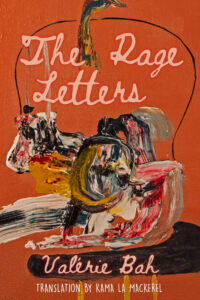
[Metonymy Press; 2023]
Tr. from the French by Kama La Mackerel
This review was originally published in the Full Stop Quarterly “Tender Tongues,” edited by Natália Affonso. Subscribe at our Patreon page to get access to this and future issues, also available for purchase here.

“Invisible ink is what lies under, between, outside the lines, hidden until the right reader discovers it . . . The reader who is ‘made for’ the book is one attuned to the invisible ink.” Toni Morrison, The Source of Self-Regard
In Valérie Bah’s debut collection of interconnected stories, Black queer and trans friends navigate the absurdities of whiteness, the vagaries of relationships, and the mystical blend of the explicable and inexplicable. Daphné, Fred, Marie, and Katia form the main cast of the stories, circling and entangling themselves with each other in a way all too familiar if you run in queer circles. Anti-Blackness, ableism, and capitalism haunt their lives like the sculptures in Marie’s apartment, which seem to hold a spirit. Bah is at turns poetic, critical of Canadian society, and empathetic to the friends and lovers at the center of the collection.
To understand the almost hypnotic draw found within the pages, we can turn to the preface. There, Stéphane Martelly, editor of the original Francophone edition, proclaims, “We write with this ‘invisible ink’ that Toni Morrison talked about, which slides between the lines to engender new readings” (viii). Martelly refers to the passage that serves as an epigraph to this review, she speaks of the invisible ink that is like a hidden message quite clear to those who know what to look for. In some ways, I am not the right reader; I’m from the US, and my first language is English. I learned French starting in middle school, and I’ve rarely had people to communicate with in French outside of school. I am sure that there are messages written in the invisible ink that I miss having not been immersed in francophone Canadian culture. However, in many of the ways that matter most, I am the right reader: Black, queer, nonbinary, living in the heart of an empire. As my eyes glided over the page, I experienced a unique kinship to the characters. I felt as if Bah had reached into my chest, touched my heart, and said “You are not, and never have been, alone.”
Daphné, a queer nonbinary leftist that appears in multiple stories from “Sculptures” to “Flânage,” presents in stark relief the different ways that gender nonconformity is expressed in French and English respectively. French, as a gendered language, demands that adjectives, nouns, past participles, etc. reflect the gender of whomever is being referred to. In the original text, Bah makes clear that Daphné eschews the modern gender binary (exemplified with the il/elle dichotomy) by using the pronoun “iel” and conjoining the masculine and feminine versions of words (for example “seul·e”). This forces the eye (and mouth if reading aloud) to hesitate and acknowledge both the masculine and the feminine. Tripping up the eye and tongue denaturalizes any strict delineation between genders; it makes the reader unsure, prompts questions about language, gender, and boundary policing. By contrast, English is much less reliant on gender. Daphné is referred to using “they,” and there is no need to disrupt the text as a reminder of their gender.
In the translator’s note, Kama La Mackerel hints at these differences in language. They say, “Writing then [in French] becomes a demanding exercise in drafting, moulding, and sculpting the language. In English, however, my third language, there is a sense of freedom and permission that I seem to have right from the outset” (155). That conspicuous construction is evident in the ways I mentioned above. “Iel,” the pronoun analogous to the English singular “they,” is still not recognized by L’Académie française, the institutional gatekeepers for the French language. La Mackerel goes on to say, “I was also constantly faced with the question of relevance regarding certain literary choices in French that I found revolutionary, but not so much . . . in English. (In English, there are already more rooted lineages of Black, racialized, and LGBTQ+ writers who have written and continue to write against the empire.)” (156) The fight against the rigid conservatism of the French language is more visible in how Bah abandons strict gendering, but that “sculpting” is lost in English. In some ways, I appreciated the original French more because I was not allowed to forget Daphné’s gender; each adjective and “iel” confronted me with how they refuse categorization. The ease of English that La Mackerel describes obfuscates the difficulty that nonbinary/gender-nonconforming people experience when they demand their proper pronouns be used. In real life, you often hear things like “she- I mean, they” or some variation of that. That stumbling is lost in the translation from French to English.
In the collection, English and French are not the only languages given space. Bah does not assume the sovereignty of verbal language; they present it as only one piece of the puzzle when engaging in interpretation and meaning-making. Tone, body language, and what is not said are just as important as, if not more important than, what is said. In “Theft,” the first story in the collection, there is very little dialogue. The story follows a child who struggles with dictées at school and steals books from the school to create grotesque creations for their “secret stash.” Instead, hair, tone, and body language construct the mother’s defensive and protective message when talking to her child’s principal. We don’t hear what she says, but we see how she prepared for (metaphorical) battle, which is arguably more important than her exact words. Bah writes, “Her whole body says: What right do you have to blame my daughter, and by extension, my person and everything that we are?” (4). Verbal language is often the domain of the oppressor; they regulate and determine what language is acceptable and “correct.” Oppressed people become experts in expressing themselves in looks, tone, body, aesthetics, etc.
“Logawou,” the story in which we get a glimpse of Fred’s childhood in foster care, demonstrates the importance of Bah uplifting other modes of expression. Fred “communicated by means of groans and postures, a paralanguage that made her teachers suggest that she switch into ‘special ed’” (81). She also has a deep attachment to a fur coat purchased when her mother was still alive; her mom said “she looked like a lougawou,” a typically female werewolf that drains blood from sleeping victims in Haitian mythology. The coat seems to have a sentience as Fred remarks that it growls on its own. Verbal language is one of the ways we distinguish humans from animals. In a white supremacist point of view, we must avoid the animal because we are above them, hence why Fred’s unwillingness to communicate “like a person” indicates to the school that she must have diminished intelligence. We must be creatures of the mind instead of the body. Bah rejects that premise by treating with reverence every avenue of expression. In “Lougawou,” Fred does not speak at all. She has a rich inner life, but the majority of her external communication is her facial expressions and the growls attributed to her fur coat. This is not a point of shame, but rather, Fred’s connection to the animal, to the (super)natural is her power. It is what allows her to consume a white man whose desire is based upon extraction, especially from women of color, in “White.”
Throughout the collection, Bah displays lovingly the survival tactics of Black people (e.g. code-switching, a term that is borrowed from English in the French text). Sometimes we cannot say everything we feel aloud, as with the mother in “Theft” or Katia in the “Fille du roi” triptych. We must subvert language through “creolization” and create meaning that is clear to those in tune with us; the invisible ink may be found in the subtle scrunching of a nose or a slicked-back hairstyle instead of on the page. In the US, AAVE is our cultural manifestation of “creolization.” To acknowledge the innovative methods of communication used by Black people, Bah aptly chooses not to shy away from the ugly truth of antiBlackness. Even as they inject the stories with magical realism, the collection is grounded by an understanding of the systems of oppression that beget antiBlackness, fetishization, white supremacy, racial capitalism, etc. However, Bah is not defeatist. Black queer and trans people create new languages and new ways of being. “The Letter,” an offering of asexual partnership from Fred to Daphné, demonstrates a liberatory imagination that could never come about if your mind is shackled by white supremacy, heteronormativity, and cissexism. Oppression desires to rob one of the ability to imagine any other way of living and loving. Bah escapes that banality to create a world filled with characters and languages that is so bursting with life that I felt as if they were people on the periphery of my life. As their first collection of stories, Bah shows immense promise and attention to craft. Most importantly, they write in that particular invisible ink that Black queer/trans readers are attuned to.
Annaya Baynes (she/they) is a Fellow specializing in curriculum at Girls Write Now. They are a Master’s student in the Martin Scorsese Department of Cinema Studies at NYU Tisch School of the Arts. Annaya has interned at various publishing houses, including Penguin Random House, Macmillan, and The Feminist Press. She believes in the liberation of all oppressed peoples from Palestine to Sudan to the DRC and beyond. You can also find their words on their Substack.
Illustration by Sally Chen: Sally Chen (they/she/he) is a queer, non-binary, second-generation Chinese (specifically Taishanese!) American multidisciplinary artist who’s born & raised in Brooklyn, NYC. They graduated from Parsons School of Design with a BFA in Illustration and Psychology minor in 2022. Find their art at https://salpalc.art/.
This post may contain affiliate links.