


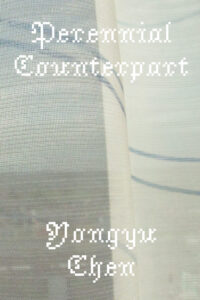
[Nightboat Books; 2026]
Consider life as a series of iterations. You might fear these past versions of yourself, but they are there. They float back to the surface in sensations, smells, places. If you write about them, they are preserved, opulent but unnerving. “A sequence of past selves lined up each next to a river of identifications,” writes Yongyu Chen. “Say—these, these are the fascinations.”
Chen’s Perennial Counterpart reckons with the desire to write as a person who also desires the natural flow of change throughout a life. Chen’s poems acknowledge the impossibility of escaping these counterparts: “Every March I think about the same things,” Chen writes. “Perceiving, possessing, perceiving again. Crystallizing, dissolving, crystallizing again.” By these descriptions, motion—change itself—is only deceptively linear, perhaps more often cyclical, perennial. Writing about yourself over time is like freezing those iterations in place. Chen writes, “Am I a component of time.//I see the components locking onto each other on the empty plane./Windswept by grass.//I am not a component of time…//Still I would like my own relation to time.” Perennial Counterpart is Chen’s attempt to create that relation, to proceed with living without letting language take the upper hand.
Chen’s desire for perpetual redefinition is intertwined with their writing practice. The first, untitled poem begins
You will not always write. Or, you will always write.
But when I’m dead I will write? Then?
You will not always write.
At some point
some point
at some point the poems will get
better. Then
it will be your expectations, not the poems
that are lacking.
Then
you will not write.
By repeating some point, Chen stages this wait, duration unknown. By the end of the poem, Chen has changed their mind: “New moments.//Pull apart the shell—you in general.//If replaced the poem.//You will always write.” This book tries to understand a human life as a metamorphosis, or perhaps just a fluctuation, through language. Poetry benefits this goal not only because it demands intention from the writer, but because a poem can, more easily than prose, express a single moment, an iteration of a person. The words move around that moment without the prosaic compulsion to move linearly.
Being “yourself,” or being genuine, depends on the people you’re with, and in Perennial Counterpart, Chen explores how the tension between self-understanding the ability to change is complicated by relationships. Many poems, some labeled as letters, are dedicated to Chen’s friends and acquaintances. In one poem, they remind the recipient, “Remember, I am writing for you, I am writing your life.” A letter—words—can define a person in the eyes of their friends as a step toward establishing the friendship itself. But while offering someone a definition of yourself might help you connect, it also takes away your permission to change. Chen considers what they value in these friendships. Maybe being deeply known and understood by another person is not as important as we think, considering their perception of us will only hold true so long as we adhere to it. About one friend, Chen writes, “When you look down your face recedes. It is a pleasure to not follow you then into the core of your body. A pleasure to stand aside,//by your recession.” It feels strange, at first, to imagine any close relationship without the constant desire to know more about someone. Chen’s work begs the question: to what end do you want to know that person more deeply? If you think the answer is to know them completely, that is an impossible goal, a false destination even if you think you have reached it.
Chen seeks to form connections without asking that a friend belong to them. This is presented as a show of respect rather than a lack of care. Perhaps they chose to write to people in poems, rather than with more traditional letters, in order to offer their loved ones an emotion or revelation instead of trying to relay personal information. Chen admits in one poem-letter to someone named Peter that their thoughts on what makes for meaningful relationships are, like most parts of the book, fluid and still evolving. They coin the term, in another poem, “being-together-alone,” a term with tension. How much should we be together, to what degree intertwined? Perhaps coming closer together is enough, never needing to fully bridge the gap between ourselves.
If Chen will have to keep writing forever to avoid dissonance between their present and written selves, in Perennial Counterpart they embrace writing’s permanence, pinning down what does feel true, minute as it may be. While wrestling with transience, Chen’s words do not merely pass over the reader—they are meant to stick. Even time is objectified: “Summer is giant, loose & empty as cloth wrinkling over the empty glass.” Chen is currently a PhD student of Film and Visual Studies at Harvard, and their investment in visual media is clear in their attention to imagery in their poems. But rather than describe visual images, they turn emotions physical. The possibility lingers of finding a version of themself to which they want to give permanence. In their images, they become frozen in any number of ways, as if it is only a matter of time before flipping through iterations becomes too difficult to maintain. “When I am thirty-three,” they write, “I will be crystal, root systems vulcanized. I will be missed. Woven into the brittle surroundings.” To have asserted a fixed version of yourself, here, is also to lose yourself—I will be missed. The brittle surroundings speak to how tenuous the meaning of such an attempt at self-assertion might be. The repetition of the short and long “I” sounds gives the lines a musicality, carrying the original “I” subject at the start of the sentence through the rest, like an echo, a self warped, changed but preserved in each following word.
Chen continues, “At the party I keep leaving. I sit in the stairwell—what is vivid is the distance. Until I pull out this droplet inside me like violence. Until I harden into the building’s impersonal structure.” To harden, what might appear like a show of self-awareness, is instead a way of giving oneself up, of becoming impersonal to one’s own self.
Chen is trying to understand life from within language. “My teacher,” Chen writes, “hated the phrase lived experience because it reminded her it’s possible to not live experience.” Word choice can be the difference between a meaningful and squandered life. Chen loves language, if you see such dedication and interest as love, but they also want to control it. They are—and believe that those they address in their writing are—in charge of their own writing and, if they take care to do so, can bend language to their will rather than being bent by it. Living life through language, which for Chen appears to be the only possibility—you will always write—does not require their life be warped by it. They use writing to make their life fuller, unfurl the details of their life by staying precise and attentive to the language with which they describe it.
For Chen, a change in word choice could mean a change in something more fundamental. They write, “Instead//of tomb, I was practicing saying, the possibility of tombs.—To see//what happens.” The material world and immaterial experiences are intertwined in Perennial Counterpart. A person or object’s potential future iteration is just as viable, as worth investigation and care, as its present state: “Matter//floats,” Chen writes, “each thing that exists dreams itself something that doesn’t, then becomes that possibility.”
Erin Evans is a writer from Michigan, now living in New York. She studied Creative Writing and Literature at the University of Michigan, where she also worked as an arts writer and editor for The Michigan Daily. Her essays and criticism have appeared there and in Vestoj.
This post may contain affiliate links.