


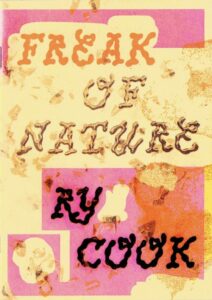
[Choo Choo Press; 2025]
For an aesthetic category that is terminally online, cringe is surprisingly bodily. Travelling from verb to noun/adjective as it travels from face to arms and spine, cringe sounds as uncomfortable as it feels. The word names embarrassment and shame, usually another’s felt as one’s own, though cringing at the (past) self is also a time-honored tradition. Like many terms for bad art (kitsch, gimmick), the term is typically applied to what someone else enjoys, to what the speaker would never be caught dead liking sincerely. Always recoiling and flinching, cringe puts distance between the self and the other. But this recoiling can be a source of inspiration: as Ry Cook writes in “11 O’Clock Number,” a poem about a karaoke night gone awry (that is to say, the average karaoke night):
A poet says to me
from beyond his grave “If
something doesn’t work in
a poem, do it more.”
And so I’m touching my
self again during kar-
aoke night this time
in perfect rhythm with
“Rollin’” by Limp Bizkit
as its chorus vibrates
my thin wooden floor boards
I fall in love with ev-
rypony forgetting
if “Love on Top” has one
more verse. […]
Karaoke is a socially acceptable form of embarrassment. It also serves as an apt metaphor for Cook’s poetics: a confession more confessional (and therefore unflattering) than confessional poetry. Instead of the consummate craft found in the revelations of Sylvia Plath or Robert Lowell, their poems are zany montages through the gross and aesthetically compromised. “11 O’Clock Number” continues to cycle through vulnerable 90s and 00s classics from Radiohead and Wheatus, the speaker flowing between imperfect renditions, each falling flat on their face but persisting regardless. As one of the characters (the one caught “mid “Teenage Dirtbag””) remarks, “If I’m a / failure let it be on / my own terms.” If you ever do get a chance to see Cook perform their work (their poetry I mean, but maybe karaoke too), please do yourself this favor. Later in the same poem, when the chorus of “rollin’ rollin’ / rollin’” appears again, the poet, when on stage, imitates Fred Durst’s iconic nu metal hollering, going full throttle where others would claim to “know better.” The performance itself feels like a karaoke set.
What would it mean to steer into this feeling that the body instinctively pulls away from? Cook’s chapbook Freak of Nature promises the reader “a garish romp through the aesthetics of cringe,” at once indulging in taboo and investigating cringe as a cultural phenomenon. The chapbook’s design is an immediate introduction: from its piss-colored paper to the pink and orange splotches across it to the brushstrokes imitating hair on the inside cover, the slim volume instantly makes the reader think of the body’s less than glamorous sides. The epigraphs prepare for the wide smorgasbord of cultural strata (talk about a mixed metaphor!) these poems draw from: from Gerard Manley Hopkin’s “No worst, there is none…” to Susan Sontag’s essay “Regarding the Pain of Others”, to My Little Pony’s Fluttershy “Were we arguing? I’m sorry.” Friendship indeed being magic, the animated series and accompanying toy franchise built around magical varicolored ponies, primarily marked to young girls, is famous for inspiring the unexpected fandom of older male fans, i.e. bronies, making it one of the internet’s favorite punch lines for cringe content (as well as the source of the abovequoted neologism “everypony”). It is at once surprising that these are the franchise’s fans, and that adults in general can sincerely like that. The quote from Fluttershy also illuminates the nervous energy that we associate with cringe: the desperate desire to be liked. To quote the opening of the aptly named “Rimbaud of Shit”:
I want as many pe-
ople to be enamored
with me as possible
before I step into
traffic. Happy Pride I
say to myself next to
the all-gender restroom
in the Starbucks.
The reference to corporate pinkwashing casts doubt on formulating an authentic sense of “pride” and “self” amid a late capitalist hellscape, where many forms of dissent and self-expression are commodified. Formally, much like Fluttershy’s timid entreaty, Cook’s stanzas are purposefully precarious, visually and syntactically, always seeming close to the verge of toppling over and segmenting words haphazardly across line breaks. This choice mimics the often-nervous conversational voice of an interlocutor desperately worried about coming off too vulnerable or revealing too much, like in Mean Girls-inspired opening poem “Burn Book” (itself an early 2000s reference to a set of secrets that would be best kept under wraps):
[…] I’m sooooo worried
about people finding
my journal or my blogs
and seeing how stupid
I really am. My lit-
tle bubblegum dia-
ry with a locket left
on the right hand side of
the uptown F. Ted Ber-
rigan found and burned each
of his theses in or-
der to erase his less
desirable parts
The line break of “dia-/ry” (as well as, ableit more subtly, Ber-/rigan), one of many intra-word line breaks throughout the chapbook, highlights the poet/speaker’s name “Ry,” a nod to cringe’s focus on the self. Tracking references to previous ways of articulating the self in poetry, I would be remiss not to quote the hilarious interpolation of William Wordsworth’s endlessly meme’d daffodils poem that “Burn Book” ends on, relating cringe to expressions of the self in the digital age:
the cloud wandering lone-
ly around the air con-
ditioned warehouses in
California where
servers whir like lonely
cats. Here! Kitty kitty.
A canonical image of Romantic individualism gets stuck in a data center, “cloud” floating from the natural to the digital. Sincere emotion is deflated into ones and zeroes, then transformed again via a simile to a silly cat joke.
To pin down “cringe” from its frenetic squirming, let’s start from the observations made by Dimes Square darling Honor Levy in her internet dictionary short story “Z was for Zoomer.” Few are more qualified to write on cringe than Levy. The detached (potentially unreliable?) narrator of “Z was for Zoomer” comes a distinctively reactionary position, juxtaposing “cringe” with “based” and associating the former with “the feeling of disgust you get when something woke […] is too woke,” adding that “the terms fraysexual, quoisexual, and placiosexual make me laugh.” Already here we can see the association of “cringe” with queerness, especially with its online manifestations on social networking sites like Tumblr. Expanding on this initial definition, Levy’s narrator refines their definition of “cringe” to not be an outright condemnation of the sincerity, but rather a reaction to the perceived threat of “people using faux sincerity and sentimentality for political gain.” The suggestion that public expressions of queerness are done “for political gain” is a cynical right-wing position but Cook’s poetics is clearly sensitive to this online (and often reactionary) perception of “cringe,” referencing the speaker’s hair “the color of the loud/est possible flower.” Still, these poems present an attempt to salvage some sense of “genuine” self apart from the online world. As the poem “Millet and Blackberries,” which largely focuses on a harrowing car crash and its fallout, concludes:
[…] A poem
or a shock site. Blue light
hypoxia. There’s a
digital sublime but
we suffocated it.
“Here’s my day in the life
as a sad gay bog wo-
man.”
What is more cringe than citing yourself? In a typology of literary badness (largely limited in scope to Russian-language material, given the author’s specialization), Venya Gushchin outlines three varieties of bad writing, each with its own assumptions about who its author is and how their aesthetic values are misaligned with the reader. Crucially for Gushchin, “badness” is in the eye of the beholder rather than an inherent property of a text and carries a moral as well as aesthetic judgement: “we want to hold the scribbler of a failed text accountable!” Thus, accusations of “bad writing” always reveal the aesthetic values of the person making the accusation. Furthermore, each variety of “bad writing” is connected to assumptions about who the author is and what specific literary sin they are guilty of. In Gushchin’s typology, cringe falls most closely under the category of graphomania, the variety of bad writing where a usually amateurish author, whose aesthetic failure is based on “an excess of personality, an inability to edit one’s works.” The graphomaniac, in the imagination of the reader, is an undisciplined pervert, compelled to keep writing as a symptom of their illness. Cook joins poets like Daniil Kharms and Dmitry Prigov as writers who deliberately incorporate elements of overzealous word-weaving into their poetics. As scholar Ilya Vinitsky notes, “if good poetry conceals its author’s complexes, [graphomania] reveals them in all their glory.” Cook’s lyric personal is all complexes, as we can see in the hurried opening to the poem “This is Not”
a bot this is a po-
ster for the new Nic Cage
movie talking. Hello!
Are you feeling today.
How are you doing so
many things so poorly
at once. Are you feeling
overwhelmed and under
showered. Does your piercing
much hurt (looks so fucking
cringe). […]
Nicholas Cage as a practitioner of non-naturalistic acting in mainstream Hollywood is the perfect avatar for the poem’s speaker to dart between various failures of communication (i.e., “are you feeling today” without the “how” and seemingly unintentional insult lobbed at the addressee’s piercing etc.). Yet the speaker is not merely failing but also all too cognizant of their failure, though self-awareness brings little relief.
To sum up, the accusation or ascription of cringe usually follows an overly sincere and therefore embarrassing confession of subjective feeling, especially on an online platform. Cook’s approach to the problems of sincerity and authenticity is anxiously vibrate between the poles of analytical detachment and embracing cringe. As has been alluded to, in addition to blending pop culture with traditional high art references, Cook reminds us of the ultimately cringe and unglamorous topic: the body. As they reflect:
[…] Every poet loves
to talk about their bo-
dy. At least until it
stops working then they love
to write about it. […]
Chronic illness, car accidents, body modification, an awkward class on the Meisner technique, getting “whisper yelled at by a boss” for getting up to pee during an event, extortion over nudes (in a poem aptly titled “I am the Werner Herzog of Hole Pics”)—these texts are full of body, drawing the reader’s attention to the way corporeal exists under internet-augmented late capitalism. The body may be the last remaining universal, but it is by no means a comfort.
Despite the heaviness of many of the topics raised in collection, Cook’s humor, often based on self-deprecation, is undeniable. While dropping references to canonical literature and narrating unpleasant situations, the speaker doesn’t take themselves too seriously, freely quoting memes and reverting into internet vernacular spellings. However, Freak of Nature is not an extended “I am cringe but I am free” celebration of unreflective online sincerity. That would be too simplistic and feel good of a reading that would sandpaper the text’s “garish romp” for the sake of palatability. Nor is it a mean-spirited cringe comp, a genre of video compilation made by conservatives to paint members of marginalized communities as overdramatic crybabies when their rights are taken away, as Levy’s dictionary entry would suggest. While the montage of cringey images shares its technique with those reactionary compilations, Cook also acts as their own anthropologist, at once taking a critical distance towards their content and leaning into it and celebrating. As they write in the conclusion of the abovequoted “Rimbaud of Shit,” a medicalized take on the classical memento mori trope:
[…]If
I die of C. diff pack
up these crappy fragments
like Verlaine did and mail
them to every poopy
lit mag that will have me.
Poetry, like its central device of apostrophe according to theorist Jonathan Culler, “is a palpable embarrassment, because it is a figure of all that is most radical, pretentious, and mystificatory.” Let’s rev our engines and rush headfirst!
Venya Gushchin is a poet, literary translator, and assistant professor of modern Russophone literature at the University of Southern California. His translations of Vladimir Mayakovsky and Elizaveta Mnatsakanova have received the Columbia University Slavic Department Pushkin Prize. Blockade Swallow, selected poems by Olga Berggolts translated by Gushchin, appeared from Smokestack Books in 2022. His translation of the Russian-language Kalmyk poet Dordzhi Dzhaldzhireev is forthcoming from World Poetry Books in 2027. His writing has appeared or in The Rumpus; Exchanges; Ballast Journal; No, Dear; and elsewhere.
This post may contain affiliate links.