


This essay was first published last month in our subscriber-only newsletter. To receive the monthly newsletter and to support Full Stop’s original literary criticism, please consider joining us on Patreon.
If there is a niche emperor of the contemporary English surreal prose poem, that globular emperor-shaped niche is best filled by the weird form of Russell Edson. And if there’s one iconic Edson poem, it’s maybe this one:
The Fall
There was a man who found two leaves and came indoors holding them out saying to his parents that he was a tree.
To which they said then go into the yard and do not grow in the living-room as your roots may ruin the carpet.
He said I was fooling I am not a tree and he dropped his leaves.
But his parents said look it is fall.
Edson’s dream logic in “The Fall” has an ominous inevitability; the man pretends to be a tree, and then what he pretends to be becomes who he is, or at least who his parents think he is. It’s a broken little narrative about how we get trapped in our own broken little narratives—about how we carelessly put down roots and in doing so ruin our living room carpets.
“The Fall” is recognizably surreal in part because it is built on anxieties about parental approval and power. André Breton, the founder of the original surrealist movement in France, became acquainted with Freudian theories as a medical orderly during World War I; he and his followers were fascinated with the unconscious and the idea that individuals were motivated by buried needs and dreams of which they were only half aware.
This led to experiments with automatic writing and hypnosis as surrealist artists attempted to access the irrational parts of the mind. And it also manifested in an interest in Freud’s ideas of sex and patriarchal sexual proscriptions—as in Luis Buñuel’s 1967 film Belle du jour about a bourgeois woman who sneaks away from her husband to become a sex worker, or Max Ernst’s 1922 painting Oedipus Rex, with its penetrated fingers and vulva-like nut.
Surrealist artists, then, saw themselves as burrowing below the surface, finding messy, suggestive truths that most people hide from themselves. “The Fall” from this perspective is a parable about how parental approval and self-definition are intertwined and constricting, about how the roles we find as children still wrap around us as adults, like creeping vines. We can’t escape the leaves we’ve picked up.
“The Fall” could be a psychological study. But it could also function simply as a kind of word game—less like a Freudian slip, and more like the semi-sadistic puns and nonsense puzzles in Lewis Carroll or Monty Python. You can see Alice looking at the man with a gimlet eye and declaring, “You’re nothing but a pack of trees!” or Michael Palin shouting “We are the knights who say fall!” Dream logic can be about buried psychosexual secrets, but it can also be about blips and bloops drifting across your forebrain and forming Rorschach blots that you helplessly and compulsively interpret. There is a surrealism of meaning and a surrealism of non-meaning, and it’s not always clear which of the two leaves you’ve got ahold of, or which you’ve let go.
*
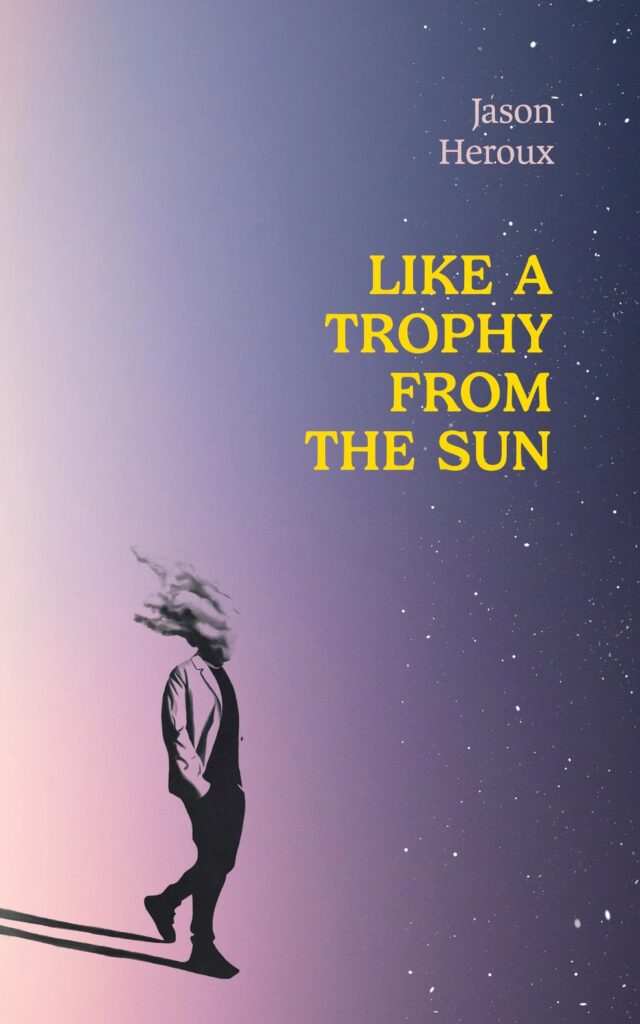
Canadian poet Jason Heroux, like Edson, works in the suggestive rabbit hole–pocked landscape where surrealism and nonsense meet and exchange hats with heads attached. His most recent volume, published by Guernica Editions last year, is a collection of (mostly) prose poems titled Like a Trophy from the Sun.
Heroux’s poems hang out closer to Lewis Carroll than André Breton for the most part, but they also play with the distance between those poles, depth and surface, inside and outside—as in this untitled piece.
There was a knock at the door. I opened it. I saw a person. I still heard the knocking. It came from inside the person. I opened the person. There was a heart. I pressed my ear against it and heard knocking within. I opened the heart. I saw a door. Another door. And another. It was like a village of tiny doors living inside the heart. Please don’t tell anyone we’re here, one of the doors said. We have nowhere else to go.
The opening of the poem (as it were) is framed as a kind of surreal journey into hidden inner truths. The knocking, which first seems like a mundane social interaction, quickly turns into a sign of something deeper and secretive, emanating from within.
But as the narrator goes deeper, the depths become more and more opaque. The door in the person opens onto a heart which opens into another door and another. This endless recursion, moreover, occurs in a space which is no space; the words which describe it don’t create any images you can grab onto. The narrator says there is “a village of tiny doors living inside a heart,” but what does that look like? Where are we? Is the narrator looking into the other person’s chest and opening doors? Has the narrator climbed into the chest, like some sort of cardiac Alice?
When the doors ask for secrecy and tell the narrator “We have nowhere else to go,” the (knock knock) joke is that the narrator has come to the end of recursion. He’s gone down to the truth of the heart, and ultimately there is nothing there—“nothing” in this case meaning the termination of a narrative which seemed to be exploring inner truths, but is, as it turns out, simply generated a meaningless series of words. The deep secret the doors don’t want anyone to know is that there is no secret and no depth. There is not even a person at the door; whoever was knocking disincorporates into the vacuousness at their heart. The closer you and the narrator look, the less is there.
As such examples illustrate, and/or refuse to illustrate, Heroux’s is a poetry of evaporation. His work builds details in surreal accretion, as Edson does, but meaning somehow gets lost somewhere in all those shuffling doors. Heroux has an Ashberyian eye for the way in which signifier and signified can refuse each other’s acquaintance, leading sense into non and reality into a shifting mass of jargon and irrelevance.
One of my favorite examples of this is from Heroux’s 2023 above/ground chapbook Something or Other.
SOMETHING
Something hit my window
and lay stunned in the grass
I thought something was dead but when I sprinkled water over something it woke up. A few minutes later something flew away. For something to be called something it needs a name. When it rains something wiggles out from the soil.
Something has two heads. If you cut something in half both halves live. We put something on our hooks to catch something in the lake.
You could read this as a pretty straightforward narrative about a man who sees a bird run into a window and then catches a worm to go fishing; the twist is just that key nouns have been replaced with the word “something.”
But replacing the nouns means that the narrative starts to bend and distort and (literally at the end there) eat itself. The “something” which strikes the window is, or could be, the same “something” which wiggles out of the soil, the same “something” with two heads, the same “something” on the hook which catches itself in the lake. Everything is suddenly one thing, a hydra-headed bird/fish/worm which brains itself and devours itself and wriggles from the ground, sprouting unkillable heads.
“For something to be called something it needs a name,” and without the name, it could be anything—a pantheistic vision of oneness, a nightmare of organic protuberances, a joke where the punchline is that the punchline is missing. Ashbery empties out his poems through meandering juxtaposition; Heroux uses the more efficient means of simply excising key words so that the poem, and the world, falls through its own holes.
I feel like this short poem from Like a Trophy from the Sun is flying into similar windows.
Someone please save me
for a rainy day, a raindrop
whispered from a puddle’s grave.
The poem starts with a cliché which is literalized and then drowned. The raindrop begs to be saved for a rainy day even as it has died or been absorbed into the puddle. It’s a clever, even precious, shorthand reminder of the water cycle—raindrops don’t need to be saved because they turn into water vapor and eventually fall to earth again. The raindrop here is not a tragic raindrop; it’s just confused about its own lifespan and role in the world.
Like “Something” above, though, the blurring of what is which—the raindrop’s merging with the puddle, the rainy day which is both now and in the future—makes the world, and the language which describes it, seem to melt and drip. The raindrop thinks it has an existence distinct from the puddle and from the rainy day because we have created distinct terms for rain and puddle and raindrop. But that’s a language game as arbitrary as anthropomorphizing water and giving it a whisper and a fear of death.
Again, the poem plays with a surreal dive into unexplored depths, falling with the raindrop into murky waters. But the depths turn out to be a shallow puddle. The mystery is on the surface, which reflects only the water that falls into and makes up the water, just as “save me for a rainy day” says only what it says and isn’t really about rainy days at all. The raindrop and the puddle have no distinct existence one from the other; or, to put it another way, something and something are both something. Surrealism is often thought of as an art of abrupt and unexpected juxtaposition—the quick cuts (in various senses) of Un Chien Andalou. But these breaks are possible because of, or indicative of, a broader breakdown in boundaries between this and that, symbol and symbolized, self and other.
That last is especially significant and is linked to surrealism’s fascination with dreams and language. The words or dreams in your head feel like you; they define you and are inside you. But both also come from outside. “I think therefore I am” is a sentence that someone else put in your brain speaking through you, just as you visit in sleep a world that you have both made and which is out of your control. The core of your identity is somewhere else—on the surface, perhaps, where everyone can see it and take it for themselves (or for their not selves, as the case may be).
Again, Heroux is quite direct about this in his elliptical way.
I opened my mouth to speak but my voice was asleep. I was either having a dream or in a dream. Not that it mattered. The person I was talking to had lost his ears. The night was so quiet one could hear dead crickets chirping in heaven. All this happened long ago. Or at least that’s what I was told. I wasn’t there so I’m afraid I can’t say.
Heroux is here appropriately channeling Steven Wright’s classic deadpan joke, “I woke up the other day . . . uh, wait, no, that wasn’t me.” Like Wright, the narrator (Heroux? Wright? Some amalgam of the two?) is not sure where he begins and someone else picks up. Is he (like Alice) dreaming, or is he in someone else’s dream? Is he (failing to) speak or is he (failing to) be heard? Communication is impossible not ultimately because voice or ears have broken down, but because identity has; you can’t speak to someone if you can’t tell where you stop and someone else begins. If you wake up and you aren’t there, then what are you talking about? The poem twitters on, like “dead crickets chirping in heaven,” silence and meaningless white noise collapsing alike into an indeterminable not mattering.
Part of the fun of Like a Trophy from the Sun, and what makes the collection more than the sum of its odd parts, is that the vertiginous indeterminacy of self and self within poem extends to a vertiginous indeterminacy between poems as well. Without titles, and mostly without line breaks, you can read the book as a single long sustained, crumbling dream or text, one voice speaking in circles, falling into puddles, climbing out and forgetting what they said, or who they were, yesterday or in the last sentence.
I don’t remember December. One way to finally appreciate this life is to live like you’re already gone.
The only heartbeat among them belonged to a moth, fluttering back and forth. I think tomorrow is my funeral, a left shoe whispered.
Hello today, how is everything going? I woke up within you.
It held yesterday’s crumbs, yesterday’s lint. Bless the one who carries a bag of fresh raindrops feeding the puddles.
Which of these two-sentence excerpts comes from a single poem and which comes from successive poems? It’s gloriously difficult to tell because the aphasiac voice is unbounded by conclusion or beginning. It’s not just Heroux’s narrators, but the poems themselves that mislay themselves in yesterday’s lint, forget December, hand their heartbeats to moths and stumble one-shoed into their own funerals. Each poem has its own conceit—doors within doors, a raindrop expiring in a puddle—but the conceit is always in part misplacing the conceit. At the bottom of the poem the poem is somewhere else.
Even at his most self-referential, Heroux manages to elude both self and reference.
Two vowels went walking. The first went talking. Complaining about the word they lived in. It’s too small. Plus I don’t even know what it means, do you? The second vowel shook its head, wondering where they were going. It was dark, growing darker, and already past their bedtime.
This brief ramble about the vicissitudes of language is one of the collection’s most poemy poems, at least to the extent that the first two sentences have rhythm and rhyme, and there’s an obvious bit of punning wordplay—on the word “word,” not coincidentally.
The vowels complain about the sentences and words they’ve found themselves in. They want more space and more meaning, they want to know where they’re going—very understandably, given that the narrative is cut off before it figures out what it is about. The final sentence is a dead-end non sequitur, an announcement that the curtains are coming even before they’ve gone up. The man in Edson’s poem is trapped by his pretend self; the vowels here can’t even find a self to pretend before they’re picked up, shaken, and tossed into another poem—if those even are the same vowels.
Like all the best nonsense, from Edward Lear to John Ashbery, Heroux’s poetry makes you feel like nothing will ever make sense again. And in the surrealist tradition of Edson, his prose leaves you wondering if the profound truth you’ve learned about yourself is that you’ve somehow misplaced yourself behind the wrong door. The title poem sums up Heroux’s approach in an epigrammatic tour de force:
Carry your shadow
through the world
like a trophy from the sun.
The poem sounds like an exhortation, but when you think about it, it starts to fade and dissipate. A shadow is a double that belongs to you and that isn’t yours at all, that looks like a hole in the earth but is even shallower than a puddle. If it’s a trophy, it’s one that disappears every time a cloud drifts across the sky, or whenever you knock on a door and go inside.
Noah Berlatsky (he/him) is a freelance writer in Chicago. His full-length collections are Not Akhamtova (Ben Yehuda Press, 2024), Gnarly Thumbs (Anxiety Press, 2025), Meaning Is Embarrassing (Ranger, 2025) and Brevity (Nun Prophet, 2025).
This post may contain affiliate links.