


[Cardboard House Press; 2026]
Tr. from the Spanish by Judah Rubin
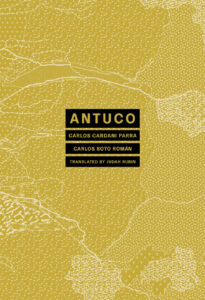
In May 2005, forty-four Chilean army conscripts were ordered to march twenty-four kilometers through a whiteout storm in inadequate gear for a training exercise, and on the slopes of the Antuco volcano, died of hypothermia. Antuco (2019), by Carlos Cardani Parra and Carlos Soto Román, interrogates the criminal negligence of the commanding officers as well as the dehumanizing military ideology and persistence of impunity in post-military-dictatorship Chile. Judah Rubin’s translation provides a nuanced reading of the text with remarkable fidelity to graphic disposition and varied registers while providing greater visibility of the poets’ work and the Antuco tragedy.
Carlos Cardani Parra’s collections raso (2009), Pasaje Tala (2010), and Du Maurier (2016) engage military culture and state violence, a thread that runs through Antuco. Carlos Soto Román is one of the most internationally recognized figures in contemporary Chilean documentary poetics, with titles including Chile Project: [Re-Classified] (2013) and 11 (2017, winner of the Municipal Poetry Prize in Santiago, 2018). Antuco represents a combination of their poetic concerns, turning a documentary lens toward post-dictatorship impunity, asking how the logic of military dehumanization persists in democratic Chile. Judah Rubin is a poet, editor of A Perfect Vacuum, and a translator of experimental Latin American poetry, including Rodrigo Quijano’s An Inherent Tear and work by Dalmacia Ruiz-Rosas Samohod. Antuco marks his first translation of Cardani Parra and Soto Roman’s work.
Antuco occupies a tense, liminal space between archive and art. The book draws on documentary evidence from testimonies, news sources, military manuals, weather indexes, studies of the effects of hypothermia, and more, although the construction of the text usually does not make explicit the use of archival sources. As a reader, it can be hard to tell where the source ends and the poetic voice begins. The authors include recruits’ dreams as they are dying from hypothermia in the snow: “While he remembered the stories that his mother read to him by the fire / He could see the flames dance / And hear, […] the first words of his favorite book.” Although these accounts feel very real and personal, they were not possibly derived from testimony. I often felt compelled to look up information to see if the text was more documentary or imaginative elaboration. The book consistently provokes this tension, inviting and resisting verification.
The flow of the narrative recalls at times of the relación genre of colonial Latin America, in which explorers documented expeditions, survival, conquest, or offered forensic denunciation of human rights abuses. Likewise, Patricia Espinoza notes its similarities to the cuaderno de bitácora (ship’s logbook) genre of colonial exploration in her 2020 review. She claims that the poems take on the form of a logbook, in which the entries mark a “fateful pulse.” The book’s language frequently has the quality of a journal, adopting a deliberately prosaic register rather than a conventionally lyric one: “Hernández’s fall fractures the company / There is a bloc that turns to help the conscript / And another that continues the march, ignoring the stragglers.” The passage reads less like a poem composed by the authors than a journal entry written by one of the recruits. That flatness seems to be the point. The poems consistently achieve their poetic force through direct, bleak, truncated prose, a strategy that formally enacts the dehumanization that the book is critiquing. This devastating accumulation can be seen in following passage: “NCO Grandón gives the order not to stay in the Universidad shelter / It is decided to finish the march as soon as possible / To go directly with his troops to La Cortina / Four more kilometers without break or pause / […] / Seven conscripts in his charge die on that journey.” The bureaucratic neutrality of the language, (orders given, decisions made, deaths recorded) mirrors the indifferent institutional military logic that sent these men to their deaths.
Inseparable from the book’s documentary argument is its use of the visual arrangement of the text as part of its signifying structure. The first thing that attracted my attention when I started reading is the placement of small blocks of text at the top of each page, leaving a vast field of white covering most of the page. The visible text seems to be peeking out above the snow, or revealing what the eye can locate during a whiteout. This visual design seems to suggest that we only have access to a small part of the story and that much of the evidence has been buried or lost. Equally striking are pages that reproduce images of handwritten text resembling words inscribed in chalk on a blackboard, simulating the military classroom in which cadets receive instruction form their officers. The first such page repeats the lines “DO NOT STOP DO NOT PAUSE DO NOT HELP,” foregrounding the instructions that the trainees received to press on regardless of the comrades they were leaving behind in the snow. The didactic blackboard text creates a clasroom atmosphere that underscores the paternalist nature of the situation in which the young conscripts are dependent on their superiors for their judgment and experience, a situation that is bitterly ironic given the catastrophic consequences of their orders. The other page that resembles a blackboard, simply repeats the word “SNOW” over and over until the word disintegrates into scrawling. The text suggests that the officers’ orders have been displaced by the inexorable snowstorm; language breaks down as the snow accumulates, and with it the capacity to hear orders, to think, and ultimately, to survive. Finally, while the fallen recruits disappeared into the snow, making it difficult to recover their bodies, the text places their names into crosswords on the pages that face their dying dreams. The visual arrangement of their names into crosses acts as a memorial.
The translation is generally arranged with the Spanish and English text on facing pages, but Rubin also recognizes when to give the original text space to dialogue with itself, like in the example above. By retaining the death dreams on the pages facing the crosswords, for example, these crosswords are not presented in the normal sense of the term, but rather as cross-shaped arrangements to mark the graves of the fallen. This edition does a remarkable job of reproducing the visual strategies of the text, replicating the chalkboard writings, cut-out collage pages, varied typography, and spatial arrangement, so that the book feels like an organic whole, instead of a work and its translation.
The text presents particular challenges for the translator in its usage of specialized language. Rubin skillfully manages a range of registers and terms from scientific texts on hypothermia and freezing, as well as military ones with ranks, commands, and procedural language. He enacts a careful reading of the text in his translation, correctly identifying terms like “un clase”, which at first glance looks like a typo for “una class” (a class), but is actually a term that refers to a type of subcommander. Hence the verse “Qué puede instruir un clase sobre el frío y la nieve” is rendered “What can an officer on cold and snow teach.” It is also notable that in the Spanish text, the recruits refer to their commanding officers with possessive adjectives, “Mi Sargento” (My Sergeant), whereas, in English, they simply say “Sergeant.” This translation is contextually correct, since it reflects how an officer would be addressed in an Anglophone context; it does however, lose the sense of trust which is expressly placed in the officers through the possessive, a detail that helps reinforce the reading of the book’s denunciation of the officers who failed the men placed in their care.
The translation is itself a political act that extends the book’s original gesture of denunciation into a new context, making the Chilean tragedy legible to readers who may be living through analogous situations. The book’s questioning of military and government impunity, state violence, and adherence to cults of masculinity are globally resonant themes that U.S. readers in particular may find disturbingly familiar. The text reveals how human beings are degraded to the point of having value only as government tools of war: “The body is a war machine, a military resource,” and those who cannot keep up are discarded. It examines the rhetoric that places men’s sole value on their ability to dominate and demonstrate strength over those that are weaker. And lastly, it questions the creation of an official story in which these young men become memorialized as heroes in order to find sense in a senseless tragedy. Against that official narrative, what Antuco ultimately offers is not a conclusion but a question, one that the Chilean state, its military institutions, and perhaps its readers have not yet fully.
Alec Schumacher is Associate Professor at Gonzaga University. His research interests are Latin American poetry, translation, and avant-garde poetics, with publications focused on Chilean poets Juan Luis Martínez and Elvira Hernández. He has translated works by Jorge Arbeleche, Elvira Hernández, Luis Correa-Díaz, and Carlos Cociña. Cociña. His translations and co-translations have been listed for several awards, including the National Translation Award, the Book Critics Circle Award, the Griffin Poetry Prize, and the Sarah Maguire Prize.
This post may contain affiliate links.