


[Open Letter Books; 2026]
Tr. from the Polish by Mark Ordon
The utopia is defined as an idealized, perfect world; and even at the roots, it proclaims impossibility. The word straddles the Greek eu-topos meaning “good place” and, in the same breath, ou-topos or “nowhere.” Coined in Thomas More’s 1516 titular novel, a utopia is primarily characterized by harmonious communal living. Still, the idea dates back almost two thousand years further than More, to Aristophanes and Plato, who were already toying with utopian visions, whether satirically or earnestly. There are often notable characteristics of utopia, but these visions vary widely. Some are marked by the overwhelming use of technology, while others hinge on its absence. Some imagine Amazonian-like spaces; others envision free love across genders. But it’s notable that the ideas of utopia, so forward-thinking in its conception, carry markers of the past into the present-day.
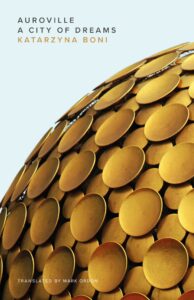
Katarzyna Boni, a Polish writer whose book Auroville: A City of Dreams has been newly translated into English, attempts to navigate the paradoxes and complications of creating a utopian common. This publication, coming six years after its initial release in Polish, is indicative of our unresolved global question of how to live together—whether in a commune, or in a shared world. In the book, Boni explores the establishment of a current-day utopian project located in the Pondicherry territory of India. Her writing doesn’t give a straightforward account of its history. Instead, it wavers between perspectives, darts from person to person, jumps back and forth across decades, and recounts day-to-day commune life, death, mystical word-of-mouth, marriages, violent infighting, petty arguments, and—as the title promises—the dreams of its residents. Chapters often begin and end with little clear connection to one another. It isn’t until halfway through the book that readers can start to piece together the residents’ lasting relationships to one another and, at the very end, learn the origins of Auroville and its founder, the Mother.
It is easy to get caught up in Boni’s storytelling of the Mother. After all, there are many chapters devoted entirely to Mira Alfassa—known to her followers and Aurovillians as “the Mother.” Primarily, Alfassa was the partner of Sri Aurobindo, an Indian philosopher and yogi whose work underpins the foundation of the project. She is also the founder of Auroville, establishing rules, breaking them, and selecting the first residents. In Auroville, “everyone is invited,” but—as is also made clear to Boni herself—not everyone is accepted. Those accepted were required to follow several rules, “the most important of which was obedience to the Mother,” coupled with the teachings of Sri Aurobindo: “Always behave as if the Mother was looking at you; because she is indeed, always present.” And yet, Alfassa passed away after only the first five years of Auroville’s founding. What remains of Alfassa’s vision, almost 60 years later, is the more compelling narrative.
The conceptualization of the commons is tied to many utopian ideals. It’s also deeply entwined with a sense of tragedy and fatalism. Garett Hardin’s “Tragedy of the Commons” looms large over the discourse of shared resources, space, and freedoms. It’s a well-worn argument that individuals will always overuse a communal resource and, as the title suggests, there are only tragic endings for the commons. Even further back, the mythology of the Edenic gardens, as depicted in John Milton’s Paradise Lost, undermines the trust in human nature’s ability to live in common with one another. In Auroville: A City of Dreams, Boni witnesses the project’s successes and failures, starkly laying out where it falls short of utopia. She writes, “Auroville is not a utopia, it’s a laboratory. A transitional being between what is and what will be.” But what will be? After several decades, it’s clear that the same question haunts Auroville.
Early in her writing, Boni notes the diversity of countries involved in the project’s opening ceremony and, as the years pass, marks the number of countries that the growing number of residents come from. Auroville is established as “a place that belongs to everybody. Nobody can claim it to be their own.” This sentiment resonates deeply with the author herself, who arrives as an honorary volunteer considering residency. However, Auroville introduces its own selectivity and curbs the “everyone.” Boni notes that during the founding era: “The Mother did not accept all ideas or all people. Auroville is not a free colony.” There is a notable preference for younger, able bodied, and financially flush residents—many from the United States or Western countries. As for that impressive numeration of diversity and globalism, Boni notes that in current-day Auroville, nationalism has continued to undermine communal life: “The Indians from the north sit together, those from the south sit together, the white people sit together, but even among them the French prefer to spend time with the French, and the Russians with the Russians…Now everyone eats alone. The conversations at a communal table are over. The gates have closed.” It’s no surprise that Pondicherry’s local villagers view the commune as only a place to work. In fact, Boni reports that six thousand local villagers are employed from the surrounding villages to work in Auroville’s restaurants, boarding houses, farmyards, and gardens—serving the commune’s three thousand residents.
Aurovillians are required to work—or rather “volunteer”—for five hours every day for the community and, in turn, receive a monthly maintenance of approximately one-hundred-ninety dollars. They partake in a wide variety of tasks, such as gardening, meditation, teaching, making clothes, building houses, farming, and other services. Today, they boast a media and communications office, a theatre, over 250 small businesses, and even a circus school for children. And yet, residents also describe Auroville as “stuck in the sixties,” short on housing, dirty, and surrounded by poverty.
The economy of Auroville remains a central point of tension. In fact, it seems that money becomes the other ghost that haunts the narrative of Auroville, just as much as the Mother. Originally, Auroville was not meant to have money internally, but rather only for exchange with the outside world; the Mother claimed to view money as only a means to an end. In fact, money is described as the greatest taboo among Auroville’s pioneers. They go so far as to say: “ ‘Profit,’ ‘gain,’ ‘salary,’ ‘tax;—these words are banned here.” Even in her own research, Boni finds it difficult to get current-day residents to talk about money. But ignoring it does not make it go away. Instead, Boni describes the functions of its economy, from the maintenance funds for volunteers to the common budget and the Auroville Foundation, owned by the Indian government. She reports that the majority of Auroville’s budget is provided via grants by the Indian government or similar subsidies and donations from around the world. Rather than money serving as an exchange with the world outside, it seems that Auroville runs on money flowing in from external sources. Moreover, it becomes clear that money—or the lack of it—is part of the reason some residents remain. As Boni writes, “It seems that some people are stuck here. They would leave if they could afford it.”
So, what is one to make of the economical and segregated reality of this utopian project? The frustration is palpable. A resident that Boni interviews says: “After only a few days I began to ask the question: What have you been doing for fifty years? Why haven’t you come even one step closer to the vision you came here to realize? You are neither self-sufficient nor have you given up on money?” The utopian vision has led the Aurovillians into a paradoxical problem, bound by contradictions in their own proclaimed goals and self-made obstacles.
It may be helpful to consider philosopher Ernst Bloch, whose writings on utopia appeal toward transcendency without transcendence itself. In Principle of Hope, he emphasizes the importance of pursuing a more ethical future in what he calls a “concrete utopia.” His focus on “becoming” is what grounds the utopian project, rejecting the idea of utopia as a distant and impossible dream. Instead, he writes, “The real is process.” Through this lens, we might begin to reconsider Auroville. Throughout its establishment, there has always been an intentional approach, working toward the goals of a concrete utopia. Initially, Boni describes the Mother’s vision as explicit in its direction, listing out “a few museums, a theater, cinema, restaurants, an auditorium…factories, hospitals, a hotel with yacht club, a nursing home, maternity clinic, schools, nurseries, libraries, milk farms, farmland, a gliding club, bakeries, potteries, workshops, laboratories, department stores, a port, a train station, an airport…maybe even a nuclear power plant.” It’s an ambitious vision, not unlike a major modern metropolitan city.
It is also shared by many of its earliest residents, such as Bob, who works on establishing waterways, dams, and algae farms; Jocelyn, who creates a space for children to live on their own; or Narad, who pivots from teaching singing to building gardens. One of the earliest residents is Frederick, a German who came to Pondicherry just before Auroville’s fruition, when the Mother was running Sri Aurobindo’s ashram. Boni writes that he was prepared to leave the ashram, but in a single encounter, “he knew his life belonged to the Mother.” Frederick describes a similar dream for Auroville:
The quiet streets will flow smoothly into parks, parks into gardens, and gardens into houses made of crystal matter glistening like a rainbow in the sun. There will be no fences, no gates. At night the air will be heavy with the smell of jasmine and roses.…there are going to be fountains, shaded canals, ponds, lakes, swimming pools. Maybe even a water tram? Cause certainly there won’t be any cars that cause this irritating dust….An infinite city, a city full of possibilities, a laboratory, an eternal development.
These hopes and dreams are widely shared, but as the book’s subtitle suggests, Auroville becomes beleaguered as a city of dreams—not a concrete utopia.
One of the central characters in Boni’s narrative includes Auroson, the son of Frederick and also the younger sibling of the first child born in Auroville. In fact, he is named after his older brother who passed away as a toddler—and considered a reincarnation as well. Throughout his life, Auroson struggles with a homesickness toward Auroville and running from expectations attached to being the “new human species” his brother was anticipated to be. In a way, he reflects the struggle toward utopia. Despite the heavy expectations and hopes for the “first child of Auroville,” he remains human, flawed, and struggling toward the future like every other character. And yet, he notes, “underneath it all, you still move forward. That’s life, what you do.”
This struggle resonates throughout Boni’s reportage. The author is often critical of what she describes as cult-like dogma toward the Mother and Sri Aurobindo. She also makes readers keenly aware of the project’s shortcomings. After her year as an honorary volunteer, Boni does not stay. She admits that her initial fears reflect her own background and cynicism from Poland’s history of communism and, even when she comes to terms with those insecurities, she wrestles with finding her purpose in Auroville. It becomes clear to readers that the project toward utopia is not an escape from reality but a challenging, frustrating mission—often requiring hard, physical labor. Still, Boni comes to admire the attempt toward building a utopia as a “refusal to accept what is.” During her residency, Auroville celebrates its 50th anniversary, and she lauds its continuing journey. She draws from Polish sociologist Jerzy Szacki, writing that an “actor’s intentions always differ from the course of the performance. But without actors the stage would be empty.” The intentions of the Mother and residents may not have resulted in the performances they expected. But the play, like life, goes on.
Throughout her book, Boni makes brief mentions of Pondicherry’s desert lands when India finally became free of French and British governance. The former forests had been devastated by colonialism, and in its place was red, infertile soil with few animals. And yet, by the time she arrives, “the forest is so dense that you can’t see the sun.” The ecological surroundings of Pondicherry are subtly threaded throughout her account of Auroville, as residents are tasked with creating water dams, building housing from available natural material, and planting trees. Initially, the demand for shade led the earliest Aurovillians to plant whatever available seeds they had—eucalyptus, Mexican gliricidia, leucaena, Australian acacia—and with its first international grant, planted a million trees in the first ten years. They eventually diversified into “almost two hundred different species of trees, vines, lianas, bushes, and herbs.” This reforesting is an impressive task and perhaps the most enduring symbol of a concrete utopia and commons in the book.
One of the residents describes the forest as “the most beautiful thing they have managed to build here…and that it just happened by accident.” It is not the intended vision of utopia as the bustling metropolitan-like space that the Mother had imagined, but it was not by accident either. Instead, the forest encapsulates a utopia embedded in the process of creating one. Perhaps it might foretell the possibility of another utopia.
Helena Gabrielle Ong is a writer, artist, and producer. She’s a member of the editorial staff at The New Yorker. You can find her online at www.helenagabrielle.com.
This post may contain affiliate links.