


[Siglio Press; 2026]
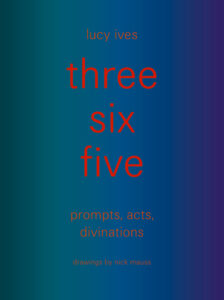
The writer, poet, curator, and professor Lucy Ives isn’t shy about her influences. In her 2022 novel, Life is Everywhere, she included a postscript letter, explaining the genesis of the novel and professing a love for Ursula K. Le Guin. She then oversaw a collection of works by conceptual artist, poet, and architect Madeline Gins, and a “phantasmagoria” pulled from federal photo archives. In her 2024 foray into nonfiction, An Image of My Name Enters America, she included a three-page syllabus and extensive footnotes. So when Ives’s new project was announced, featuring the subtitle: “an inexhaustible compendium for writing,” I assumed I knew what was to be expected. I expected that the book would explore Ives’ interest in graphomania, a psychiatric condition that causes an obsessive compulsion to write. The condition shows up in Life is Everywhere, and again in Image of my Name. Reading further into the press release, I realized that this book was instead an expansion of a different body of Ives’ work: a series of “writing prompts” that Ives used to post on her instagram. Months later, when I got my hands on the book and opened to the introduction, I was greeted on the book’s very first page, in the third paragraph, by an appearance of the word “Graphomania” with such emphasis that it is italicized, and suffixed with not one but two exclamation points. Graphomania!! I laughed at this. Real, out-loud laughter. That feeling of delight and surprise is, on the whole, similar to the experience of reading three six five.
So what, then, are the stated influences on three six five? The first, and perhaps most obvious, is Yoko Ono’s Grapefruit. The presentation is similar, in that the book (the actual printed object that you hold in your hand) is square. Ono’s Grapefruit is a book full of instructions for the reader, featuring occasional black and white illustrations. The instructions range from the easily accomplished (“breathe at dawn”), to the extreme (“Paint with your own blood… Paint until you die.”) The other stated influence is Raymond Queneau’s Exercises in Style. Considered his masterpiece, Exercises is 99 retellings of the same scene, each time in a different method. He employs poetry, prose, mathematics, abstraction, and finds a constellation of interpretation and meaning in an otherwise unremarkable scene. Queneau was the co-founder and president of the Oulipo group, a collective of writers who emerged in 1960 and were united by their interest in restraint. They would place constraints and restrictions on themselves and then set out to do their work. Perhaps the most famous of these constraints is Georges Perec’s La disparition, a 1969 novel that does not use a single word containing the letter “e.” (In an absolutely heroic feat, the English translation of the book, A Void, abides by the rule.)
Ives names all three hundred and sixty-five prompts, many of which take their titles from other important works in literary history. Prompt number fifty-six is called “Making Americans” and encourages repetition, a nod to the circuitous sentence structure in Gertrude Stein’s thousand-page modernist cornerstone, The Making of Americans. The books referenced in the prompt titles are often ones with strange formal flourishes, from which Ives draws oblique inspiration for the actual content of the prompt. Other titles include: Hopscotch (Cortazar), House of Leaves (Danielewski), Carrier Bag (Le Guin, again),The Waves (Woolf), and, naturally, Exercise in Style (Queneau) & A Void (Perec).
But even with these concrete reference points, three six five is a book that defies easy classification. The book exists in a sort of Schrodinger-esque state, changing and solidifying at the moment of observation. On occasion, it is straightforwardly a “craft” book designed to assist writers, and on another it offers small, parable-ish microfictions, or else Buddhist koans. For example, prompt fifteen in its entirety here:
Write a description of your bed after you have slept in it. Write a description of a chair after you have sat in it. Write a description of a room after you have closed the door. Write a description of an empty glass after a meal. Write a description of a person you no longer know. Write a description of a belief you no longer hold. Write a description of something that is so far out of sight it cannot be seen. Where did that last thought of yours, the one you were having just moments ago, come to an end? Turn toward the now-invisible place from whence you came. Wave slowly.
What starts as a writing exercise, instructing you to describe specific objects in specific settings, ends by needling the nature of human consciousness. The book is going to encourage the reader (or writer) to reconsider many of their most taken-for-granted realities, like in prompt seventeen, when Ives instructs you to “describe something you have completely forgotten.”
That prompt features a note from Ives herself, at the bottom of the page, saying “If you are asking ‘how can I describe something I’ve completely forgotten?!’ you are on the right track.”
The book is an almost-living thing, asking the reader to meet it halfway. Ives is the sort of conceptual thinker who views the audience as a collaborator, or else a co-conspirator. Though not an inaccessible book by any means, it is without question an experimental one. As literary critic Fredric Jameson put it: “a true-avant garde is characterized not merely by a modification in the way a work is constructed or executed, but also by a program of changes for its reception.” When a truly inventive artist creates something “new,” they must also create the audience for it. This is accomplished by teaching people how to approach the work in order to have the best possible experience with it.
Three six five approaches the creation of this audience through the introduction, titled “Why I Wrote—and How to Use—This Book,” and in the fact that it is, quite literally, a book of instructions. Many of the earlier prompts instruct the reader to participate in activities that do not involve writing at all. There are instructions for rearranging furniture, and the suggestion that you go through the drafts of abandoned emails that are automatically saved to see what sorts of situations you had once found yourself in. You will watch films, write letters, cook dinner. You will go on lots of walks. Sometimes you will be asked to write about these things, other times, you are simply encouraged to see things from a new perspective, or to refamiliarize yourself “with the broader ecosystem you inhabit,” as Ives puts it in the introduction.
It is in these moments of refamiliarization when the Oulipo influence begins to show itself. Ives encourages you to follow Queneau, and to reimagine banalities into something new and exciting and vital. With this in mind, Ives’ prompts begin to feel like her own collection of Oulipo constraints, to be used as a springboard by anyone wishing to create, and solve, a maze.
Ives has stated that she has found writing prompts to be “patronizing or sentimental” and her interest in them at all comes from a desire to push back against the conventions of the genre. In short, she wanted it to be impossible to complete many of the exercises “correctly.” As the book progresses, and the reader/writer gets more comfortable with what is being asked of them, the work begins to grow more conceptual. It’s not long before time breaks down completely. What were ostensibly daily activities take on certain impossible properties. Prompt ninety-nine, for example, is a single-day activity in which the reader is supposed to keep a diary for an entire year. Another prompt instructs you to write something, forget it completely, and return to it when you are “pretty sure you’ll have become a different person.”
I found the impossible tasks to be the most exciting. The cognitive dissonance that arose spurred alternate ways of approaching the problem. I felt somewhat like a cat burglar, casing a locked building, searching for windows or ventilation shafts through which I could enter.
Even the task of writing a review of three six five seemed, at first, impossible. Beyond the temporal obstacle of engaging with a yearlong project in only two months, I was initially at a loss for how to structure my thoughts on a book that lacks any sort of traditional footholds. The solution, it turned out, was to alter my thinking about how to write a review in the first place.
I have now read the book approximately one-point-two times. My first experience with three six five was to sit down and read the thing cover to cover over a handful of afternoons without actually attempting any of the exercises. Approached like this, the book becomes something like Queneau’s Exercises. It gives the impression of being a collection of uncanny short stories, written entirely in the second person. You are the main character of three six five. Reading this way, my imagined self wrote dozens of letters and maintained multiple diaries. I answered abstract and impossible questions (“are there things that cannot be taught?”). On at least one occasion, I threw an imaginary party.
Endeavoring to complete the asks in just a few sittings, without actually taking the time to write them down, was an experience not unlike the first day of a new job. The amount of information, the developing of skills, happened in such rapid order that I would close the book and feel something like exhaustion.
Then, after finishing the entire thing in several gulps, I started to take it on a day at a time, as intended. And here, the experience of reading three six five changed once again. I’m sure that over the course of an entire year, one will significantly strengthen their creative muscles. Not enough time has yet elapsed for me to say for sure, but even in the few months that I have spent with the book have helped to change my relationship to time, to creativity, and to gratification.
And it was in this slower mode that prompt fifty-three stood out in a way that it hadn’t previously. The exercise is to write a motto, though Ives does not specify if it is supposed to be personal, political, or institutional. “It can be provisional or impermanent,” she says. “You need not live by it, but you could.”
At first, this seemed to be another playful subversion of what I had come to expect from the book. To set myself a motto, or a rule to live by, was like the Oulipo constraints. I thought of famous mottos like the Boy Scouts succinct, “Be Prepared,” the historical “make haste, slowly” (which itself felt like the sort of self-negating instruction Ives might provide) But the longer I sat with the end of prompt fifty-three, the larger and deeper the scope of the thing became, until it took on the air of one of literature’s most famous mottoes: “I would prefer not to.”
“You need not live by it,” rings true of nearly everything—all art, language, and just about all of the rules that govern the world. “But you could,” Ives continues. And that is where the work begins.
James Webster is a writer, reader, and the co-owner of Recluse Books, an independent bookstore in Fort Worth, Texas.
This post may contain affiliate links.