


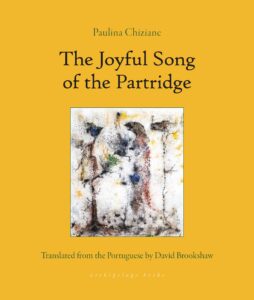
The Joyful Song of the Partridge – Paulina Chiziane
[Archipelago Books; 2024]
Tr. from the Portuguese by David Brookshaw
This review was originally published in the Full Stop Quarterly “Tender Tongues,” edited by Natália Affonso. Subscribe at our Patreon page to get access to this and future issues, also available for purchase here.
The Joyful Song of the Partridge reads in the same way a song carries a voice, or voices: with intermittently sustained breaths, rests, climaxes, accents, catches in the throat. Paulina Chiziane’s second novel to appear in English, in David Brookshaw’s lush translation from Portuguese, weaves a chorus of competing accounts that we follow in turns and tides—three generations of women “dreaming of the same mountain” during three crucial periods in Mozambican history: Portuguese colonization, independence, and post-independence. Its method may be understood in these opening lines: “A collective cry. A refrain.” And then, this opening image: “There is a naked woman on the banks of the River Licungo. In the men’s area.” Here we are introduced to a cluster of words that energize the novel: collective, music, river, refrain, woman, women.
Chiziane was born in 1955, in the Gaza province of Mozambique. She grew up speaking Chope and Ronga, both Bantu languages, and was forbidden to talk to white colonizers during her youth. It was in her twenties that Chiziane began writing in Portuguese; she went on to study linguistics. Her first novel was published in 1990, right after Mozambique gained independence following four hundred and seventy years of Portuguese colonial rule. Chiziane has since written eight other books, two of which have been translated from Portuguese into English by Brookshaw and published by Archipelago Books: her second novel, The First Wife (2002) was translated into English in 2016; and now the English translation of The Joyful Song of the Partridge (2008) has just been published. Both translated books span about 500 pages and illuminate the stories, dreams, misfortunes, and interior languages of Mozambican women.

The woman at the center of Joyful Song is Maria das Dores, who appears one day “in the solitude of the waters of the river.” No one knows where she comes from. She is facing a “sleepy little town” in which “nothing ever happens and everything is news.” She is naked (“beautiful and resplendent”), young (“awaiting some revelation”), tattooed (“on her belly, thighs, and shoulders”), and Black (“jet black, as black as sculptures carved from ebony”). Her shameless nudity is completely bewildering to the townspeople; they hurl insults at her and plead that she cover up her body. Unblinkingly she asks: “What for?” Our intrusive narrator continues for her, overlapping the woman’s indifference with mythic authority: “What for, if she has nothing to hide under her clothes? She has nothing to hide, that is for sure. She is the daughter of a drop of water from the overflowing river. She was born from the algae. […] This why she loves water. She is a lover of the water. She came like the foam on the eddies of the river. She came from nowhere.”
This novel is largely an attempt to draw a line—crooked, errant—from Maria’s nowhere to elsewhere, from a now to a past-when. Chiziane unhurriedly traces Maria back to her sister, Jacinta; her grandmother, Serafina; her mother, Delfina, who is a Black sex worker; her father, José dos Montes, who became an assimilado at Delfina’s urging; and the person whom Maria calls her white father, Delfina’s second husband, a Portuguese colonist named Soares. The tensions of miscegenation, colonialism, and assimilation determine the movement of this line.
Throughout Joyful Song, the narrator makes the reader aware of her listening, as well as her judgment. One chapter begins by reframing the pages that precede it: “José dos Montes would not tell the same story if he were here.” Earlier, Maria is identified by the narrator as a “mad woman,” even though her interlocutor “senses he is facing a hermit and not a mad woman.” Sometimes the narration slips from third to first person and back again: “The mad woman of the river looks at the church at the top of the mountain, and it opens the route to her memory. I seem to have been here before, but when? In what circumstances? Years of memories converge in her mind.” We are in the hands—or inside the mouth—of a narrator performing her own reading of the song she sings. Sometimes we want her to slow down, or withhold commentary; or move along, go on, speed up to get somewhere that we, in our own readerly idiom, feel to be “the good part.” Imagine a party in which the same story sneaks its way through different bodies and rooms at varying decibels, in several versions and vocabularies. This story finds new truths and new lies in each utterance.
*
There are variations of a sentence that begin nearly every critical response to Chiziane’s work: Paulina Chiziane was the first woman in Mozambique to publish a novel. It’s a sentence made to shock or awe—but Chiziane insists: “I just wrote a great story that others called a novel.” The author’s biography on the inside flap of this latest novel to appear in English explains that “Chiziane prefers to call herself a storyteller rather than a novelist and bases her work on the rich heritage of the oral tradition.” The two novels that have been translated into English were written using the same technique, rooted in the oral confessions of others. In a 2017 interview with Nafeesah Allen that was later published in Transition Magazine, Chiziane chronicled the first strokes of Joyful Song: “In front of my house there was a woman of mixed race. Later, I introduced myself to the person who cleaned the house, who was the woman’s eldest sister. I followed this story until I found its root. I searched for books and did not find them. I talked with some people and went about constructing the story from oral confessions, which is better anyway. More or less, that’s the way I work.”
Chiziane is also a musician: as a young girl, she wanted to become a singer, but her father forbade her. In 2021, the same year she won the Camões Prize— the highest honor in Portuguese-language literature—she released her first singer-songwriter album, Cantos de Esperança, or Songs of Hope. In other recent interviews she continues to insist upon the superiority of voice over written word: “If my neighbor plays music, even if I don’t want to, I’ll hear the message.” Yet Chiziane’s written word, in Brookshaw’s English, is exceptionally rich—we can’t help but hear its music, too. Chiziane reaches for language and images that feel both simple and exaggerated, supple, vibrating in the upper octaves of language. For example, the crystalline sentence “And he discovers that he has a body and isn’t dead” resides in the same paragraph as this series of hifalutin fragments: “The salt of life. A drop of water in the inferno of the world. A tongue of flame in an abandoned heart.”
“Words of high drama” is a phrase used in the novel to describe the rhetorical tendencies of José dos Montes, and here I’m tempted to apply it to Joyful Song as a whole: this is a novel made from words of high drama to form a swirling epic of gossip, history, mythology, roadside chatter, and dreams. Its characters are asking the most enormous questions of life—“What does it mean to know?” “Where am I going if I don’t even know who I am?” “Why do people have to walk in a particular direction if all places are places for walking? Why do I have to walk at certain hours if all hours are for walking?”—and contradicting each other about what any of it means. Chiziane is herself asking what it means to tell a story, what it means to love, and what it means to be a Black Mozambican woman. Following the last page of the novel, a glossary is provided. I regret that I became aware of the glossary only at the end of my reading, though I recognize, too, that a glossary of just 14 words to accompany a book of nearly 500 pages is not made to feel all that necessary, or be often referenced. I was nonetheless reminded of Poetics of Relation, the major work of French-Caribbean writer and philosopher Édouard Glissant, which was published in 1990. Its first section, “Approaches,” begins with a fragment, “One way ashore, a thousand channels.” If we pour this image into Joyful Song using the associative principles that inform both texts, we may also come to understand: The woman has appeared in the solitude of the water from a thousand channels, or a thousand voices. Betsy Wing’s English translation of Poetics of Relation includes a glossary that quite helpfully precedes the book. Wing includes an epigraph from Glissant’s 1975 novel, Malemort: “Glossary: for readers from elsewhere, who don’t deal very well with unknown words or who want to understand everything. But, perhaps to establish for ourselves, ourselves as well, the long list of words within us whose sense escapes or, taking this farther, to fix the syntax of this language we are babbling. The readers of here are future.”
The readers of Chiziane in Brookshaw’s English might be from elsewhere, but in music, unknown words do not preclude shivers, do not stifle feeling. “Song” is the last word of the book, and in a gesture that resembles a repeat sign, I recall Joyful Song’s first words: “A collective cry. A refrain.” This is a novel that begins and ends in music; it is a “song that reminds the youngest women of the most ancient things, the beginning of all beginnings. The story of matriarchy.” A finger that raises itself to draw a spiral in midair can mean two different things: to wrap it up, or begin again.
Claire Foster is a reader, writer, and bookseller. She is also a literary translator from French, most recently of Pierre Clémenti’s 1973 prison memoir, A Few Personal Messages(Small Press, 2022). Her writing and translations have appeared in The Hopkins Review, Public Books, the Los Angeles Review of Books, and The Kenyon Review. Her translation of Valérie Manteau’s novel The Furrow(Prix Renaudot 2018) is forthcoming from Invisible Publishing. Born and raised in Ohio, she lives and works in Toronto.
This post may contain affiliate links.