


[Two Lines Press; 2026]
Tr. from the Polish by Kate Webster
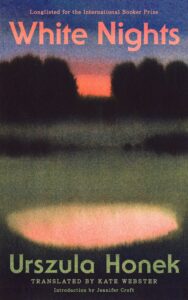
Consisting of thirteen interconnected stories set in a Polish village, Urszula Honek’s collection begins with a story about a man named Pilot who sets out to dig a pond and ends up digging his own grave. Day after day he climbs up a hill to a field outside the village and digs, refusing help. As the pond grows wider and deeper, his plans gradually cohere: he wants to release carp in the water and invite his friends to see what he’s created. As the story unfolds, we learn more about Pilot and his friends, one of whom narrates the story years later. They live in a beautiful region, but their lives are hard. Pilot drinks too much and can barely read. He grew up in a rickety house that looked like a chicken coop, and his parents used to beat him. His stagnation in life may be his reason for digging this pond, an exercise of agency. As the narrator speculates, Pilot had “seen people build houses, get married, have children, and he wanted to make an impression.” Pilot finishes the pond and releases the fish, but not long after its completion, he’s found dead in the water. The reason for his death, whether accident or suicide, is unclear. The narrator doesn’t attend the funeral.
In this poor village in Poland’s Low Beskids region, Pilot and his friends have little opportunity to advance. The narrator of the first story, “Permission to Land,” goes off to work in Germany for a few years but can’t seem to escape the village, and we get the sense that everyone in this village, if they ever leave it, will eventually return. It’s a place of repetition and drudgery, where despair overtakes people like a slowly spreading disease. As the narrator of another story says, the villagers aren’t “consumed by sorrow in a single moment but throughout their lives, little by little, until suddenly they have nothing to breath, they collapse.” Personal losses become family tragedies, traumas pass from generation to generation, unresolved and perhaps inescapable.
Like her characters, poet and fiction writer Urszula Honek grew up in a village in southern Poland, and in White Nights she sensitively reimagines the region and its people. While writing the book, Honek traveled extensively around the Low Beskids, studying the landscape at different times of day and in different seasons to evoke the region in close detail: the light, the apple trees, the river, the hay bales. In an interview for the International Booker Prize, for which White Nights was long-listed in 2024, Honek said that she often draws on people she has known in creating her characters. In her skilled hands they all seem crafted from real life. White Nights, her first work of fiction, was published in 2022 and was nominated for several literary prizes in Poland; Honek has also won the Kościelski Award, given to the most promising writers in Poland under the age of forty. The book seems like a natural choice for Kate Webster, who previously translated another collection of interconnected stories telling a non-linear narrative: Barbara Sadurska’s The Map, which was shortlisted for the Oxford-Weidenfeld Translation Prize in 2023.
Despite its bleak premise, White Nights is a hopeful book. Honek avoids depicting violence and cruelty directly, acknowledging the presence of these forces in the characters’ lives but often gliding past the details. In “The Cliff,” a group of children run up a cliff while out exploring. After a section break in the story, the children are sitting in the local police station, explaining to officers what they saw: a dead woman at the bottom of the drop. The implication is that the woman, Małgorzata, died by suicide, but the story’s narrator doesn’t describe her dead body or the children’s discovery of it. There is no violence, just the fact that the children found her and reported what they found. Honek has acknowledged a love for horror and the Brothers Grimm, and any influence of these literary interests on her book is more in mood—sadness, dread, and unease—than in gory or shocking images. For a book about people living such hard lives, it is surprisingly tame. This approach dignifies the characters, raising them above the sordid details of their lives, but it can sometimes leave the reasons for their pain unclear.
White Nights focuses instead on the characters’ inner lives, presenting them all with dignity and empathy. There are no genuinely unsympathetic characters. I was reminded of László Krasznahorkai’s novels Satantango and The Melancholy of Resistance, which also depict characters in crumbling Central European towns, but in very different ways: where Krasznahorkai’s novels are often ironic or darkly humorous, Honek’s novel is earnest and sincere. In her International Booker Prize interview, Honek said that she wanted to “give a voice to those who are unheard, to illuminate their lives and stories for a moment; to make them feel important and valued.” She often goes deep into the mental and emotional worlds of her characters. In “The Cliff,” for example, Małgorzata deals with loneliness and loss all through her life. The story’s narrator, a former classmate, sensitively describes Małgorzata’s inner experiences:
The sorrow would hit her when she least expected it—right after waking, when her mother was bustling around in the kitchen and the light was bursting through the curtains, or when she was sitting with her friends by the river and everyone suddenly fell silent. Back then she didn’t know how to control it, it would sweep over her body and she’d lose the strength in her arms and legs, barely managing to hold her smoldering cigarette.
In flowing, lucid prose, the narrator captures the sadness that pervades Małgorzata’s body from the moment she wakes up. This sadness follows her from childhood to adulthood. It is a physical sensation. And as the passage suggests, the sadness lives amongst the small details of Małgorzata’s life—her mother “bustling around” the kitchen or the “smoldering cigarette” in her hand—the banal moments or objects that, neither happy nor sad in themselves, add up to a melancholy, empty life. The narrator has empathy for Małgorzata, seeming to share some kind of bond with her, though they don’t really have a relationship. Like the other characters in White Nights, they are close but distant, together and alone.
Most narrators (each story has a different one) are from the village, linking the stories together and making White Nights feel more like a polyphonic novel than a story collection. The narrator of one story and the characters they mention will often appear in other stories, so that, as in a Faulkner novel, we see different perspectives on the same events—a house fire or a character’s disappearance. Gradually, we learn how characters are related to each other and how they treat each other. While the characters tend to be lonely or isolated, they have also spent their entire lives together. In her introduction to the book, Jennifer Croft—one of Nobel Laureate Olga Tokarczuk’s English-language translators—writes that Honek’s book rejects “the comfort […] in the abilities of communities to come together and to overcome” that one might find in books like the 1919 short story cycle Winesburg, Ohio by American writer Sherwood Anderson. While it’s true that the characters never band together (the word “community” has too positive a connotation to describe what they have here), they experience moments of connection: saving someone from drowning, for example, or even just having the empathy to imagine someone else’s inner world.
With its shifting narrators, the collection plays in an often melodious, sometimes jangling range of registers. In her International Booker Prize interview, Webster noted the challenges of bringing the book’s different voices and registers into English, saying that she had to be “vigilant and sensitive” in setting each story’s tone. Honek is a poet (she has published four poetry collections, none of which have been fully translated into English), and her prose, in Webster’s translation, is gentle and lyrical. The dialogue is usually colloquial, with words like “cuz,” “ain’t,” and “fuck.” Webster’s translations navigate the different voices and registers skillfully, even if I occasionally found the gruffer voices less convincing than others, lacking a certain authenticity at times. While the prose is strongest in the more lyrical passages, the novel’s tone can sometimes be at odds with the tough, unpleasant situations and places being described. At a bar in the village, the owners have stopped using glass mugs because the barmaid would have to sweep up the broken glass too often. The shards of glass would get “stuck in the soles of shoes glistening with cheap polish.” The detail of the patron’s shoes “glistening” with polish gives the description of the bar a lyrical tone that softens the image’s hard edges. Throughout the collection, the prose is frequently a pleasure to read, making it easy at times to slip past the darkness of the stories and not feel this world’s full gritty texture like I may have wanted.
White Nights is a book about despair that isn’t despairing. Reading it feels like taking a journey along a smooth and well-lit path through a dark forest. Its themes of hope, empathy, and dignity through despair are clear, but I wondered if they would have felt even more earned if the book had occasionally been more direct in its images or language, if it had put us fully in the shadows.
Noah Slaughter writes fiction and essays. He lives in St. Louis.
This post may contain affiliate links.