


[Fonograf Editions; 2026]
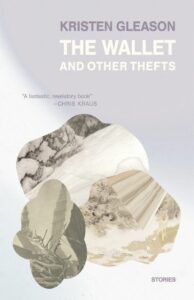
Can a story be a theft? Kristen Gleason’s debut short story collection, The Wallet and Other Thefts, foregrounds the form of the story from its title page, altering the conventional “and Other Stories” with a word insinuating an affinity between narrative and disappearance, crookedness, ill-gotten gains. The book’s epigraph, adapted from a Katherine Anne Porter story called “Theft,” seems to elaborate the theme: “I was right not to fear any thief but myself, who will end by leaving me with nothing.” But if Porter makes loss an inside job, Gleason both inherits and expands this premise, moving theft—and fear—outwards. In these off-kilter worlds, people suffer from an illness that causes their hearts to surface through their chests. A boy is declared a saint for refusing medical care and left to slowly die in a public park. In a number of stories, the characters are living in the wake of ecological disaster. Ponies have ceased to exist. A woman speaking of a pop star with an eating disorder gives voice to one of the collection’s most unsettling, gnomic insights: “Nobody acknowledges a disappearance, so long as you keep it public.”
Explicit thefts occur across the sixteen tales that make up the collection. In “The Café,” women swap stories from their travels and dreams. One describes an encounter with a weeping stranger wandering the corridors of her hotel. Across a language barrier, the woman communicates with her hands that she’s hunting a man who stole her scarf and her book, which “described a coming catastrophe.” The book she has written is in grave danger of being misunderstood if she cannot accompany it to “provide the genre: nonfiction, prophetic.” Should this prophecy be misread as a novel, “thousands of people would die.” In “The Wager,” two friends go on vacation in a city famed for its public scribes. Greg pays a scribe to write a letter to his estranged father, intending to revise and publish it under a pseudonym. The scribe, overhearing Greg’s plan for the document, reclaims it: “the rights to his entire childhood as he had described it [now] belonged to the city.” Gleason’s stories glint with the knowledge that forfeiting control of our narratives, being unable to protect what we mean, is an inescapable risk of writing and speaking.
Gleason is a writer of displacement and mischance. Travel is routinely peddled as a planned form of enjoyable estrangement, a brush with the foreign that restores the self to itself, but in The Wallet’s fictions, it’s most often a collision with the surreal or cruel. As one narrator reflects, “Vacation, as far as I knew, was not something you thought about in advance of its happening. It was more like a surprise assault.” After brutally beating a café waiter for refusing to accept their form of currency, an unmarked coin of shifting colors, a group of women insists they are not tourists. One exclaims, “I can always tell when a person doesn’t quite get travel […] They’re more like symbols than people, and yet their fright makes them seem so alive!” The collection is equally interested in another side of travel: the unchosen estrangements of those made into symbols by their hosts. “Eat with me,” asks Brian Ed, “At night.” A solitary refugee in a vaguely Nordic village, he is unfamiliar with the English word “dinner,” making the mundanity of sharing this meal newly intimate, refreshed by precision. Fluency, for Gleason, is a kind of bad perception, even a form of illiteracy. Responding to an interview question about the “linguistic quirks” of an earlier story, not included in this collection, Gleason commented: “Mastery is gross. It isn’t real. I don’t know about you, but all my practice has made me illiterate, and in situations where my literacy is presumed, I like to be exposed as a fraud by someone getting it powerfully wrong, someone clean of practice and fresh as hell.” She aspires to be like her out-of-place character who “in a different country, isn’t ruined yet. This could be a feeling that someone could feel, reading this story, if I were lucky.”
We readers of The Wallet and Other Thefts are lucky: placed in a position of non-mastery, presented with surprises and oblique connections to puzzle through. Repeatedly, language is detuned by substituting a common word with something unexpected. In “Vacation,” a worker at a “gob factory” takes her holiday at the company’s villa: “The gobs stayed with her even when she closed her eyes. Even in her dreams—gobs. It would be gobs.” Gobs intrude into the close third-person of the story as “the grapes gobbed all around.” Elsewhere, “rosa” is blood, “plunging” is having sex. A deified, life-devouring being called “the pale pig” may be a hydroelectric dam. More subtly, there’s an alien tone to the book, a quality produced by a tendency to approach humanness or personhood itself as not quite given, as unanchored properties requiring verification. A character has slept for over 14 hours, “which, for a living person, is a restorative amount of time.” Or consider the hedged: “The accident affected her! She’s a real girl, it turns out. In some ways. Or at least she’s had a shock.” My favorite descriptions in this category are the absurd yet obscurely menacing, “Tony had two hands, but he only ever used one” and “Sometimes I thought I could hear laughing coming from the inside. Not the laughing of a person. Just laughing.”
These stories will be called odd, uncanny, surreal, perhaps baffling—all terms pointing to something easy to get wrong or not get at all. Their mysteriousness isn’t merely a result of withholding. Rather, the collection gives an appealing sense that there are too many handholds for a reader to grasp onto, all kinds of shiny lures for intensive interpretation. Beyond thematic preoccupations, the stories begin to link together across words and objects, forming a charged web of suggestion. A reader might become alert, for example, to instances of: a bare human butt surfacing in water (twice), mention of a large “black horn” rising out of the earth (eleven times), or the word “green” (fifty-one times). It’s “all simply gorged with meaning,” someone jokes, and it, the nest of stories she’s speaking inside, really is.
The collection’s brilliant title story begins as an homage to Katherine Anne Porter’s “Theft,” growing stranger as it robs selfhood of its givens. A man has attempted to return a wallet left behind on a bus to the narrator, who disavows owning a wallet. The man’s face seems to register disappointment, which the narrator later realizes was fear. After spending many paragraphs digging for clues to their own recent past and unrecalled preferences, the narrator concedes the wallet must have be theirs: “A person did need money to survive. It was an essential accessory, and I was a living, breathing person so far as I could tell.” A revised echo of the book’s epigraph – “The man had been right, after all, to fear me” – suggests Gleason is not interested in a consoling type of defamiliarization. There is something both dangerous and pleasurable about the defamiliarization of the self, yes. But there’s also a practice of estrangement threaded through the book that bears little resemblance to the now-cliched, too-comforting notion that readerly estrangement—not unlike tourism—is a form of self-improvement, restoring us to our senses, making us better feelers, deeper empathizers. “Clean of practice,” compelled to read the world through less tutored eyes, chances are, you’ll be wrong. Chances are, you’ll lose the thread. Or get excluded. Or be injured. Or become someone to be feared. Or all of the above.
While on vacation, the co-worker in “The Wallet” achieves a delicious state of distance from wonder, “truly alive.” She’s kicked in the thigh by a mule, mid-epiphany. The Wallet and Other Thefts is a book of sudden kicks and inhuman laughter. Is there a theory of fiction suggested by its many losses and thefts—of eyeglasses, wallets, manuscripts, lovers, entire species? I’m not certain. A character critiques an online bus tracker thus: “it’s important to preserve the possibility of its never coming. The bus should not be a given. It should feel, every time, like the miraculous return of something useful—even necessary—that you’d worried might be gone for good.” Stories that question what a living person needs in order to behave like one, that make givens come loose and levitate, are the opposite of the bus tracker. In a world increasingly designed for the fully accounted for, the thefts of these sly, confounding fictions are welcome disturbances.
C. Greer Comrie (she/her) works in the music industry and lives in New York’s Hudson Valley.
This post may contain affiliate links.