


[University of Nebraska Press; 2026]
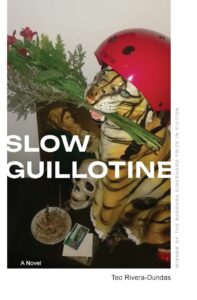
Some people hold a certain kind of elitist reverence for literature, as if books were sacred, set apart, and existed in a rarefied realm untarnished by economics. Such people would be horrified by Ford, a consummate capitalist who sees books as products and believes that value is conferred by consumer taste, rather than some esoteric aesthetic or moral sensibility. Ford is the owner of Book Buffet, a fictional two-location independent bookstore in New York City and one of the primary settings for Teo Rivera-Dundas’s debut novel, Slow Guillotine. The novel interrogates the nature of literature under late capitalism and the diminishment of the self in the face of insurmountable debt, countered by the sustenance of friendship. This is a work book, organized by repetitive motions and routine obligations, threaded through with the particularities and inanities of hourly labor. Against all this bleakness, friendship and mutual care blossom like a vibrant red stain.
The narrator works at Book Buffet, first in the receiving room at the flagship location, then as receiving manager at the sister location. Ford’s presence and questionable business ethos saturate both outlets. “I really like books,” the narrator confesses. “I wanted to work the sales floor, as a regular bookseller, but the back room had an opening and I needed the job. Now I internalize corporate gossip, shipping and receiving jargon—I guess knowing all this can become a kind of skill, or hobby, eventually, too.” This statement of optimism comes early in the book, before the grind of labor has dulled the narrator’s senses. At first, the job is an opportunity; over time, it starts to resemble a sinkhole. The narrator’s love for books becomes something he must protect, a flame that the ever-accumulating packing material and the gusts of wind from the elevated train threaten to extinguish. His engagement with books matures over the course of the story, from compulsive consumption to a more active consideration of the work novels perform within his lived context. “Is it possible,” the narrator asks, “that the point of fiction is to dramatize time passing? Or not even dramatize: to bring readers into some purposeful experience of time?” His queries of literature take on a metacritical application in the select moments when the narrator breaks the frame of fiction and addresses the reader directly. “I might say: after the scenes above, time passes. Please put the book down and pick it up some time later.”
Ford, too, might have loved books, once. He delivers long, pontificating speeches during staff meetings, in which he frames running the bookstore as a public service. Whether or not Ford is compelled by the artistic merit of literature, he is moved by the freedom inherent to the sales floor, an innovation that he attributes to bookstores themselves. “Before bookstores here’s what would happen, you would walk into a pharmacy or a grocery and here’s what you would see, a man behind a desk, that’s it, a man behind a desk,” Ford monologues. “And that’s not all, no, when you create the sales floor everything else changes too, the books themselves need to be beautiful on a sales floor, folks, they have to entice the customer, compete in the free market.” Ford describes the bookstore as a kind of intellectual dressing room, a place where customers can mill about, hefting the weight of a book in their hands, assessing its paper quality with their fingertips, testing gel pens on a tiny block of paper exclusively designated for that purpose.
The real value proposition of a bookstore, Ford informs his employees, is to provide an answer to the question that every customer carries in with them, more elemental and intrinsic than their wallet: What am I? The bookstore provides an answer. “The secret though,” Ford continues, “the sister location, this very shop, we say that too, sure, you’re smart, but we don’t leave it there. We dare to ask the second question, which is this. What is a smart person?” The bookstore’s ultimate product is identity reassurance, image management for the conscientious consumer. The bookstore, after all, barely sells books. The logic of the internet has led to the commodification of the self, a tide that has swept over even the industries that predated it, a new framework for capitalism to which all industries must capitulate or die. We are drowning, choking, and sputtering on the saline logic of late capitalism: water, water everywhere, but not a drop to drink. The constructed self is the final product, Ford recognizes; everything else is accessory.
The lackluster book sales are subsidized, then, with a litany of ridiculous objects: vegan leather purses, quill-and-ink sets, ethical baby toys. Slow Guillotine is a dark satire about the absurdity of a bookstore that barely moves books, a bookstore that makes more profit from returning false inventory than actually selling those books to customers. The owner has shed whatever sentimentality he may once have held for literature, though his schemes occasionally backfire. “Ford recently implemented a ‘buy a coloring book get My Brilliant Friend half off’ special that became so popular he had to discontinue it,” the narrator recounts. “People started returning My Brilliant Friend for full store credit just to turn around and buy another coloring book, essentially for free.” The bookstore’s accounts are eventually frozen; Ford promotes employees out of the union (a move of dubious legality) only to fire them days later.
I’m tempted to call Slow Guillotine a comedy, but whether or not its humor lands likely depends on one’s personal relationship to hourly labor. If comedy is tragedy plus time, how much time have you had to process the tragedy? The novel is narrated in painstaking present tense, with a focus on what working in a warehouse does to the body. “I scald my inside with coffee at ten and shit in a rushed burst at ten thirty,” he says. “Such conditions create the demand for either trance or obsession. Small things expand. It’s a phenomenon I have been tracking.” His back is always hurting. The novel’s existence itself, outside the scope of the story, is the only thing that suggests the narrator will be able to escape the closed Sisyphean system of hourly work and constantly accruing debt. Slow Guillotine dramatizes the trap of low-wage work, wherein the gains accrued only barely outpace, if at all, the mounting costs of living.
For a while, most of the narrator’s earnings go to paying rent for an apartment he shares with his college roommate Precious, a conceptual video artist and chef who finds work as a birthday party clown to pay for culinary school. “’So I’m going to clown school,’ Precious explains, ‘to pay off the debt I’m racking up going to a trade school I started at so I could make money after getting a college degree that can’t get me a job but came with lots of debt,’ says Precious. Trees are a form of time, I think.” The narrator’s non-response to Precious’s summary of his economic conundrum reiterates just how self-evident their plight is: of course none of us can afford the degrees we were told we needed in order to be employable. Employable is a rapidly degrading category, perhaps a fiction unto itself. We are watching the tower of cards collapse in slow motion.
Maybe this is the ‘slow’ of the title: a combination of stagnation and decline, not immediate enough to be news, stable enough to be manageable. Ironically, guillotines are most associated with their role in the French Revolution: decapitating the aristocrats. But this blade dangles above the necks of the proletariat. In Slow Guillotine, the power brokers and the owning class exist but are invisibilized, cloaked in wealth. How are we supposed to eat the rich if they never show their faces? The characters inhabit a grayscale, de-peopled New York City, a gutted skyline that shelters capital rather than people (strangely reminiscent of the apocalyptic emptiness and the salvaged intimacy of Ling Ma’s Severance). The narrator, Precious, and their friend Felix all came from elsewhere, half-erased hometowns that operate like a palimpsest, an unremarkable Before meant to heighten the triumph of Arriving in ‘the one true city’ (as it’s described in Madeline McDonnell’s Lonesome Ballroom). Rivera-Dundas mocks the hollow cliche of New York City as a mecca for art and creative freedom, showing that narrative to be as hollow a facade as their apartment building. All the other units are being gutted, while the characters are forced to navigate around the detritus.
The bleakness of their situation feels hard to overstate: their apartment lacks basic utilities, while the apartment opposite theirs is renovated into oblivion, a canvas for a digital listing that serves to inflate rental prices rather than attract actual tenants. No one ever responds to their plea to have their utilities reinstated. Ordinary channels of communication yield nothing. They live within a vacuum of dignity. Eventually, the narrator and his roommate resort to the only recourse they have: refusing to pay. “Precious learns that the CEO of the company that owns our building has been convicted for murder, or has been murdered, I don’t bother to internalize which it is. Someday the entire city will be reduced to rubble—we labor under the condition that we will die. . . In the lawless microcosm of our brick building next to the elevated train, a shell company headed by either a murderer or a ghost sanctions illegal construction and ignores the failure of basic utilities, and we with equal disregard for the rules withhold our rent. We haven’t paid since December.” The novel chafes against powerful, faceless entities that dictate the conditions under which we live.
Slow Guillotine is written for those who already know the strain of hefting cases with one’s back, under-employed college graduates who were primed for ‘more’ but lack any way to get there, those who seek beauty and meaning in spite of the ever-accumulating humiliation of service work, whether that ‘service’ is channeled through a bookstore or a buzzy new restaurant or a booking for birthday party clowns. Rivera-Dundas is making a formal artistic practice of paying attention to the way “small things expand.” Illuminating the absurdity is the point. Why can’t art be made of this, the drudgery that so often undergirds its inglorious production? The metafictional answer, of course, is that it can be, it has, in the form of a novel you can hold in your hands. “Obliteration and ruin, retail workers, service workers. Humiliation carried around and carried home,” writes Rivera-Dundas. “Minutiae and ritual. The question being what happens to a person pressed against the glass?” Even this, Rivera-Dundas seems to say. Even us.
McKenzie Watson-Fore serves as the executive editor for sneaker wave magazine and the inaugural critic-in-residence for MAYDAY. She holds an MFA in Writing from Pacific University, and her work has been published or is forthcoming in the Offing, Bridge Eight, Christian Century, and elsewhere. She can be found at MWatsonFore.com or drinking tea on her back porch.
This post may contain affiliate links.