


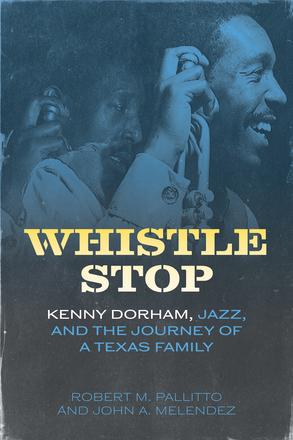
Robert Pallitto and John Melendez’s Whistle Stop, published by University Press of Mississippi, explores the life, legacy and family history of legendary jazz trumpeter Kenny Dorham. Pallitto and Melendez dive into the details of Dorham’s music while also examining the social and political forces that shaped and pressured it, looking at him through the perspective of his peers, relatives and journalists. The book takes a wide view of his story, charting his early successes in the bebop and hard bop eras and his later struggles, dedicating special focus to his innovations as a composer, improviser and instrumentalist. Whistle Stop is a unique book shaped to fit the narrative of a true jazz maverick.
We spoke earlier this fall to discuss the book, taking an unusual approach to biography and Dorham’s contribution to the jazz canon.
Aidan Levy: Thanks for writing this book. It simultaneously fills a void in jazz studies and gives us the details of how Kenny Dorham came to define a particular sound and a particular trumpet vocabulary and built on the work of the bebop generation, even as he was one of the architects of that movement. But it’s also a migration narrative. And I’m wondering why you decided to foreground his family so much and his Texas roots, which is part of the title of course, Whistle Stop, Kenny Dorham, Jazz and The Journey of a Texas Family.
Robert Pallitto: I think that part was the genesis of the project for me, even before John was around. I was really fascinated by Kenny Dorham’s playing when I was an undergrad trying to learn how to play jazz trumpet. So, I got all of his albums and I would see these quotes from a text that sounded like an autobiography and over the years I kept thinking about the connections between his music and where he came from. Eventually, I found the text and it was just a short essay for DownBeat from 1970 that he wrote. I guess he wanted to write a full autobiography but ran out of time. So, from those notes leading me to the essay he wrote, it was just so clear how important his roots were to him. It comes out in some of the ways that he talks about his life but also in music, obviously in the album, Whistle Stop, but other albums too.
Then, when John and I decided to do this project, we just realized how much was in the roots part of it. I made a couple of trips down to East Texas and saw the place where he grew up as a smaller child, before he moved to Austin as an early teenager. Then it was really clear to me how much this is a part of who he was, you know, where he came from, geographically. But also, being a part of a family that came to East Texas enslaved and then prospered later and then lost some of what they had but also were really tied to the land. I have been interested in music for many years but my day job is being a political science professor, and some of the things about migration and the Jim Crow era and the Civil Rights era are things I write about and study. So I was also comfortable with that part.
John Melendez: The only thing I was going to tack on here is that in the middle of working on this, I saw Questlove’s documentary, Summer of Soul, and I feel like I was kind of struggling to explain to people the connection between our book and that documentary. But in doing some of these interviews and thinking about it a bit more, what we were trying to do is show how his background was important to his music and to the trajectory of his life.
When I saw the documentary, I was really struck by the way he was able to capture normal lives and the way it was not just highlighting the extraordinary narratives of the musicians who were performing but also the people who were in attendance and people whose lives were touched by the music or who had relationships with the musicians. And that’s when that part of the book sort of clicked for me, in that context where it’s not just foregrounding the extraordinary individual, which I feel like is often the structure of these books and stories, but it is also capturing the social fabric around them and the people who make it up.
Yeah, I find in the jazz community there is a tendency to deify our canonical figures. And Kenny Dorham is one of them, although he has been overlooked throughout the history of the music since he burst onto the scene. But what gets glossed as a result of that is some of the hardships that go into it, and the sacrifices that need to be made in order to forge a life in this music, because it’s deeply challenging music. What I will say is that Kenny Dorham, as one of the harmonic masters of the art form, exemplifies a certain kind of mobility through the harmony on the trumpet. So much of this book is about geographic mobility and immobility. Even the title of the book gestures towards that. I’m wondering if you can speak about that a little bit.
John Melendez: I think part of what we talked about with the mobility question is that there are almost two ways of reading this story. There is the sort of optimistic, and I think more typical, take on it which is that he faced these extraordinary hardships but look at all of the music he was able to compose and play and the mastery he was able to attain of his instrument. Look at the moments where he rose above that adversity and struggle. I think the other way to read it is, you know, he was an artist who was in this incredible crucible of pressure who didn’t get the financial support that he deserved, and he watched other people get. I think that was a central question of the book and one of the difficult elements of working on it on an emotional level, which is that he was able to do so much with the resources he had but is sort of a tragedy that his work wasn’t recognized for what it was, the way it is now. You know, the way people speak about those albums and songs today.
Robert Pallitto: There’s this other kind of mobility too. Like, he moves through so many musical traditions. First of all, taking in some of the country music, in a really broad sense, the music people were playing in the country, not “country” music but blues and some of the other things he was he was hearing. And then he goes through the big band world and then into bebop and then into modal jazz. And then the other thing, which is something I got from John’s interviews with different trumpet players, is how his ideas have become so mobile. They’ve migrated into all of these different styles of playing, like David Weiss was saying that he learned all of Kenny Dorham’s solos in college but now, the way he plays, you wouldn’t think of him playing like in a hard bop or necessarily even modal vocabulary. I feel like that idea of mobility is so interesting because there is a geographic mobility but also the way he moves through all of these musical worlds.
Just to continue with the geographic mobility side of this, how did you fill in some of the gaps in his genealogy and in the family history? Because he does have the fragments of an autobiography, but there is so much rich detail that you’re able to bring out through the historical research. And I’m wondering how you did that research and if you could share some of the surprising details that stood out.
Robert Pallitto: One of our research librarians pointed me to census records and the stuff was just kind of jumping out at me. Like in 1870, his maternal great-grandfather was in the Fairfield area and he owned land and he was able to help his sons own land. So, I got all of that from the census records. And then when you followed through from 1870 to the next census, you could see the family kind of deepening the roots. We’ll never know for sure, but it looks like the Mannings, on his mother’s side, were brought to East Texas enslaved and then they maintained contact with the Manning family who had enslaved them even after Emancipation. And then the deed records in Freestone County Courthouse show all of these land transactions and some of them are photocopied into books. You can see how they’re buying and selling land and land is being taken away from them. So just going through the index and then finding all of the deeds with Manning parties involved and seeing how the land was either acquired because his great-grandfather had a lot of kids and the male children purchased land all around this Butler area in Freestone County. And then eventually you can see that the land is transferred to someone else. And there were court records where land was taken by plaintiffs through court actions. So those two big sources were the census records and then the deed records for the county.
What comes out in the book is that the Manning family essentially gets swindled or coerced out of the land they had acquired, to the point that it becomes impossible for them to build any generational wealth. The question that it raised for me immediately is, how does this relate to Kenny Dorham’s potential to forge a successful career as an artist? He had all these health problems later on and he had money problems and they were sort of compounded by his personal problems. But, if the family had land from the 1870s all the way into the 1960s when he was struggling, potentially they would have had more resources to help him. His dad died a couple years before he did, and his mother lived quite a long time into her nineties and into the 1990s. They moved from Freestone County to California and then back to Austin. When I was in Austin, I found records showing that his father was working as a doorman at one point. McKinley Senior (Dorham’s dad) was an incredibly skilled person with all of these things that he could do. Part of it, I think, was his work ethic, but the other part of it was just finding a way to make a living. You get older, your body isn’t as strong, so you find a job that’s not demanding.
It’s almost like there’s this snowball effect where they lost what they had, and they just couldn’t get out of this place. They’re in Austin, they’re living in the same apartment, and they don’t own a home. They did own land at one time, but they don’t own a home now. This path dependency from the land theft all the way down to struggling to the end of their lives. There’s a lay historian, Evelyn Lawson down there in Freestone County and she’s done a lot of work there. She was very helpful. But something she told me was that when she, as a Black woman, would go and research these land transfers, she would get hassled and one of her colleagues was beaten up for looking into the theft story. So it’s amazing how the grip on this land, which is part of our national history, is still there, even when there’s not as much of a stake now. You know, she’s not looking to buy land, she’s just trying to understand what happened.
Just to continue on this thread, I’m thinking about two albums, Whistle Stop and Una Mas. How do you see those related to geography? There is this idea that geography is fate. Ralph Ellison talks about this, and he’s sort of glossing Heraclitus, the idea that you could never step in the same river twice and that kind of thing. But it comes out in Dorham’s music, the family history, where he has been, his own peripatetic life. So when you think about who Kenny Dorham was, if you don’t know who he was, it doesn’t jump out at you that “Una Mas” [the song] would be the kind of piece that he would have created. But, of course, it is. I’m wondering if you could talk about that a little bit?
John Melendez: I mean they’re kind of a study in contrast, right? Because Una Mas, to me, is sort of the culmination of what he started with Afro-Cuban, maybe not of all of his pieces with a sort of Latin groove, but his ability to incorporate Brazilian and Afro-Cuban rhythms into his compositions and playing. That album is so interesting too because I feel like you hear this other dimension of his playing, even though the reviews take this position that he’s beginning to sound sort of worn out or tired, but I hear this dimension of space and maybe some modal exploration that hints at where he might have been going. I think you hear that in the next album, Trompeta Toccata, as well. It also represents what he got out of his trip to Brazil in the sixties, that we talk about in the book, and some of the stuff he picked up there and was finding a way to make a part of his idiom. I also wrote a lot about how that album is a glimpse of him playing with one of the biggest rhythm sections of the sixties, with Herbie Hancock and Tony Williams. You hear Tony Williams doing all of this really incredible stuff with Brazilian rhythms that you hear him do with Stan Getz later on.
So, if that album represents possibility and codifying new ideas into the language, Whistle Stop, in a sort of not programmatic way, is him bringing it back to those roots, to where he’s from. He’s writing about the landscape but not in a kind of, “the sun is rising and here is the trumpet theme that represents that.” This was in the book section about Henry Threadgill and his titles, it’s not a one-to-one representation, it’s more that he’s painting these landscapes of his hometown and also continuing to come back to his blues vocabulary in a way that feels very elegant and unforced.
Those albums are a great highlight of the different sides of his playing. For me too, it’s also sort of a toss-up between those albums because Whistle Stop is probably his most polished, most complete album but Una Mas is my personal favorite and I always have a little bit of a hard time with that element of uncertainty. Trompeta Toccata has that as well where it’s like, where could this have gone? There are things that he was experimenting with that that we just never got to hear the end of.
People talk in the jazz community a lot about the Texas Tenors, Illinois Jacquet or Booker Ervin, the Texas saxophone sound. If you think about Ornette Coleman, he almost has this kind of this “big sky” sound. You can think about Skies of America. You don’t hear as much about the Texas trumpet sound. Is that something that you hear in Kenny Dorham? And is there a kind of Texas sound in his music?
John Melendez: We definitely felt like there was. Another person I kept thinking about, someone else people try to imitate but don’t quite get, is Dewey Redman. The way that, with Old and New Dreams or other groups, as out there as he can get, he always circles back to the blues. And we do think that about Kenny Dorham as well. Looking at his solos, you can see he would play some very hip sort of bebop, scalar thing and then his ideas would, in short little phrases, keep coming back to that blues vocabulary. It’s a subtle part of his playing and something that I think can be hard to assimilate for people trying to imitate him.
Robert Pallitto: I mean, this is really subjective, but I hear a connection between his trumpet style and Blind Lemon Jefferson, you know some of the runs and the way he used space. The other thing is, and this maybe cost him with the critic’s estimation of his playing, but he liked to play with the sound in a way. You think of someone like Clifford Brown who played trumpet with a very clear tone and sometimes he would bend notes and use vibrato, but mostly the sound was transmitting his ideas. But with Kenny Dorham, he would play with the sound in these ways, like half-valve things and swelling a note by breathing into it or sliding up and down. It’s not that nobody else did this but when I hear him do that, I do think of Texas blues guitarists. You can do a lot more with the guitar but it’s like he was trying to do it with the trumpet. I can say personally it’s very difficult. Some people are down on his sound because it’s not as pure, for lack of a better word. But I think some of that was deliberate. He was trying to say how can I play more than one note at once? Or how can I play in-between, half step notes? Again, it’s subjective but that’s something I hear after listening to him a lot.
I’m also thinking about Kenny Dorham the singer. I think most people know about that. Can you talk a little about that and how it relates to his trumpet vocabulary?
John Melendez: Well, to start with the obvious, This is the Moment! is a great record. His performance of “I’ll Remember Clifford” is beautiful and affecting, especially knowing the personal context between them. To me, the album was kind of a key to understanding his approach and how lyrical his playing was and the similarities between his trumpet and vocal phrasing. Particularly in the way he would approach ballads and the care he would put into the phrasing there. Once I heard it, I couldn’t forget it, the way he shapes his ideas there. We talked about that a lot too with That’s Him, one of the albums he did with Abbey Lincoln, hearing the way he fit so naturally into that ensemble and the delicacy of his choices there, mirroring her singing of the melodies. The connection is sort of undeniable, and I think that makes those albums so interesting to check out.
Robert Pallitto: Yeah, and on “This is the Moment,” when he sings “Since I Fell for You,” he does some of the same things with his voice that he does with the trumpet. Like on a sustained note, he’ll have the note swell or go a little bit out of pitch deliberately and come back. So it’s interesting; it’s almost like he’s playing the trumpet but he’s singing.
Yeah, it was amazing to hear him do that and hear the resonances between his trumpet style and his vocal style. You also demystify the circuit of influence and artistic exchange that Kenny Dorham is really the center of. You tell the story of Dorham sitting in with Miles Davis at the Café Bohemia and I’ve pulled up the quote here from the autobiography:
“Kenny was a hell of a trumpet player—great style, all his own. He never got all the credit he deserved. After I got through playing, I introduced Kenny, who came up and played just like a motherfucker. Just kicked whatever I had played right out of everyone’s head. So I was mad as hell, because nobody likes for someone to come on their gig and show them up. Jackie McLean was out in the audience and so I went up to him and asked him, ‘Jackie, what did I sound like?’ He looked me straight in the eye and said, ‘Miles, tonight Kenny is playing so beautiful, you sound like an imitation of yourself.’”
I’ve noted that this is maybe one of the instances of the expletive that we hear and read so many times in the autobiography that feels fully earned.
Can you talk a little bit about that moment and what it reveals about Dorham’s persona and also his mastery?
John Melendez: I remember years ago, before we worked on the book, when I read that anecdote and I was just kind of struck by it because by the time I got to the end of the book I realized it’s a short list of people he compliments! He talks positively about Louis Armstrong, Charlie Parker and Tony Williams. And then he tells this story. I remember thinking, you must really hold this person in high esteem. On the Kenny side of things, I think what it reveals is that he had so much control over his vocabulary. I think he gets pigeonholed sometimes in a certain idiom and what I find so interesting about this story is that I can imagine, just from some of the more minimalistic things he plays, he could have played in that style. To me, it’s kind of evidence that he had the ability to play in other people’s idioms. He wasn’t just playing the way he did because it was the only thing he could do.
I mean, I also think that although Dorham was a master of the ballad, he had this effortless technical virtuosity that everybody on the scene took note of, especially Miles Davis. My sense is that a night like that, but also just his being aware of Kenny Dorham to some extent, influenced Miles Davis to go deeper into texture. Dizzy Gillespie as well, obviously, but Kenny Dorham right in there who’s just a master of the bebop vocabulary and a just a virtuoso on the trumpet.
John Melendez: Definitely. He was in what Dave Liebman calls “King Arthur’s Court” of trumpet players, you know, people who had this amazing level of facility. The other thing that’s kind of funny is that I think this is a side of him we both admire. He had this kind of quiet confidence. He’s not the person who’s going to throw the cymbal. He’s not going to humiliate people on the bandstand, and he was so supportive of younger musicians, which comes up in the stories in the book. But he did have this element of like, you’re not going to tell me that you’re better than me. And it comes out, I think, in this way, which is not so much an in-your-face response but is something where, ok, if you give me the opportunity, I’m going to get up on the stage.
Robert Pallitto: For sure. I was just thinking about one of the later interviews that Lewis Porter unearthed, that we used, from the end of Dorham’s career. And he’s clearly seeing, you know, he’s past any kind of peak and his health is not good. And the interviewer asks him, when you got to play with Max Roach, wasn’t that the greatest thrill? And he, you can almost hear it in the tone of his voice, said, no I was just doing what I’d been doing for many years. It’s not like I was given this great honor. It was a great opportunity, but I was at their level already and people knew that. And it’s like even in this short part of the interview here, I’m kind of frustrated, why are you thinking that Max Roach and Sonny Rollins are here and I’m just trying to climb up there because I played with them before. They respected me and so it’s not a surprise I got to be in that spot at that time.
And it’s sad because he’s fully aware of it. But he also knows that at least the critical world was not aware of it. And yet, and we say this over and over again in the book, every musician we talked to has this deep, deep respect, without any exception, for him. But the critics don’t. There’s this sharp line between what musicians think and what critics think.
He was pigeonholed as a musician’s musician. And you talked about how people might ask him, what was it like to play with Max Roach and Sonny Rollins and try to scale those heights? But that’s not how Max Roach or Sonny Rollins felt about it. I can definitely tell you that’s not how Rollins felt about it. He revered Kenny Dorham and Dorham had some years on him. Coming up and performing in Brooklyn as a teenage prodigy, Rollins became aware of Dorham and he learned from him. So many people learned from Kenny Dorham. Can you maybe talk about any of that, but specifically about Kenny Dorham as a mentor to other musicians?
John Melendez: That was honestly one of my favorite parts. When people ask about the big surprises of the research, there’s the technical music stuff and funny stories and difficult aspects, but the nicest surprise was hearing people talk about the way he taught and mentored. I mean, getting the chance to speak with Sonny Rollins, he talked about the relationship that they had, the way that it was a friendship and a mentorship, how they were playing together all the time and how he would go over to the house and spend time with Dorham’s family while they were working these things out. It was really affecting.
We heard stories like this again and again. Talking to Lew Tabackin, he described recording that live album, Toshiko at Top of the Gate, with Toshiko Akiyoshi, his wife, and Dorham. He also talked about encountering him at a jam session and at Manny’s Music Store and his being supportive and giving him some advice. Likewise, John Eckert, who took some lessons with him, said that Dorham gave him these technical building blocks and explained how to work on different things, just being very welcoming while also encouraging Eckert to not just copy someone else’s sound, which he thought was a personal thing.
What I was the most struck by, and I think this comes out in the way he talks about the Lenox School, is that I think he recognized where we were headed with jazz education. And was on the cutting edge of that. You see when he’s doing some of those camps and he’s starting to look at some of these university programs and seeing the beginning of that system. But I think he really appreciated what these participants were getting. I mean he says, I would have loved it if Charlie Parker or Dizzy Gillespie had been open with me in the same way. Not even as a criticism but just that I had to learn everything off of their records and they didn’t really talk to me in that way. And so, if I had had this opportunity, that would have really meant something to me. And I feel like, that could have translated into gatekeeping or some cutting session, sort of thing, like let’s play “All the Things You Are” really fast in F sharp or something. But for him, he was very much like I want to give people this opportunity I didn’t have and I’m going to be supportive and give you the tools that I have to work on different concepts.
Robert Pallitto: One thing that makes me really sad is that on the one hand he loved teaching, and Phil Schaap made this comment in an interview about how he kind of ran the scene of bringing younger musicians into the music. And, I don’t know, that may have been an overstatement but people like Jackie McLean and John Lewis got into a secure teaching position at a university level and Kenny Dorham, for a combination of reasons, was just aspiring to finish a college degree and maybe teach in public schools in New York. Obviously, that’s a very worthy thing to do, but it’s not going to give the same kind of financial rewards and recognition and opportunities that Jackie McLean had at Hartford, or Jimmy Heath had. So, he really wanted to teach but his vision for how to actually do that as a vocation was so different and difficult. The part that struck me as overwhelmingly sad was that he was trying to get into the UT jazz ensemble and I’m thinking, you know, you’re Kenny Dorham and this is a college jazz ensemble and you’re asking if you can get into it because of how your life has gone and what your opportunities are. That was really striking, the disconnect between wanting to teach and the kind of teaching that some people were able to do and sustain their lives and raise their families, even back then in the sixties and seventies.
Yeah. I don’t know if there is much documentation of Kenny Dorham’s influence on John Coltrane, but there is John Coltrane’s song “Like Sonny” from Jazz Contrasts. What I mean by that is that the song “Like Sonny” takes a few bars of Sonny Rollins solo from “My Old Flame” on Jazz Contrasts and bases the melody off of it. So, to me, that song is “like” Sonny but it’s also “like” Kenny.
Robert Pallitto: Yes. I know the part of the Sonny Rollins solo that generated it. I never thought of that connection, but I can hear it in my mind right now.
Can you talk about the process of writing the book?
John Melendez: Sure. Well, you had this idea, like you said before, before I was on the scene. Then, during the pandemic, we talked about what it could look like and sort of laid the foundation for how we wanted to approach this. I think we were both in agreement that we wanted to do something that wasn’t a book-length Wikipedia page kind of thing. Obviously, that has value too, but we wanted to do something that had a broader scope. In terms of the actual writing, we split up some of the sections based on our interests and backgrounds. You can see initially that some of the chapters are a bit more split and then as the book goes on, especially towards the end, it’s a mixture of different sections. We found that there are some moments where maybe you can tell who is who, but we really tried to find a voice that was consistent throughout. So not just doing the alternating chapters sort of thing but having a style that was meeting somewhere in the middle.
Robert Pallitto: I think it’s fair to say I was obsessed with the family history part. And that came first from his references to it in the autobiographical piece and then, the more I dug into it, I became more interested in trying to make that connection. Like, where did he come from? But I feel like I was relying on John a lot. He has more musical training and performance experience than I do. When I was undergrad at Rutgers I studied trumpet for a bit with William Fielder, who taught Wynton Marsalis and, later, Sean Jones. But then I went in a completely different direction career-wise. I had some trumpet lessons, studied and played in an ensemble at Rutgers back in the eighties but my career went in a totally different direction. So that explained why I really zeroed in on some of these historical currents but also how I was really leaning on John to talk about the experience of performing and the theory parts of the book, because I never really got any formal training in theory.
Well, I just wanted to thank you for writing this book. It’s important and you were able to talk to some folks who no one would have talked to about Kenny Dorham had you not done this. I think this is not only a vital resource but it’s also just an excellent read.
Robert Pallitto: Well, that’s a big compliment coming from you.
John Melendez: Yeah, thank you again.
It was great to go back to the music. I was listening all the way through it. Kenny Dorham contained multitudes and you really show us the many layers to it, to his sound and his artistry.
Aidan Levy is the author of Saxophone Colossus: The Life and Music of Sonny Rollins and Dirty Blvd.: The Life and Music of Lou Reed, and editor of Patti Smith on Patti Smith: Interviews and Encounters. A former Leon Levy Center for Biography Fellow, his writing has appeared in The New York Times, The Village Voice, JazzTimes, The Nation, and elsewhere. He is an Assistant Professor of English and Director of the First-Year Writing Program at the University of Saint Joseph in Connecticut. He received his doctorate from Columbia University in the Department of English and Comparative Literature, where he served as co-convener of the African American Studies Colloquium and worked with the Center for Jazz Studies. For ten years, he was the baritone saxophonist in the Stan Rubin Orchestra. He lives with his family in West Hartford, Connecticut.
This post may contain affiliate links.