


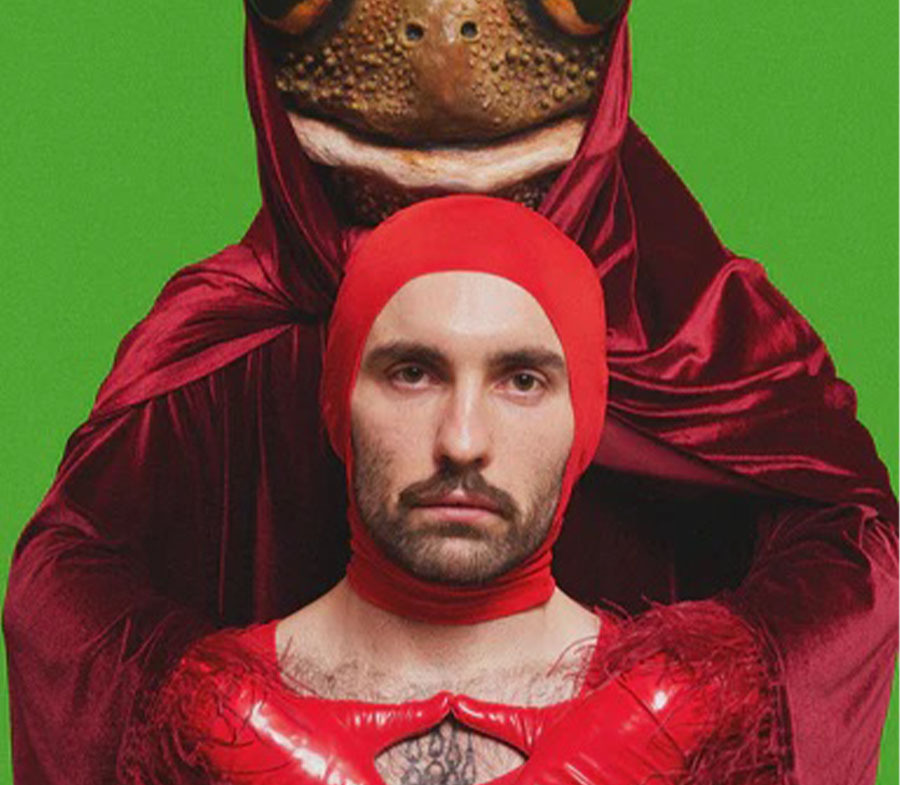
Every October, my husband and I drive north to Salem, Massachusetts to visit our friend who makes and sells jewelry at the annual Salem Night Faire. The event—which takes place over the course of two weekends at Pioneer Village, where the 17th century scenes in Hocus Pocus were filmed—is sparkly and spooky, lots of fog machines and fairy lights, with dozens of artists and craftspeople vending their wares while performers, donning masks and black robes, dance, tell stories, and read fortunes. It’s fun and Halloween-y, and also dark and a little morbid, which is exactly how you can describe the work of artist Bill Crisafi, who you can find at the heart of the Night Faire selling prints, shirts, and plushies featuring his entourage of characters: sexy frogs wearing witch hats, jack-o-lanterns with enormous boobs, a toad dressed like a Russian grandmother, and a demon in a red thong.
I bought one of Bill’s prints the first year I went to the Night Faire, and it’s been hanging on the wall of my home office ever since. A black-and-white drawing of a stylish angel of death, her black cloak swooped to the side, revealing one long sexy leg and a high-heeled foot, with the caption: “I put the bitch in obituary.” This is the Glam Reaper, and now she has a book of her own.
The Glam Reaper’s Guide to Slaying: Life Lessons for Rebellious Souls was published at the end of August, just in time for spooky season, but it’s really a book to be enjoyed year-round. I laughed, I cried, and I was reminded that life is short but friendship is eternal, so grab your gang and hold on tight. Having admired Bill’s work for so many years now, I was thrilled that he was able to take the time to chat with me about his new book, my girl the Glam Reaper, how art can help you process grief, and the importance of having a creative community.
E.B. Bartels: Okay, so, I have a million things I want to ask you about, but let’s start with your book. Congratulations on its publication! Have you always wanted to write a book?
Bill Crisafi: It’s always been something I’ve wanted to do—I imagined myself writing a children’s book, so it makes sense that the result is sort of like an adult children’s book–but actually I was approached by Penguin UK to write the book. When I got the email, I was like, “This has to be fake.” Honestly, the whole thing fell in my lap in a way, but it pushed me to figure it out as I went.
Were there certain artists or authors you were channeling while you wrote The Glam Reaper’s Guide to Slaying?
I’m such an Edward Gorey fan, and also, visually, I like to keep myself entertained, so I added in a bunch of references to some of my favorite films and paintings and pop culture things throughout the book. Like there is one moment where Miss Phillip is swimming in a pond, but she looks like Ophelia. There are lots of fun little things like that which keep me occupied. I’m also heavily influenced by drag culture, so you see the characters reading each other and stuff like that.
I also read that your mom also played an influential role—how so?
Right away when I started working on the book, I knew I wanted to give the Glam Reaper my mom’s personality, and I got to tell her that before she passed. My mom was just this no nonsense, take-no-shit sort of lady—but also really loving, really emotional, for better or for worse. But then my mom died midway through writing the book. She’d had small cell carcinoma, but she actually passed due to complications from pneumonia, because she was so weak from all of her treatments.
I have to be honest with you—when I was writing before that happened, I hadn’t really fallen in love with the book yet. I was having a good time doing it but it just felt like work. But she died right before I did the Babushka Toad section, and that was when my mindset changed. I was thinking about paying attention to the little things that make you happy, or being thankful for the sun on your face, and so writing that section was really cathartic and super emotional. I left the gym one day and just jotted it down on my phone walking home crying, and that was when I was like, okay, I love this. Babushka Toad is my favorite section of the book because of that.
The Babushka Toad section was also my favorite! Though I also feel like I already loved her going into the book from seeing her at the Salem Night Faire. Can you actually speak a bit about that—how the characters in the book evolved from existing characters you’d already created?
I’ve worked with all of the characters for a while, and each one sort of represented an idealized version of me or something I want to project into the world. I almost use them like little amulets of positive energy. So, for example, when I drew Slut for October—the orange frog with the witch hat bikini—I was like, this bitch does not give a shit. She’s like, I’m here, I’m wearing this crazy outfit, but I’m unbothered. Her facial expression in my original drawing is just her staring off into the distance, disassociating.
A lot of my drawings in general are something that I would do as a prerequisite for making a costume, or that I’d imagine myself dressing up as. So, when I started writing the book and wanted to develop the characters a little further beyond being bad bitches, I asked myself, how are they going to need to learn how to slay? And I was like, well, I guess I can just give them all of my actual insecurities. It was kind of fun to think of things that have bothered me about myself over the years and put them into the characters. So, yeah, they’re not just all-powerful—they have problems too.
There’s nothing revolutionary about the insecurities, but it’s all things that I feel like we deal with on a daily basis. I’m not a therapist. You’re not going to open the book and actually get like insane therapeutic help, but it’s a fun reminder. I need reminders all the time! I wanted readers to be able to turn to one of the pages and laugh and be like, “This is so stupid and it’s so right.”
Totally. Okay, but now I really need to talk to you about Massachusetts. You grew up in Salem?
Around Salem, yeah.
I’m also from Massachusetts, and so I need to ask: do you feel that there is a particular New England influence on this book or your work in general?
Do you mean an influence like the haunting landscapes, or like how a like New England family deals with conflict?
Both, I guess! A lot of the advice felt like things my Massachusetts grandmother would say, like get over yourself, you’re fine.
For the outer world, my work is definitely influenced by the haunting feeling New England has in general. This book is also like a silly interpretation of my nostalgia for what Halloween was like as kid, but I think my older work speaks more towards whimsical stories about ghosts and witches.
But for inner world, like internal conflict, there is a feeling of holding everything in until you’re ready to explode. Maybe not the best way to deal with things, but it’s absolutely ingrained in me and it’s something I’m trying to fix.
In some ways the book did read like somebody who grew up in a New England family and is now working through the experience in therapy. But you don’t live in New England anymore, right? You’re in Chicago now?
Yeah, I’ve been in Chicago since 2018, but I go back to Massachusetts every October—sometimes for the whole month or at least just for the Night Faire. A dream of mine has always been to open a store there—I’m very much attached to the area.
One of my favorite things about the book was how all the characters are in community with each other—how the Glam Reaper is picking up her friends as she goes, and they’re all supporting each other and cheering each other on. I’d love to know what your community is like—who do you turn to for support as a person and an artist?
Back in Massachusetts I have so many creative friends—now I have a group in Chicago too, but I was on the outside for a while because I spent so much time here working by myself. But when I first moved to Salem with my friend Jamie, we went knowing we already had a small friend group of artists and creatives there, and then it just blew up. There are so many in such a small area, and in that way it’s super motivating to be around that energy all the time. My friends Matt and Ryan are the ones who put on the Night Faire every year and I’m so happy for their success—now they’re doing a masquerade ball on Halloween too. Chicago is comfortable, but I miss the pulse of creativity in Salem—it makes you, not competitive exactly, but it makes you get your ass in gear. You get inspired by each other! And every October I’m so excited to be back in that environment again.
Well, I’ll be sure to come find you when I’m at the Night Faire!
Yes! Please come say hi.
E.B. Bartels is a nonfiction writer, a teacher, an editor, and a former bookseller with a BA from Wellesley and an MFA from Columbia. She is the author of Good Grief: On Loving Pets, Here and Hereafter (Mariner Books/HarperCollins), a narrative nonfiction book about loving and losing animals, which has received positive press from many media outlets including The Associated Press, NPR, The Boston Globe, WBUR, Kinship, Psychology Today, and the American Kennel Club, and which has been translated into Korean. Her essays and interviews have appeared in Salon, Slate, WBUR, Literary Hub, Catapult, Electric Literature, The Believer, and The Rumpus, among others. E.B. lives in Massachusetts with her human and non-human family members. Visit www.ebbartels.com or follow @goodgriefpetsbook on Instagram for more information about E.B.
This post may contain affiliate links.