


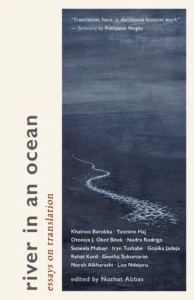
River in an Ocean: Essays on Translation – Nuzhat Abbas, ed.
[trace press; 2023]
This review was originally published in the Full Stop Quarterly “Tender Tongues,” edited by Natália Affonso. Subscribe at our Patreon page to get access to this and future issues, also available for purchase here.
“I cannot find a way to say ‘how much I love you’ to my daughter in English. It’s just too dry.”
The bilingual speaker understands the possibility of true exuberance in language. This declaration about expressing love for one’s daughter was uttered by an acquaintance as we spoke about movies, and she wondered how to raise her kid in Europe, where access to the parents’ pop culture was scarce. My friend was scared to confuse her child with mixed linguistic signals. English is the language of power, so she understood that her daughter needed to be fluent in it. But Arabic was the language of her roots. The pressure to assimilate for new immigrants is overwhelming, and parents find themselves with the often thankless task of translating between cultures. There is the constant fear of erasure, and while it doesn’t color everything, it lingers on the periphery.
River in an Ocean: Essays on Translation is an astute collection of writing that provides a singular take on translation as both a profession and a political act. The editor, Nuzhat Abbas, explains in her introduction how the project came together at the height of the COVID-19 pandemic, during a summer of racial unrest that shook most of the Western world, highlighting urgent conversations around violence and decolonization. As such, the work of translation is thrown into high relief in this contemporary landscape. Translation here is not just a way to make a favored piece of art accessible, nor a dry profession for would-be corporate copywriters, or—ghastly to think of—intelligence operatives working in the Global South. As noted by Ibrahim Fawzy in his own review of River in an Ocean, translation is presented as a work of “ethical and political love,” one that requires open engagement with different worlds and moving beyond the self, blurring the lines between translator and subject matter.
This essay collection represents a wide array of languages, regions and histories, covering from Arabic to Indonesian, traversing Chile, Nigeria, Saudi Arabia, and beyond. Language is both a constraint and a generous container of abundance when communicating how we feel in our bodies, in connection to the land, and how humans have historically dealt with the traumas of colonialism, displacement, and migration. Words florid or simple embody the collective concerns of entire peoples, and translation and reflections around it—when done through a feminist, decolonial lens—are an apt power broker.
Between Rebellion and Commerce
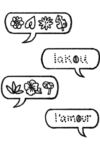
In the first essay, “How are You, Translator,” written by Khairani Barokka, paragraphs in Indonesian are interspersed with their English translations, and the technique is surprising to someone who, like me, is newer to the art and craft of translation. We are reminded of the fact that reading books in translation can sometimes create an artificial sense of distance, even if the content is supposed to help us uncover a different point of view or bring us closer to the subject. Monolingual readers are typically so divorced from the original language that observing the sinuous movement of a curvy script in Arabic, Tamil, or Indonesian against English swirling across the page can feel like a subversive act. The essay is also written in the intimate tone of an in-person conversation with the author— Barokka offers a cup of tea, and says “…I do in earnestness want to ask: are you alright?” She speaks about our bodies, and the impact of the COVID-19 pandemic on us both physically and spiritually. Throughout this “conversation,” she writes about the economics impacting the translating profession, and we, as readers, are guided through a series of poignant ruminations that further underscore the urgency of translation. Employed together, these methods demystify the language that is “othered,” thereby undoing the colonial underpinnings of more traditional translation work.
A few other essays in the book employ a similar method, such as Yasmine Haj’s “Rast.” Haj’s essay is composed of impressionistic segments that poetically capture different aspects of translation, and the ways it speaks to the bifurcated identity of a Palestinian living in Israel, one who is fluent in Arabic, Hebrew, and English. Haj outlines the way in which manipulating a few characters here or there in written Arabic makes the Israeli government and its dictates seem feeble, and less like an all-powerful entity that determines the minutiae of daily life for Palestinians. These punctures in the armor of those in power are presented in a humorous way, while also stressing the rebellious potential of translation. In the space of just a few pages, she draws from themes and motifs as wide ranging as motherhood, love, cartography, jokes and rebellion to demonstrate the ability of a translator to move nimbly from one state of being to the next, from one language to another. But, because language is so heavy with history, it often brings about waves of nostalgia and pain. On what the Arabic language represents to her, she writes:
Arabic is all the moments snatched away by borders, colonization, and other languages that descended on us from heaven, or some in-between hell. Arabic is all the jokes we couldn’t tell, the stories we couldn’t share, or co-create. It is all the cities and towns we had to leave and rebuild. All the places we are forced to call home.
Translation is a distinct form of resistance, a way to deny the erasure of culture by colonial forces. It is a way of preserving proverbs, customs, terms of endearment, and a whole way of life that is obscured by land grabs, forced displacements, and scholasticide. All while acknowledging the heartbreak contained within the original language; a pain that could be somewhat dulled through translation, without incurring a loss of meaning.
Translation is also a professionalized realm, and the writers featured in the collection contend with its nature as a viable career prospect. As in other professions, translation involves, as Barokka puts it, “the calculus of ethics versus feeding oneself…the identical dilemma of so many millions of people on Earth.” Each of the writers featured in this volume faces the ethics of translating within a capitalist sphere, advocating for a more revolutionary understanding of what translation can do, while balancing the quotidian concern of making a living. Labor must be paid for, but often the book publishing industry won’t make space to celebrate a foreign work by translating it unless it fits a certain narrative—often an essentializing one—about a people or culture. Translators with a decolonial impetus usually come to the field with an idealistic bent that unfortunately might become hard to realize, given the constraints of the industry.
Throughout River in an Ocean, the translators grapple with the capitalistic machinations that drive much of the publishing industry, and these tensions feel especially striking in light of the different discussions centered around safety: working from home, trying to escape a pandemic that only served to underline structural inequalities, while remaining committed to amplifying marginalized voices despite a clear lack of funding from the powers that be. The desire for security is a deeply human one, but the harsh realities of the outside world often impinge upon the studious, solitary work of translation.
Written onto the Land
The topography of the land we inhabit is inscribed onto the linguistic threads that tie together our patterns of speech. Perhaps one of the richest contributions in River in an Ocean is the way different writers contemplate how language reflects ecology. As some of the essays indicate, this poignant reality further complicates the work of translation, making it at times feel like an utterly impossible task. Nedra Rodrgio’s moving essay, “Crossing Terrains,” emphasizes the need for translating more works far beyond the beaten path (highlighting lesser known writers, focusing on a wider array of genres), while also acknowledging the difficulty in finding words that fully capture life in different parts of the Global South. The ruptures caused by settler colonialism, or forced displacements, inevitably lead to the painful erosion of identity. Rodrigo writes:
When a cultural identity is deeply tied to a landscape through song, poetry, story, or even film, being forced to leave that place, or witness its destruction erodes the psyche. The loss of a homeland is not simply the loss of a territory where one has planted a flag…[there] are ways in which the terrain we inhabit gives meaning to our lives.
The extent to which our day-to-day idioms and proverbs are an extension of the tangible terrain around us is oftentimes buried, forgotten. This theory has a name in Tamil poetics, “tinai,” a discursive turn that Rodrigo comes to again and again in the essay. Through the perceptive eyes of a translator, we are suddenly made aware of the mythologies and ancient stories passed on from generation to generation, and the ways these stories were directly used to describe the landscape, colors, traditions and food to inform how we earn a livelihood, to transmit history, and so on. The work of the translator is made all the more sensitive given this context—how to convey entire worlds without forgetting the land that bore them?
Representation and Authenticity
One question that periodically rears its head throughout this collection is whether translation can truly be an act of decolonization, given the power differential that can sometimes occur between the translator and the original text. Some translators are seen as outsiders looking in, and this duality can spur suspicion, especially towards bilingual speakers who are not hegemonic subjects. Suneela Mubayi, in their thought-provoking essay, “The Temple Whore of Language,” delicately disentangles ideas around authorship and positionality within the field. Immigrants and refugees are viewed as the “other,” people looking to undermine the hegemony of powerful groups in a newly adopted country.
Translation work can mean embodying the gaze of the colonizer and refugee all at once, a reality that complicates the desire for authenticity. As Mubayi points out, to translate is to don the cloak of the perpetual outsider, “I translate because I am not stably anchored – neither in my origins, nor in my cultural affiliations, sense of belonging or my gender. To translate, for me, is to experience being an outsider, a trespasser, a poser – and to be able to revel in that condition.”
Mubayi points to the similarities between being mixed race and trans and being a bilingual speaker, and how these very different forms of existence seem, at times, to elicit the same wary response from others. Erasure is then imposed upon an immigrant or refugee by the adopted country, in an attempt to tame that which feels unknowable.
Throughout the collection, several writers—Mubayi, Haj, Bitek—note that the desire for representation is a major motivating factor for people itching to become translators. At the same time, a self-consciousness haunts many translators working in the mother tongue of their parents, given the lingering question of whether they are able to communicate the secrets buried within language to others, or even if they should. For this reason, some of the writers featured in River in an Ocean have decided to hone their expertise in languages they do not personally feel tethered to in the same way – as in the example of Mubayi, an Indian native English speaker who decides to focus their considerable expertise on Arabic. They still find themselves in an emotionally fraught territory, but its impact on personhood is decidedly different. Translating poetry, literary fiction, nonfiction, and contemporary fiction representing marginalized communities into English and French is vital and a much needed form of resistance, but it can also be difficult to consistently operate within this politicized terrain.
Norah Alkharashi brings up a similar point in her essay, “Translating Courageously,” which traces her work making Edwidge Danticat’s books The Dew Breaker (2004) and Everything Inside (2019) available in Arabic. The essay explores various questions on belonging, language, and power that arose while she worked on the translations. Alkharashi eloquently writes about translation as a way of sharing stories with one another, of collapsing the temporal space between peoples and slowly breaking away barriers. She describes the drive Danticat’s writing propelled within her, to reconsider prescribed narratives and become a “‘conduit’ for transcultural writers.” Alkharashi realized that by translating important books by a Haitian American author, she could also combat the anti-blackness prevalent in some parts of the Arab world, thereby cracking away at societal prejudices. While she considers the idea that “translation [is] a necessary evil for some,” it is nonetheless a vital cultural practice. A “deformation of the original” would only occur if the work is not done with the care and courage necessary to work “toward a shared decolonial future.” This unmooring is fully mined throughout the various essays presented here, belying an honesty regarding the personal challenges undertaken by translators that typically go unnoticed by readers.
Mothering
Translation, like motherhood, entails a level of invisible labor that often escapes the general public. Much like societies dismiss mothering as a natural state entailing little to no effort, translating is taken for granted. It is still rare to find a translated novel that features the translator’s name on the cover. In the Englishspeaking world, incremental changes are being made after years of translators advocating for it, including movements such as #NameTheTranslator. There is something insidious about the way in which capitalistic forces have invisibilized the work of translation, when the process is just as fraught and wonderfully creative as bringing to life something wholly original. Kate Briggs previously made this argument in This Little Art (2017), a book-length essay that posed a number of provocative questions regarding literary translation. That work is referenced in Otoniya J. Bitek’s essay “The Meaning of a Song,” which explores the relationship between parenthood, authenticity, and using the written word as a vessel for these concerns.
The essay is structured as a series of letters to her father in which she shares dreamy impressions of daily life and the creative process (“Today I woke up feeling like a bottle.”) She grapples with the idea of representation, what it means to see something of yourself reflected in the public sphere, and the desire for one’s personal history to be in conversation with other histories, images, and languages. Translation as collaboration – an idea Briggs wrote about, which Bitek references – is brought up here to conjure the synergy of working with other linguistic elements rooted in her parent’s ties to Uganda and Kenya to give a translated text life.
The mother as a source of connection during the translation process is also evoked in Haj’s “Rast.” She compares the desire to be known in the intimate way only a parent can convey as a kind of translation: “to be seen is a reminder that we existed, as ourselves and more.” This line of inquiry raised by Bitek, Haj and other writers in the book further grounds translation as a discursive method within a feminist decolonial framework. The work of a translator is often rendered invisible, and yet it is that very invisibility that conveys a sense of ease for the reader, even as it muddies the waters in terms of authorship. Translators are tasked with doing the interpretive work of transmitting signals from a text produced in the original language, melding them into familiar territory for readers. It’s a complex game, the labor of which tends to disappear into the ether.
Translation and Resistance
River in an Ocean provides a compelling behind-the-scenes glimpse of the mechanics of translation, and the personal toll it takes on translators in light of pressures from the publishing world working in the vulgar twilight of capitalism. It deeply humanizes the translator, shining a bright light on the labor involved, and the passion their work elicits. It is also unique in its centering of translators from the global majority.
There were too many inspiring essays to note in this one review, but the takeaway should be that this book is an important addition to the field, one which foregrounds the intricate work undertaken by translators and the political ideals that propel them forward. In the midst of the erasure and forced displacement of Indigenous peoples by brutal imperialist forces, it’s easy to succumb to an overwhelming sense of grief and loss. But, as a contributor, Rahat Kurd, beautifully puts it “Loss may be our experience, but loss is not our destiny. To translate is to remember how to resist.”
Yasmin Desouki is an audiovisual archivist, writer, and curator.
This post may contain affiliate links.