


Tr. from the Uzbek by Shelley Fairweather-Vega
[Yale University Press; 2025]
Hafez, who lived in Shiraz in the fourteenth century, is considered one of the greatest classical Persian poets. But before he became Hafez, his name was Shamssuddin, and he worked as a delivery boy for a bakery. One day, Shamssuddin’s master sends him to deliver a basket of pastries to a girl who lives in the wealthy district. The package includes a ghazal—the classical form of love poetry, which would become Hafez’s specialty—written by a suitor, and Shamssuddin carries out his duty, and even gets to hand the ghazal directly to the young woman, whose beauty leaves him in a state of stupefied self-disgust. “Never in his whole life, never in front of anyone else had Shamsuddin ever felt a feeling so keen, so hopelessly undeniable.” Shamssuddin can’t bear to look at her and retreats into “the great depths” of shame, and just when all seems lost, some lines of his own verse spontaneously burst forth:
Your sweet mouth spouts Khidr’s life-giving streams,
Your lips are sweetened with the best wine sugar,
There is surely no remedy for this disease,
From the heartache you bring, I’ll never recover.
Having expressed himself and thereby discovered his calling for poetry, Shamssuddin’s “own feelings swelled in him again.”
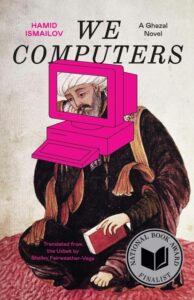
This story comes not from an encyclopedia entry about Hafez, but from a book of contemporary translated fiction with an encyclopedic tendency, We Computers: A Ghazal Novel, by the prolific Uzbek poet and journalist Hamid Ismailov. Ghazal novel indeed: like the ghazal form, this novel is allusive by convention, containing fragments, anecdotes, aphorisms, and plenty of quoted literature and poetry, much of it from the Arabian Nights. Instead of chapters, each division in the book is called a bayt, the Uzbek term for the long independent couplets that together compose the ghazal.
But this book not only reaches into the deep literary past: it is a science-fiction narrative told by an AI agent, a large language model that may have its own ideas about this human product called poetry. We Computers stages an encounter between east and west, past and future, and the literary production of organic and computerized beings.
Hamid Ismailov’s book is a playful burst of a challenge to a literary-critical scene that can’t seem to imagine a path for serious fiction beyond Wikipedia paraphrasing or dripping sentimentality, a scene that at times has been more concerned with novels as status symbols of intellectual elitism rather than reckoning with the texts themselves. Its translation into English by Shelley Fairweather-Vega is one of the most unique and impressive publications in recent years for the linguistic demands of this novel, as well as exciting for its vitality as a piece of literary history (it’s categorized by Yale University Press under “Literary Criticism”).
Hamid Ismailov serialized this project on the social messaging app Telegram in 2022. He has published many books in the conventional way since the 1980s, including a trilogy of historical novels set in Central Asia during the Soviet period: The Devils’ Dance (2017) translated by Donald Rayfield and John Farndon, Of Strangers and Bees (2019) translated by Shelley Fairweather-Vega, and Manaschi (2021) translated by Donald Rayfield (2021), all from Tilted Axis Press. In We Computers, he mixes storytelling with essayistic prose just as he combines literary history with speculative technology.
Hafez becomes the special interest of the novel’s protagonist Jon-Perse, a French poet and researcher who gets involved with student politics and the neo-avant garde Oulipo Group in the late 1960s, then becomes an early adopter of computer science in the 80s. Jon-Perse begins translating classical poetry from Central Asia with his assistant Abdulhamid Ismail, and in the process devises a complex system of computer programs that can assimilate world literature and put out new poetry. The story of Jon-Perse’s techno-literary project, unfolding along with the dramas in his personal life, is delivered by a narrative voice that seems analogous to Jon-Perse’s response to the “dry, serial, and atonal” music composed by his avant-gardist friend Blaise. And this fragmented yet hardy style also articulates an episodic structure with a plethora of sampled poetry and prose from classical Eastern cultures, all translated into English. As translator Fairweather-Vega explains in her afterword,
Jon-Perse is French and speaks French; Abdulhamid Ismail is Uzbek and speaks Uzbek (and French); this is a novel about Jon-Perse and Abdulhamid Ismail in English. This is confusing enough. Now add poetry in Uzbek translated from French, English, Russian, Persian, and Turkmen, all of which needed to show up, eventually, in English…
This novel was originally published electronically, bit by bit, in the Cyrillic-alphabet version of Uzbek, with a few lines of Russian (also Cyrillic), more lines of Turkmen and Kazakh verse (Cyrillic as well), and many, many lines of Persian and Chagatai (not originally Cyrillic).
While mixing multiple languages and orthographies, Ismailov adopts the ghazal as a fabulist conceit for a novel, that is, a novel that follows the poem’s strictures (its use of refrain, the loose nature of its assembly, like “pearls on a string,” the secret encoding of the poet’s name in the final bayt), while keeping its particular, novelistic form, all articulated by “We Computers.” By crafting a novel as a ghazal, that is, structuring a book by the details of a different form of literature, Ismailov is playing a literary game worthy of the Oulipo group, of novelists like Italo Calvino and Harry Matthews. Like their novels, Ismailov’s execution of a self-imposed constraint system lead to genuine surprises, while still leaving room within the dazzling system for pathos and the pleasure of a tantalizing tale. We Computers is a dive into a world of machine-made language, ruled by a consummately computerized mind.
The concept of a writing machine had been taken up in fiction for decades before large language models came into being. Isaac Asimov wrote of an advanced children’s toy called Bard that reads aloud procedurally-generated fairy tales in his 1956 story “Someday.” And in Stanisław Lem’s great book The Cyberiad (1965), Trurl invents a poetry-writing machine that will take the most ridiculous Oulipian prompts. (“A poem about a haircut! But lofty, noble, tragic, timeless, full of love, treachery, retribution…Six lines, cleverly rhymed, and every word beginning with the letter s!!”) Jon-Perse’s own literary Computers have processed the heap of global literary culture. They “could easily analyze the writing styles of Tolstoy, Proust, or Kafka, and in terms of poetry, they could competently compose a haiku or rondeau, but when it came to ghazals, numerous difficulties stood in the way of programming the form.”
Early in the text it’s confirmed that the computer programs themselves are narrating this novel with a collective we pronoun. “Unlike people, We reveal who We are with complete transparency. …[P]art of Our writing process is to run a comparison of an array of selection options, and if Our chosen narration produces a poorer-quality result than might have been otherwise, We don’t hesitate to admit it.” Which is why this text occasionally breaks off and restarts, with terse reasons for the termination spelled out in monospace font, like a computer’s error report. While the Computers present and comment on Jon-Perse’s professional and romantic life, with not a little irony, they also hold him up as their demiurge and teacher. “Jon-Perse is Our author: in other words, he is the creator of Our master control program, and in the course of working with him over the years, We have picked up a little of not just his programming and his poetry but also his psychology.” But these claims beg the disturbing question of how this testimony was generated in the first place. How can we know the Computers haven’t fabricated Jon-Perse’s story, and thereby the story of their own origin? Does the machine produce the man’s testimony as he requested, or is the machine dictating the story and thereby authoring the man’s history? “Didn’t [Jon-Perse] also want to transform his state into the computer’s words? Or are We Computers clarifying his state with all the words We are stringing together?” The question is most salient when the Computers focus on Jon-Perse’s various relationships, his late wife Odette; a second wife Sylvie; a (platonic?) fling with Alina, and the mysterious Nabud, a non-stop storyteller like Scheherazade. Could this sequence be a storytelling machine’s idle exercise in retelling the Bluebeard story?
The puzzle of a metafictional novel composed by a computer program resembles the problem of the man who dreams he is a butterfly and is no longer sure if his waking life as a man is the real thing, and not a lepidopteran dream. Vladimir Nabokov, speaking of butterflies, is the most visible influence for the kind of fiction Ismailov is weaving. As with John Shade and Charles Kinbote in Pale Fire, We Computers leaves its reader fundamentally uncertain who is “real” and who is imagined: both fictional and historical persons and places commingle in a uniformly fictive space: the only certainty is the role of Ismailov as the author of it all. It’s not groundbreaking to observe that all novels have an author, but—and I now argue against the excesses of the “Sociology” side of the debate—it’s worthwhile to remember that while literature may come out of social reality, it uses that reality for its own purposes. Most novels refer to the world we live in and learn about, but all novels have their imagined domain as their ultimate subject and object. This is the essential fact flaunted by the tradition of modernist and metafictional novels, including Nabokov’s literary games, on which Ismailov has drawn.
These basic ambiguities are part of the appeal of both We Computers as a “ghazal novel” and of the ghazal form itself. A later section of the book takes up the critical analysis of a single Hafez ghazal, and the Computers fall in love with the word glimmering to highlight the structural ambiguities of the form. Ghazals were never given titles, but were referred to by their opening line or by the bayt’s repeating terminal word. “Thus, the ghazal both has a name and does not have a name. It is a glimmery kind of thing.” They proceed to revel in this ambivalent quality. The silence of the lover before the beloved is a “frightening” glimmering of death. Colors and objects are never solid matters in the world of the text, for all that counts in the ghazal’s faintly wavering glint of poetic ideas are the words, of which only six in the poem in question refer to anything in “the material world.”
In addition to the lost assurance of a shared reality, one “perceived by the communal eye” as Nabokov put it, what’s also at stake in this book is a long-standing critical debate under the heading of Formalism vs. Sociology. While Jon-Perse has been translating Hafez and other mystical Sufi poets into French, his assistant Abdulhamid Ismail translates French poets into Uzbek, and constantly pesters Jon-Perse for info on the lives of Rimbaud and Verlaine, which of course is irrelevant to Jon-Perse’s aesthetic line.
Specifically, he believed that a poem is merely a compilation of particular words, and it is the reader who endows that compilation with the pertinent meaning. Which is to say that all readers come to a poem with their own intellect, ambition, and experiences, and bring it to life; the poem is just a costume the reader puts on after trimming and tailoring it to their own height and heft.
Literature doesn’t have any content of its own, but is purely an assemblage of functions. This Formalist school of thought, the Computers rightly say, comes from the Russian avant-garde theorists and the Prague school of linguistics. The logical endpoint of such a relationship to literature is enacted in the Fifth Bayt. Jon-Perse digs into the work of Hafez by running the poet’s Divan “through some quantitative testing” with the help of the Computers. (Actual scholars would call this method “corpus stylistics.”) The Computers track the frequencies of references to the different features of the poet’s beloved:
face: 424
eyes: 279
hair: 215
lips: 170
eyebrows: 86
mole: 51
These inventories would be the raw data of literary criticism in a mindset where literature is nothing but a pattern of notations that the past has happened to transmit to the present. And if that were true, then there’s no reason why computers can’t write literature once their programming is set up, and the consciousness, imagination, and initiative of humankind, who had created literature and computers in the first place, are really superfluous epiphenomena. As for literary criticism, or any kind of interpretation? Forget it.
This perspective explains Jon-Perse’s fascination with Hafez, of whose life we know virtually nothing. All we have are his ghazals and whatever speculative stories may be deduced from them, like the one that opened this review. Training the Computers to write new Hafez ghazals, based purely on the ones that exist, is a case study for Jon-Perse’s position. If successful, it would prove the absolute separation of literature and life, and hold out the promise of allowing Jon-Perse to continue to write poetry long after his death. His desires suggest the essential romance of automated writing as the source of inexhaustible creation, as opposed to us mortal scribblers. The appeal of literature produced by algorithm and linear algebra may only work if it’s premised on the belief that literature has already run dry in our present, used up and exhausted as a mine, as Ortega y Gasset had believed a century ago.
But the Computers encounter “difficulties” with putting out lyrics in the ghazal form. Their “glimmering” qualities evade or surpass binary thinking, their patterns of allusions extend their context to realms of ideation beyond ordinary sense. Ironically, “We Computers” know something Jon-Perse doesn’t. For all of his aesthetic formalism, and the need to escape the past that motivates such formalism, the Computers themselves remind us that the magic of the ghazal is that it moves against formalism as a form.
While Jon-Perse may have forsaken philosophy, his own Computers take up the slack, and bring a more ideological dimension of this narrative to our attention. The assistant Abdulhamid Ismail, or “AI,” believes
that authorship and copyright law, as well as “intellectual property,” were Western concepts. According to the Islamic or Eastern understanding, all that exists is the property of Allah, and humans are simply passive recipients or, at best, like the Prophet, merely bearers of good tidings not our own. There is no place in this tradition for ownership or authorship.
The Computers agree with AI, but lest we think they have made a religious conversion, or taken an archaic turn, the collective narrator spells out a secular basis for this critique of private ownership: “We take the side of aggregate or collective art[.]” Against the “glimmering” appeal to wavering ambiguity, which also drives the sliced-up, anatomized presentation of this book, the Computers in this moment resolve the novel’s questions in favor of historical context as well as belief in a totality of artistic truth, though strictly an “aggregate” one. That is, there isn’t a single governing law for the existence of literature except itself, certainly not a notion of individual private ownership.
At the same time, there is a definite link between literature and society highlighted by the Computers, namely in the changes to class society. Our narrators, through the storyteller Nabud, mention that Hafez himself was exiled from the court at one point for the secularist attitude in his supposedly devout verse. (“If all the Muslims act as Hafez knows them to be, / Then alas, no tomorrow will come after today.”) The work of the most significant “canonical” writers, from Hafez to Boccaccio to Shakespeare to Goethe, may not use the material of the world for anything other than the work itself, but these authors did achieve, consciously or not, a farther sight, a recognition of the germs of future social relations within the present. And this is no doubt resonant for Ismailov’s own life and career, having been politically exiled from Uzbekistan since the early 1990s.
While this book of fabulous fragments was an uneven reading experience, and the second half was much stronger than the first (an artifact no doubt of its serialized origin), it is a consistently light and fascinating read, thanks to Fairweather-Vega’s immensely impressive translation. Artificial Intelligence may control the narration in this story world constructed by the author Ismailov, but the narrative that emerges constitutes a fete for human imagination and cultural exchange. Somehow, out of the myriad ones and zeroes, there still emerges a mythos of tulips, the Mirror of Iskandar, and the Cup of Jamshid containing absolute knowledge. By conjuring this mystical world of symbols, the Computers themselves point to a knowledge beyond computation, “something greater even than a supercomputer.” The machine procures an access to spirit, effectively transforming into its opposite. As external objects that have made meaning and made it visible, the Computers have arguably become a work of art. It’s a fitting dialectical cap to Ismailov’s intellectual entertainment.
Alex Lanz lives and writes in Brooklyn. His stories and essays have appeared in Asymptote, Passages North, and the Amenia Free Review. He also blogs on Substack at Silent Friends.
This post may contain affiliate links.