


[New York Review of Books; 2026]
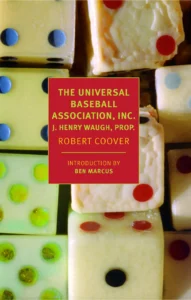
Recently reissued, Robert Coover’s novel, The Universal Baseball Association, Inc., J. Henry Waugh, Prop., breaks down the myths of the “Great American Pastime.” The book follows J. Henry Waugh, a sadsack accountant whose life’s greatest joy is his minutely curated fictional baseball association. He develops a complex system of dice mathematics to determine game outcomes and creates a detailed history for the individual teams and players as well as the league itself that would put most high fantasy lore to shame.
Each night, he brings this world to life, rolling his dice and scrupulously noting each strike, hit, error and run, all the while reflecting on the particulars of each game, player and team, worrying over the inherent balance of this world. Tellingly, Henry neither watches nor listens to any actual games. He does not care about real-world baseball.
The book’s surface-level insight is its anticipation of how athletic fandom would shift. In our new nightmarishly unregulated landscape of sports (and whatever else) gambling, the fan’s attachment to the game has become increasingly individual, in the form of event-specific parlays. People are now able to bet not only on the outcome of games but on the performance of individual players, placing overs and unders on things like rebounds, strikes, and field goals. To these participants, the games have less meaning than the atomized actions to which they have affixed financial significance. Likewise, in an arena I know little of, fantasy sports has increased fans’ engagement by using isolated actions to sum total positive outcomes for a fictional team in a theoretical league. In the reverse direction, athletes are now known to argue with video game designers about their skill ratings in games like 2K, The Show and FIFA.
In a post-Moneyball era, the very “reading” of athletes has shifted away from the eye test to the spreadsheet, as increasingly advanced sports analytics are being employed to determine player value. Billy Beane’s Oakland Athletics proved that, through analytics, you could piece together a team of specifically talented, undervalued players and beat the regular contenders. Likewise, Daryl Morey’s James Harden-led Houston Rockets demonstrated that a meticulous focus on shot efficiency could yield a high-octane offense. The dice reign supreme. There now appear to be more math-minded J. Henry Waughs today than mystical Annie Savoys (love interest of Bull Durham (1988), played wonderfully by Susan Sarandon, a self-proclaimed believer in the “Church of Baseball”). Writing the book in the late sixties, Coover expected it only to appeal to other writers and was surprised to learn of its following, after its publication in 1968, among athletes and coaches, a positive perception which feels more and more understandable with each passing year (and concurrent insider gambling scandal).
The book remains formally fresh as it unfolds on two fields of play: Henry’s drab outer life and the technicolor world of his league. As most reviewers have noted, his baseball sphere overpowers his real world in the texture of the prose. In contrast to Henry’s stultified existence of clockwatching and bus commutes, the fantasy ballplayers swagger and curse in barrooms and dugouts before carrying off dramatic (but statistically reviewed for randomized action) plays on the field. The ballpark receives a more muscular share of language.
In a 1979 interview with critic Larry McCaffery, an early champion of the book and Coover’s body of work, Coover claimed that the world had become increasingly gamefied:
We live in a skeptical age in which games are increasingly important. When life has no ontological meaning, it becomes a kind of game itself. Thus it’s a metaphor for a perception of the way the world works, and also something that almost everybody’s doing—if not on the playing fields, then in politics or business or education. If you’re cynical about it, you learn the rules and strategies, shut up about them, and get what you can out of it. If you’re not inclined to be a manipulator, you might want to expose the game plan for your own protection and ask how it can be a better game than it is at present. And formal games reflect on the hidden games, more so in an age without a Final Arbiter. So it’s an important metaphor to be explored.
Coover is expressing an idea that things like education and politics function with an underlying “game.” This is, effectively, the function of metafiction, the story within the story, in his work here. By presenting us with a determined but fairly hapless creator, Coover cracks open the mythologies around which we build our lives, the rites of the ballpark little different from religious fundamentalism (as he explored in The Origin of the Brunists) or American politics (as he would unpack in The Public Burning). Coover wrote during the heyday of American postmodernism, alongside Thomas Pynchon, Don DeLillo and John Barth, sharing their interest in authenticity. Like his fellow postmodernists, Coover believes that these systems of meaning are simultaneously constructs of varying degrees of flimsiness and fully enthralling to their adherents. Baseball suits him well: it is a game that acknowledges itself as such, as opposed to religion and politics, as portrayed in his other books, which conceal their game qualities to sinister ends.
In the same interview, Coover said that the idea for the book came to him while he was going through a box of his childhood games and founding a tabletop dice game in which he had written the names of fictional players and game scores. He said he could immediately recall each player, in appearance and demeanor, from their name alone. While this anecdote is slightly unsatisfying for anyone hoping for a more theoretical explanation of the novel’s origins, it shines a light on the book’s interior structure. In place of traditional narrative shape and character development, we receive an accumulation of information and fragments, dioramas of familiar baseball iconography. Coover understood the power of the textual world he had created but now, fully grown, he could also appreciate its limitations. The players he had created as a child remained clear in his imagination from years ago but they existed solely in his mind.
Henry lives in an intricate textual world. A typical accounting of a game involves numerous steps:
This done, the posting of all statistics from the day’s play, Henry turned to the job he enjoyed most– writing it up in the Book. He’d begun the logs in Year IX, feeling the need by then to take counsel with himself, though even before that, he had been writing up uncommonly exciting moments on loose sheets of typing paper (glad he did; these later got bound). Now it consisted of some forty volumes, kept in shelves built into the kitchen wall, along with the permanent record books, league financial ledgers, and the loose-leaf notebooks of running life histories.
Henry’s Universal Baseball Association is entombed in dense textuality. No detail is too small. Coover reveals this system as comically overburdened, swelling to the point of spilling off the shelf. By the time we encounter Henry, his world has boundaries well established. This obsessive order becomes threatened by his human attachments. Consider his jubilation for star rookie Damon Rutherford and his perfect game-clinching pitch:
Henry held his breath, walked straight to the table, picked up the dice and tossed them down.
Hard John Horvath took a cut at Rutherford’s second pitch, a letter-high inside curve, pulled it down the third-base line: Hatrack Hines took it backhanded, paused one mighty spell-binding moment—then fired across the diamond to Goodman James, and Horvath was out.
The game was over.
Giddily, Henry returned to the bathroom and washed his hands. He stared down at his wet hands, thinking: he did it! And then, at the top of his voice, “WA-HOO!” he bellowed.
Henry conjures the world with a dice roll and he feels its dramatic arc, both peaks and pitfalls, acutely. The game, as reflected in the electricity of this part of the writing itself, is more real than his life. Damon, a suave superstar, is an object of Henry’s unwavering admiration. Damon comes to represent a logistical issue for Henry. He likes him too much and this fact skews his ability to stay harshly objective. This is a dilemma anyone who has attempted to write fiction about sports will reckon with eventually, scaling down the ability of your players to believable heights. He wrestles with his unconscious favoritism, worrying over whether he is simply recreating predictable story beats: the breakout season, the overly perfect performance on the mound.
Meanwhile, Henry’s exterior life comes undone: he loses his job due to tardiness and inattention. Henry’s control-freak solipsism is most on display when his friend, and sole tether to the everyday, Lou, comes over to participate in the baseball game. Henry quickly becomes frustrated with Lou as he is unable to grasp the complex rules, gets too excited by the wins, talks incessantly about a movie he just saw and grows bored with the methodical slowness of the games. Then, dread, he spills beer on the table:
Lou yawned: “Hee-oooff!” and slapped his hat to the table –bop! the beer can somersaulted and rolled, bubbling out over charts and scoresheets and open logbooks and rosters and records–
“Lou!” screamed Henry…
He toweled up the beer as fast as he could, but everywhere he looked ink was swimming on soaked paper…When he’d got up the worst of it, he sank into his chair, stared at the mess that was his Association. The Pioneer-Knickerbocker game lay before him, damp but still legible.
The moment sends Henry into frenzied despair, as he contemplates the ruin of his narrative world. The Association is a party to which no one else is invited. The fantasy collapses, for Henry, when another individual attempts to take part in the game. They add unwanted variability, disrupting what he views as perfect calibration.
By the novel’s end, Henry vanishes from the page entirely, either having passed on or been completely subsumed by his fictional creation. His whereabouts unknown, the ballplayers hold court. Many seasons have passed and various players have been enshrined as legends of religious significance. Players take sides in the generational squabble and reenact the deadly pitch, now the subject of years of textual analysis, vigorous disagreement and ritual deification (splintered into various sects) within the Association world.
In the novel’s closing scene, Hardy Ingram, a latter-day player and descendant of Royce, receives words of support from Damon Rutherford:
“It’s not a trial,” says Damon, glove tucked in his armpit, hand working the new ball… “It’s not even a lesson. It’s just what it is.” Damon holds the ball between them. It is hard and white and alive in the sun.
He laughs. It’s beautiful, that ball. He punches Damon lightly in the ribs with his mitt. “Hang loose,” he says, and pulling down his mask, trots back behind home plate.
The symbol rejects analysis. The ball eludes the various mechanisms of in-world demystification. The contradiction at the crux of the book is why Coover could not, and did not, explain the book and why he rises above the level of crank-turner metafiction, which primarily revels in pointing out its own artifice but offers little else. He deconstructs the cliches of sports drama, the golden rookie, the pivotal play, the generational tragedy, but refuses to strip them for parts. Instead, he allows the characters to run afoul of their creator, throwing the careful order of his world into chaos, ultimately creating their own systems of meaning within and in opposition to his.
In What Is Sport?, critic Roland Barthes offers a possible explanation of why this friction between the novel’s deconstructive intent and engaging execution occurs:
Why? Why love sport? First, it must be remembered that everything happening to the player also happens to the spectator. But whereas in the theater the spectator is only a voyeur, in sport he is a participant, an actor. And then, in sport, man does not confront man directly. There enters between them an intermediary, a stake, a machine, a puck, or a ball. And this thing is the very symbol of things: it is in order to possess it, to master it, that one is strong, adroit, courageous. To watch, here, is not only to live, to suffer, to hope, to understand but also, and especially, to say so– by voice, by gesture, by facial expression, it is to call the whole world to witness: in a word, it is to communicate. Ultimately man knows certain forces, certain conflicts, joys and agonies: sports expresses them, liberates them, consumes them without ever letting anything be destroyed.
In sport man experiences life’s fatal combat, but this combat is distanced by the spectacle, reduced to its forms, cleared of its effects, of its dangers, and of its shames: it loses its noxiousness, not its brilliance or its meaning.
In Barthes’ ever-expansive reading, sport is many things at once: a safe facsimile of combat, a wellspring of stirring emotion, a transport for collapsed identification between actor and spectator. The sport remains not only beautiful but enchanting. The novel’s ball games may be occurring in Henry’s mind and on his tabletop, but the prose through which Coover summons them is luminous and true to a certain kind of near-universal sentimentality. This Cooverian sensation is embedded in the feeling that arises when I watch the tearful conclusion of a 30 for 30 documentary or witness a deadly, late-game crossover. The moment is never anything we haven’t seen before and yet the response, the leap from the barstool or the couch, the disappointed head shake, is almost Pavlovian in its predictability. While Coover does not come out and say it, he seems to understand well the brilliance of these moments.
John Melendez is a writer and musician based in Brooklyn. He is co-author of Whistle Stop (University Press of Mississippi 2026), a biography of jazz trumpeter Kenny Dorham. His work has appeared in Full Stop, On the Run, and Bluegrass Unlimited.
This post may contain affiliate links.