


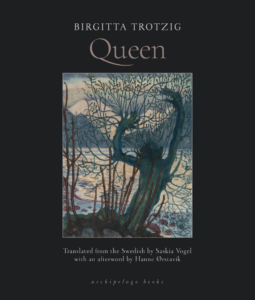
[Archipelago; 2026]
Tr. from the Swedish by Saskia Vogel
When silence and darkness permeate our lives, certainty begins to dissolve. Birgitta Trotzig’s Queen, newly translated from the Swedish by Saskia Vogel, descends into that darkness with poetic intensity. Through images of crashing Baltic waves, a decaying Swedish farm, and empty family tables, Trotzig probes the recesses of human guilt and revelation. Released in Sweden in 1964 under the title Drottningen, but long unavailable in English, Queen is a powerful reintroduction to one of Sweden’s most distinctive literary voices. Vogel, known for translating other formally dense texts such as Aednan, preserves the rhythm of Trotzig’s prose. Yet for all its ambition and striking beauty, Trotzig’s dense, highly ornate prose ultimately creates a paradox: the further it delves into inner life, the more it distances the reader, leaving the novel feeling more admirable than emotionally affecting.
The story opens in Bäck, a village framed by the Baltic Sea in southern Sweden. At its core is Judit, a young girl known simply as “the Queen,” living with her aging parents and two brothers, Viktor and Albert. Their family farm’s gradual collapse mirrors the declining health of both parents and is ultimately left under Judit’s fragile authority. At nine, she witnesses her mother’s struggle with childbirth and is left with a new object of authority: her brother Viktor. Though she remains estranged from Albert, Viktor’s starry-eyed gaze draws her into a fragile, maternal attachment. With the subsequent passing of both parents, the three siblings are locked in a strange, interdependent family living on the farm, which comes to feel less like a home than a burden. Trotzig describes it as:
warped, wrecked, strung together, serviceably repaired but in fact not serviceable: it was apparent in all things that those to whom the farm belonged in fact couldn’t handle it, apparent overall were efforts wrecked and stranded, it was as if they’d left scars behind: works begun, begun and abandoned attempts at repair.
The novel’s narration moves fluidly between perspectives, though it often descends into the interiority of a single character, primarily Judit. Rather than grounding the reader in a stable viewpoint, Trotzig renders each character in an abstract flurry of language, blending visual descriptions with emotional states.
Throughout the novel, authority becomes less a position of true control than an abstract, isolating burden. “And she was queen of rags, of sagging moldering roofs, of nothing.” Despite filling herself with this vague sense of power, Judit is unable to keep Viktor under control. After seducing and abandoning a young village girl, leaving her pregnant, he quickly spirals into guilt and alienation, culminating in his departure from Sweden in search of a better life in America. Lost within the maelstrom of New York City, Viktor forms a strained, intimate connection with a Polish immigrant woman: “they clung to each other like children in a dark curious sibling-bed. New York had become a sea, the uncertain ocean of hunger and death.” Each senses an untamed animal within the other’s eyes, a silent recognition that binds them even as it leaves a wall between them. In this middle section, the novel’s earliest images come into focus and take on a clearer meaning. Tragedy soon follows in New York, sending the narrative on a voyage across the seas, back to the small Swedish farm.
Draped in rags and knocking timidly on the great farm door stands the widowed Polish woman, awaiting her fate. Despite her visible suffering, Judit sees her not as someone to care for, but as an adversary, an extension of the same authority she has already failed to maintain with her brothers. What follows is a stark, elemental conclusion to a story steeped in quiet suffering and dominion.
As in the writing of Clarice Lispector, Trotzig pushes language towards the boundaries of the inexpressible, blending poetry and philosophical revelation. Readers may find themselves lost within a profusion of hyphenated descriptors, often carrying an alliterative cadence and otherworldly imagery. With this experimental style, Trotzig probes regions of human experience that resist straightforward narration. Yet this same style often disrupts narrative cohesion, making it difficult to track character relationships or sustain emotional engagement. One passage captures this tension through its description of an intense personal experience:
The girl lay in darkness and sensed that there was no way out, out into the world for her. The crown was here, where she already was. The core was here, dense, hot, alive. There was nothing to look forward to. All that was left for her was to plummet, fall back – part ways and die.
Queen is an ambitious work of experimental fiction that prioritizes atmosphere and style over narrative development. In Saskia Vogel’s translation, the qualities that earned Trotzig the respect of Swedish critics remain evident on every page, giving the work a linguistic intensity. Yet that same intensity often comes at the expense of emotional clarity, leaving the reader detached from the story and making it easier to admire than to fully inhabit. For readers drawn to austere, language-driven fiction, Queen offers moments of undeniable power. For others, its severity may feel more confining than illuminating.
Conner Whitfield is a critic with interests in modern fiction, translated literature, and experimental writing. He is currently studying engineering.
This post may contain affiliate links.