


[Wesleyan University Press; 2025]
In Larry McMurtry’s 1970 novel Moving On, a charming but ultimately unlikeable character in his mid-twenties drives to Los Angeles after following a rodeo circuit across Texas and New Mexico, north to Montana, through Colorado, and back to Houston. This is the description of his first time driving into the Los Angeles of the 1960s:
“It was only as the great current of traffic swept them into L.A. that Jim began to relax a little. He began to feel secure in his spot, in his lane, and the spectacle of the river of cars was astonishing, almost majestic. After years on the tributaries he had finally reached the Father of Waters, where traffic was concerned. … It was as if the whole country was emptying itself into the freeways of Los Angeles.”
Moving On is a massive novel about relationships, and Jim is the character I sympathize with the least, but still I think about our nation of tributaries and joining the great communal river every time I get on the freeway in LA.
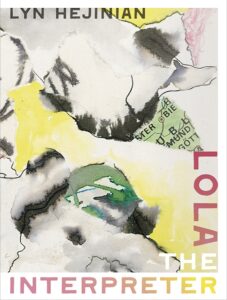
Though Lyn Hejinian was a Californian, her posthumously published Lola the Interpreter is (probably?) not set in Los Angeles and there is no reason to read these two books in mutual context except for the incidental temporal relationship they had in my reading life in early autumn, 2025. Lola’s associative nature asks to be considered alongside other things I was reading and thinking about at that point in the year: Larry McMurtry, the poets and art history I read for work, fragments of personal narrative on social media, drafts of the novel my friend is building out of her journals, Netflix reality tv, poems about friendship grief and widowhood, the Missoula of Robert Redford’s A River Runs Through It, where, in a different sense than in LA, all things flow into one. (In both Lola the Interpreter and in the Denver season of Love Is Blind, there exists a cat called Chardonnay, which sounds like confirmation bias but I did experience this as uncanny.) Associative reading with a porous mind is the work of Language poetry and of interpretation: Lola’s work, the first-person narrator’s work, Hejinian’s work, and my work as her reader and as a person with a life in the world of constant stimulation and influence.
Reading Lola means taking a close look at what interpretation is, at the emotive substance mediating between the thing apprehended and its viewer. It is a book with and about people, about overwhelm and social exchange. The first-person perspective represents just one stream in a network of other streams. Lola’s narrative community, made up of characters with conceptual mists on their names (like Fiasco Bikash McBee), some noted with their particular vocations or qualities (like Tony Van Heuvel, the independent curator, or Enrico Wren Roberts, “more than a name, it seems: he’s a two-minded optimist, maintaining ethical ambivalence while feeling”), also includes citations (like Cicero and George Eliot). Literary history collapses into present reality: “Which is to say that everyday life is underwritten to one extent or another by ideology.”
Reading parts of this book in an Echo Park bar, I thought about how everyone around me has full legal names, invisible to me even though their physical presence was immediate. In Lola, much of the thinking happens in dialogue, but there is a simultaneity of narrative perspective. The first-person perspective could belong to any or all of the characters, which gives the prose the quality of a thought experiment—an inherent safety in experimental conversation, a real empathy. This is the speculative possibility in this prose, the ease of its social dynamic, characters acknowledging each other without any break. In a debate between Lola and another first-middle-last named character, they say, “Let’s not fall for the illusion that a name can contain all the contradictions, interactions, coordinators, disconnects, and contexts that enter into—that create—any actual life.” Here, the problem of sign and signifier is the problem with reality, but not a lack of nuance or ability to listen mutually.
Inhabitable, sometimes funny, specific-to-Lola but also generalized statements on personhood occur throughout the book, like: “Lola as an unfinished person with wide distribution.” Everyone extends hundreds of miles out of where they are, everyone is an unfinished person with a wide distribution, and the effect of this syntactic formulation is a language to chew on. In Hejinian’s syntax of personhood within and around community, the self fits in only precariously among others: “the thrill is in the living, without possibility of certainty, without possibility of universal assent.”
As in some of Hejinian’s writing about her 1980 book My Life in Allegorical Moments (published by Wesleyan in 2023), Lola’s subjectivities are embedded in their contexts, description is social, and the way life unfolds is relational. My Life couches subjectivity in its own languaging. Lola does some of that same work, hopscotching subjectivity through community and through time. Who are we when we’re alone, and who are we when we’re around others? Who are we inside our bodies? “If my skull were cracked open, would my mother be there, and, if she were, it would be as I remember her, right, and not as she actually was? The real question, though, is this: if my skull were cracked open, would I be there?”
Concurrent with my reading is the disaster of our political and cultural moment, the violence of it, with so much reality that is not permitted official acknowledgement or visibility. Like memory, history “doesn’t provide a home for every moment,” but history “includes not only all that is remembered but all that is memorable, which is to say everything.” Lola has a sense of humor, but Hejinian’s deconstructionism is not simple. Lola also has an edginess, a sharp attention to the moment when “respective clarities clash.” Time makes this kind of clashing inevitable, but it’s hard to say what happens in this book, other than characters speaking in relation to one another, or language happening in time. The drama it produces is in the friction between the allegorical statement rubbing up against the syntax of individual perspective in dialogue. I read it as not-exactly-narrative, or too many narratives to form a singular fiction—like life.
In the moments that highlight the passage of time and the gulf between perspectives, Lola produces a sense of vertigo. “Situating moments,” Hejinian calls these moments, where “the rupture between microcosm and macrocosm disappears.” Cultural and ecological disaster create this sort of rupture, but so too does quotidian movement through and within community, like commuting in heavy traffic, merging into the stream of traffic into which all other streams empty, less a symbol than physical fact. In Allegorical Moments, Hejinian writes, “the allegorical is not in itself a solely literary instrument; it is always conjoined to social and political concerns.”
Hejinian’s associative tendencies and the way this prose is at once narrative, conceptual, and daily makes Lola crucial, relevant, political. Allegorical, maybe, but also alive. Debating, calling, reading, sharing, boycotting, streaming, demonstrating, scrolling, and listening: it’s reasonable to imagine Lola’s community in the ways we might recognize ourselves participating in our daily experience, because “people live ideas as much as they live lives.” Lola’s is a buoyant sort of life, this living through ideas, underwritten by ideology: “scattered through the present there are instructions for continuing onward.”
Onward, like the momentum of narrative, or like the momentum of paragraphs. “But I will leave it to you to visualize this,” Hejinian writes.
Anna Zumbahlen lives in Southern California and is the author of Surety (Inlandia, 2026). Find recent work at www.annazum.com.
This post may contain affiliate links.