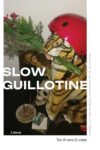



“What is work? What are our days for?” These, perhaps, are the central questions of Slow Guillotine, Teo Rivera-Dundas’ debut novel and the winner of the Barbara DiBernard Prize in Fiction. The book follows “three broke weirdos” living in New York and struggling as they work arts-adjacent jobs, but what the novel excels at is never falling into the trap of every other “young person trying to figure it out” book I’ve read before. By this I mean––the characters in Slow Guillotine are curious and humorous even whilst being sardonic. The narrator fiercely loves his friends and his girlfriend’s snake. There’s a genuine obsession with language and what it can do, even though everyone in the book is pretty sure the answer is “nothing.” It’s a novel that doesn’t fall into the party-girl (gender neutral) trope of early 20s living in New York, a type of narrative arc that has filled many books with tales of drugs, sleeplessness, and messiness. The characters in the book do do drugs. And they lose sleep and lead messy existences, but Rivera-Dundas injects the book’s contents with something that supersedes these conditions and makes the reader think about the body, the poetics of space, and what the bildungsroman novel might offer us in 2026. “It’s tremulous, wobbling,” he writes, “but we are together.” I spoke to Teo over Zoom, while he experienced precarious internet connection.
Sarah Yanni: Teo, you’ve written across different genres, but this is your first full length novel, and it’s described on your website as a text about “being poor in New York.” I would love to start just with the general process of how this book came to be. Did it stem from an existing shorter work? Or was this just your MFA thesis that you kind of tweaked?
Teo Rivera-Dundas: I wrote a short story called “10 Notes About Work” which is actually the first chapter of the book now. That story was the kernel, and I wrote it while I was working in the back room of a bookstore, which I had a lot of thoughts about. I was documenting everything. I think I wrote that in like, 2015. And then I left it alone.
How old were you?
23? And I’m sort of an obsessive journaler, so I kept all of these records from that period of my life, and I started to think maybe I could make something about this juicy world that is the back of a bookstore. I had never seen that side of the publishing industry represented. And it’s so unsexy — it’s boring and monotonous. So much of my experience was just, like, being in pain and never seeing the sun. So I had that kernel, and then I returned to it in 2020 just before COVID started. I was living in LA and had just finished my MFA and I guess I just wanted to see if I could take that voice inside the room and expand it into a more full length project.
A very “MFA” thing is to talk about the “emotional core” of a work, whether it’s fiction or poetry… and it’s often this singular point or heart that is identified and isolated. But with your book, I kept finding a shift in what I thought the emotional core was. At first I thought: it’s New York. This is a place-based novel. But then I was like, no, the emotional core is friendship. And then, no — it’s labor. It’s a book about labor, truly. And then hearing you talk about it now, it’s almost like the emotional core is the publishing industry and how it operates on a fundamental level; that’s what informs the entire action of the book. How do you think about that? Or maybe, is the fact that this “core” feels so in flux part of the point?
I definitely think, yeah, the flux is the point. One of the situations the book takes up is this experience of being so close to the thing you want, but never really getting it. The narrator is somebody who’s very invested in reading and literature, but the only way that they can access that as a life is to work this sort of meaningless retail job. And the other characters in the book also have their own versions of that. Which I guess really means — what happens when you’re poor in New York, and you can’t really get what you want. That’s one node. But definitely, like you said — friendship is another one. And the ways that your day-to-day networks can perhaps provide you with the thing that the rest of your life is not giving you. And reading! I wanted to write about reading. That’s another core.
And snakes.
Yes, and snakes.
Not to be so of-the-moment, but I wanted to ask you a question about nihilism and also about hope.
Sick.
As you said, the narrator works in this independent bookstore, and the store’s practices fall somewhere between kind of earnest at times and then deeply questionable and unethical. And his partner works for a gallery; I wrote down a quote I really liked, “We play at apocalypse. We continue doing the same stuff.” And there’s just so much about how capitalism has subsumed art and literature, while at the same time, there is an earnest devotion to the act of creating and reading to be found in your novel. The book doesn’t feel completely nihilistic, even as you’re telling the reader about the horrible back-end of these industries. You haven’t completely given up. You actually really love language. I guess I’m just casting a wide net to see how you think about cynicism and hope during capitalism.
Damn, I wish I knew. I mean, I think we’re fucked. But I don’t think that being fucked means having no hope. Do you know what I mean? I think that a lot of what I was trying to do in the book is to explore a sense of play within a knowledge that things probably won’t get better. Or at least, to see how we can have a willingness to play, explore, and build meaningful connections even while your immediate surroundings are crumbling.
That makes a lot of sense. There’s not necessarily a huge urge to break out of the conditions or to strive for upward mobility. There’s an acceptance of hardship that simply is. There’s a part near the end where the characters think about making an art project out of the absurdity of their everyday lives, which also felt like a really good example of seeking play rather than change, I guess? But I do think that means there’s some hope! Because I think play feels like an impulse towards possibility?
Yeah, no, I think there definitely is a little bit of hope. I was worried while writing this that I was writing another one of these novels where it’s just like — nothing matters, I hate my life. And I don’t think this is that.
I don’t think so either.
It’s something that I was reading a lot of, and I was kind of exhausted by it. Especially books that are set in New York, and it’s just like, somebody who is super isolated in the city, feeling like everything is collapsing, they are shitty to their friends, they don’t respect themselves… and I don’t think I have a lot of patience for that kind of book anymore. I wanted to write a book where maybe friendship is the antidote to the way that things suck. It’s also very much a novel about really young people. Being that age, and not having the resources to affect change.
Are the ages stated in the book? Did I miss it?
They’re not.
But they feel young, cause they’re having a lot of fun. These characters aren’t wallowing. They’re like, going to karaoke. And there’s a lot of humor in the dialogue as well.
I want to ask you about poets now. Or maybe, something that poets think about a lot, which is “the body” and the way the body carries and archives things in a very symbolic way. But your book is very concerned with the body in a real way — the narrator’s back hurts all the time, the conditions of labor capitalism are literally in the characters’ bones and muscles. And there’s this slow deterioration of the body in a way that almost warps time as there continue to be ambient pains and aches that become part of the status quo. Which is to say, I also want to ask you about Clarice Lispector, whose work makes me think about the body and time in really funky ways. You’ve mentioned her as a source of inspiration, and then you directly reference her in the way that you give the novel multiple titles. Could you speak on how she’s informed you as a writer, and the way you approach these mind/body conundrums? Are there any other big voices that were propelling your thinking around such themes?
I associate Clarice Lispector so much with that era in my life. And yeah, that’s what the title of the book is based on, because I was obsessed with her. It really was right place, right time for me. 23 and obsessive over learning.
She’s incredible, writing about like, a cockroach for 200 pages.
She’s writing about the cockroach! But I do think that what she is able to do with staying with and resting with the body in time is kind of excruciating. In a way, I have a hard time getting through a lot of her writing.
Yeah, it’s very anxious.
Yes and it creates emotional and physical responses in a way that I think a lot of other writing can’t. She’s a huge, huge, huge influence. And her multiple titles in Hour of the Star, I mean, some of them are funny. She’s dour and fucked up in the best way. Some of the other subtitles in my book come from a book called The Mezzanine by Nicholson Baker. It’s crazy, it’s also very much about time. The entire book is just a 100-page novel that is a businessman on his lunch break going up an escalator. But it’s him thinking and reminiscing about his lunch break, and it gets into the minutia of the staple on the paper bag that has his sandwich in it, and things like that. It really inspired the impulse to sort of be as annoying as possible about cataloging.
I will maybe read that…
It’s very funny! But it is very white guy 90s literature.
One turn of phrase you use in the book is the idea of “non-moments.” And I really liked that, because I do think this is a book that sneaks up on you. You’ll have a whole passage about the unceasing construction that’s happening in the narrator’s apartment, and then anecdotes about weird things he sees in the street, and then recurring, freakish dreams about his partner’s snake…but together, all these things build a whole vivid life! They make a book! And I think that’s really beautiful to do, rather than relying on a kind of huge traditional narrative event or some central mystery that needs to be solved. I guess I’d just like to hear about your approach to fiction, and how much of how you write is a conscious effort to reorient or destabilize our understanding of narrative and/or plot. Is this something you’re trying to do? Or organically, the way you write lends itself to this quality of gradual accumulation?
I don’t know if I can speak to my practice as a whole, but definitely in writing this, I was thinking about plot and narrative as a layering. Almost like a quilt or tapestry, rather than a movement. The point is the way ideas weave, not necessarily what happens. I was also worried at some point that this book was extremely boring. That I had basically written a bunch of lists and feelings, and who was gonna give a shit? So I did also have a conscious effort to find ways of signposting that things were happening. I like what you said about the book sneaking up on you. Because that also feels reflective of life and the way that you’re obsessing over the random, little things of your job or the ache in your arm and then next thing you know, something earth-shattering has happened.
You also include some techniques that are very directly playing with form, like repeated direct address to the reader, which I think is really fun. We almost get to the end of the novel before the narrator is like, “Wait, I haven’t told you what my apartment looks like.”
I think direct address was one of those things that came after writing the first draft. It felt useful for building the novel out, and also it was fun to give the narrator a bit of leeway to fuck around with being straightforward. There’s also a couple places where the narrator is deliberately withholding, which comes courtesy of Tisa Bryant’s autofiction class at CalArts. She was always drilling us on the difference between being withholding for a purpose versus being withholding because you don’t actually know what’s happening. So I think I also wanted to play around with a narrator that wasn’t fully telling the reader what was going on.
We briefly touched on place earlier. This book is not only set in New York, but very tied to it, as a condition. You moved to rural Massachusetts a few years ago, though, and I’m curious if your relationship to art and literature has changed since moving there?
It’s funny because I’m writing a lot of really narrative things right now. In some ways, I feel like this novel has gotten something out of my system and now I don’t have to be as concerned with these clever techniques. I’m just writing like, a thriller novel, set in rural Massachusetts.
Do you like writing about the places where you live?
Yeah, I guess I do.
Okay, where’s the LA book?
I don’t know! I wrote a long LA story and tried to get it published and nobody was fucking with it. I love LA. But maybe I love it so much, I can’t write about it. Or maybe it’s so hard to write about it because of cars, and the sprawl. Maybe I’m only really able to write in very tight or small or contained places.
Sarah Yanni’s writing has appeared in Mizna, Pleiades, Nat Brut, APOGEE, The Los Angeles Review of Books, and others. She lives in Los Angeles.
This post may contain affiliate links.