


[New Vessel Press, 2026]
Tr. from the Russian by Lisa Hayden
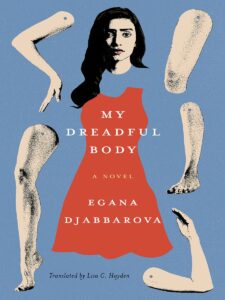
In Egana Djabbarova’s novel My Dreadful Body, translated from Russian by Lisa Hayden, the body, especially the female body, is a metaphor for colonization. The novel’s protagonist Egana is born to Azerbaijani parents in Russia and grows up feeling like an outsider both in Russia and in Azerbaijan. Her tongue—her language—is colonized by Russian, which displaces the Azeri spoken by her parents. When she travels to stay with family in Baku or Georgia, she is referred to as a rus bala, a “Russian child” in Azeri.In her dark eyebrows, which her mother forbids her to pluck, she sees only her otherness. She dislikes the brown eyes that sit under those brows, because she has been taught that blue eyes are best: “It turned out that the Earth had been poisoned to its very core after the decaying bodies of former colonizers managed to pass on their standards to the world, whereby everything blue was beautiful but brown was hideous.”
Djabbarova herself grew up in the Russian town of Ekaterinburg, a daughter of Azerbaijani parents. Through her novel’s protagonist Egana, Djabbarova shows us what it is like to be part of this community, where a woman’s body is expected to manifest her parents’ cultural values: to be a subservient wife, a mother, to use her body to carry out domestic chores. Importantly, her body is also expected to maintain silence. In a devastatingly effective parallel, Egana describes her body as it is being colonized by dystonia. As this disease of the nervous system progresses, it slowly robs her of control over her legs, arms, hands and even her voice. The cause of the dystonia, we eventually discover, is rooted in subjugation, gendered violence and silence. Her illness, it turns out, is a physical manifestation of patriarchal power and control.
For Djabbarova, the body functions as a palimpsest of symbols, layered with social, cultural, and political meaning. She dedicates each chapter to a different part of the body, exploring the physical and symbolic significance of eyebrows, eyes, hair, mouth, shoulders, hands, tongue, back, legs, throat, and belly. In this way she shows us Egana’s place in the world, as “not Russian […] an outsider, an other.” She is an outsider in Russia, in Azerbaijan, and thanks to her illness, also to her own community. Before Egana is diagnosed and treated for her dystonia, she is also an outsider to herself.
In Russian, the novel’s title is In my family, women’s hands were not for writing. A woman’s body has intrinsic value —it is for giving to her husband, for bearing children, for obeying and serving. The body holds cultural memory, it is the bearer of language, and the site of colonial violence. Bodies are judged by other bodies, the subject of ill-intentioned gossip and judgement. A women’s body is not for rest, not for leisure, and is certainly not hers alone. It is definitely not for writing.
Perhaps the most striking aspect of Djabbarova’s novel is the open discussion of Russian colonization—striking because until recently, its direct naming has been rare. The chapter titled Tongue is the most telling, and poignant, here. In Russian, the word for tongue (iazyk) also means language, and so this chapter has the dual role of describing both the organ and the language in which Egana speaks. Egana speaks Russian, but at home hears Azeri and Turkish. She speaks Azeri with a Russian accent, and Russian words force out her Azeri words over time. This loss is not caused by dystonia, but by the internal colonization of a language that is omnipresent at home, and in Baku where she visits her family. She tells us:
I lost my language gradually, as if it were an organ that slowly failed me and initially felt restorable, as if I would always be able to return to it, switching it back on again whenever I needed it. But as time went on I had fewer and fewer Azerbaijani words: the organ had stopped fulfilling its function and lay powerless in my mouth.
Djabbarova expands the metaphor of the tongue. Egana describes how her mother holds her tongue and maintains her silence when she and her children suffer racist abuse in Russia. Unable to interact freely with her Russian classmates, Egana retreats into reading, consuming Russian classics and foreign literature translated into Russian (these books would not, of course, exist in Azeri). But this does not erase her perceived otherness. She asks, with breathtaking simplicity: “How had it happened that the only language I could express myself in found no affectionate ways to address me, instead flinging insults at me like lifeless kernels of corn, reminding me that I’m black…”
Egana’s use of the term “black” might be surprising to the anglophone reader. It was, and remains, common practice in Russia to refer to people from the Caucasus and Central Asia as “chernyi” (black) whereas another, overtly racist term applies to people of African descent. Egana’s status as “black,” though, highlights her position as other within Russian society. This alienation applies to her entire body, as Djabbarova explores chapter by chapter. In one, Egana tells us about her father, and the power of his hands to harm, in another, the fear that she feels when she looks in his eyes. In the chapter titled “Eyes,” Egana is castigated by her grandmother because she punches a man in the face for using his eyes to look at her. This prompts her to remember how she is supposed to use her own eyes, and the cultural expectations around how she uses her mouth: “Bibi realized that I would cause only problems because I was unable to lower my eyes and keep my mouth shut.”
But there are some kind men in Egana’s life, and Djabbarova’s most beautiful writing is reserved for Egana’s grandfather. She tells us that her grandmother married him because he was gentle, and it is this man who brings her joy and love, which she expresses in relation to the body: “He conveyed the most important things of all to me […]: love is the ability to read others’ bodies, to see the good in the mundane, and to see light in darkness.” Egana’s devastation when he dies, when his body ceases to serve him, is visceral: “I couldn’t speak when I learned of his death, nor sleep not eat; he seemed everlasting, so I didn’t believe he could die; he was as eternal as the mountains and the mulberry tree in the yard.”
Egana’s link with her grandparents shows us another meaning of the body: it echoes and repeats the lives and bodies of its forebears. When Djabbarova shows us Egana’s experience of illness, of cutting her long plaits for treatment, it is echoed by descriptions of both her grandmothers as they were ill and forced to cut their own hair. She shows how Egana’s body grows to become like her mother’s, and how it repeats her grandmothers’. Importantly, it is for Egana’s ancestors that Djabbarova reserves her poetry. Egana describes travelling to Georgia to bury her grandmother:
The Georgian sky was more beautiful than anything I’d ever seen: the full moon hung low over the Earth, like the pupil of an eye you could easily touch with your finger if you jumped. Night covered the small Georgian village in dense darkness, as if someone had gently pressed a heavenly light switch. Stars winked at one another, conveying entire poems in Morse code to local residents but remaining undeciphered. My grandmother wordlessly observed the celestial bodies from her heavenly coffin, watching as their glistening white shrouds stopped radiating light when they began merging with the darkness. She knew this fate awaited everyone on Earth but felt sorry she wouldn’t be able to sew clothes, tapping away at the pedal of her sewing machine. There were no sounds in her coffin—it was a place where speech had returned to the Creator.
Despite her physical ties to the past, Egana is not silent like the other women in her family; she uses her hard-won voice to write about male violence, about the taboo of periods, the shock of seeing other women’s bodies, and in doing so pushes back against the expectations her own body is supposed to fulfill. Perhaps she is emboldened by her illness—she is already different, an outsider observing two very different cultures from the periphery. From that sometimes-liminal space she is perfectly placed to comment on both.
Lisa Hayden, whose hands bring this clever novel into English, deserves true praise here. She captures the ebb and flow of Egana’s beautiful prose as it shifts from direct, almost simplistic sentences to elegant poetry. The entire novel feels as though it could be breathed in—it is light and airy, and almost devastatingly profound. Hayden also preserves the liminality expressed in the novel’s language. The text is peppered with Azeri, Turkish and Arabic words—Hayden sometimes explains these through seamless glosses and sometimes retains the original footnotes. It is not insignificant that the Russian text also requires definitions of these non-Russian words. The need to explain these terms in both languages signals that they are foreign to each; they signal the presence of the other both in Russia and abroad. The peripheral position of My Dreadful Body is also signaled by the fact that it is no longer freely available for sale in Russia. It was published in 2023 by No Kidding Press, who primarily commission feminist Russian and foreign texts. The publisher was forced to close in December 2024 after unspecified difficulties, and that same year, Djabbarova was forced to flee the country because of her LGBTQ activism.
No matter its position in Russia, or perhaps precisely because of it, My Dreadful Body is essential feminist, anticolonial reading. Near the novel’s end, Egana regains control over her body when she is treated with deep brain stimulation. For it to work, she has to wear an implant which overrides her body’s dystonia and allows her to function. In one horrific scene, which she recounts with astonishing calm, the doctor turns the implant off as they makes adjustments. For a few terrifying moments Egana is again locked inside her own body, without agency. She jokes that she now has a remote control for herself, but in reality, this device liberates her. Her body has become, we sense, more firmly her own. She is free to address the racism, misogyny and subjugation that so many women face. She is able to write openly about colonization, and she is able to say things other women cannot, precisely because she has taken that step back from her community, and from her own body. Egana tells us:
I wanted to finally break the vicious circle of retribution and open our shut mouths so I could shout about my own existence and the existences of mothers, grandmothers, sisters, and girlfriends. We’d been clutching each other by the throat, in a death grip of fear, for too long—but what if someone sees, but what if someone finds out, but what will people say, but what will your relatives think, but what will your father do when he finds out—and an unbreakable chain of horror had held us by the throat for years, suffocating us, just as dystonia had suffocated me.
My Dreadful Body is about power. The power of one nation to colonize another, which is in turn echoed by the power of men to control women. It is about having the power to be in control of one’s own body. But it is also about having the power to fight back. To find your voice and to use it. By writing the body into language in this honestly perfect novel, Djabbarova transforms alienation into agency, and the colonized body into a site of resistance.
Sarah Gear teaches Russian at the University of St. Andrews in Scotland and is currently writing a book about the influence of politics on literary translation. Her reviews and interviews have appeared in, Asymptote, The Times Literary Supplement, Los Angeles Review of Books, Full Stop, Modern Language Review, Glasgow Review of Books and Rights in Russia.
This post may contain affiliate links.