


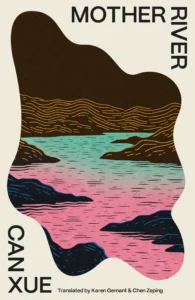
[Open Letter Books; 2025]
Tr. from the Chinese by Karen Gernant and Chen Zeping
Reading Can Xue’s collection Mother River is like following the course of a Möbius strip. We move along its curves from the outside to the inside and then back out again, tracing an infinite series of loops where the transition between inner and outer is barely detectible and always tenuous. Once we think we’ve gotten our bearings, reached some kind of inside, a strange event throws us back on the outside. Along the way we meet characters who are outsiders to these events but also passively accepting of them. They baffle us further. At some point, we’ll be led back into the stories and, what’s most important to Can Xue, back to ourselves. To Can Xue, a work of literature should stimulate self-reflection, allowing us a “direct-viewing in our soul.” Her literary project of “soul literature” is as bold and provocative as this collection’s individual stories, whose characters confront weird, inexplicable happenings in places where time and space get all mixed up: a city unexpectedly and permanently filled with smog, a man searching for a golden peacock, a town whose inhabitants fish on a spherical river. These events never receive any kind of explanation, natural, magical, psychological, or otherwise; there are few rules and very little conventional logic in the worlds Can Xue builds. It’s easier to feel them than to really think about them.
Born Deng Xiaohua in Hunan Province, China, in 1953, Can Xue is considered one of the most important writers of experimental fiction in China and the world and a forerunner for the Nobel Prize. Her pseudonym, Can Xue, means both dirty snow that won’t melt and pure snow at the top of a mountain, a double meaning that perfectly captures the ambiguity in her stories. Largely an autodidact, she ended her formal education after elementary school when her family endured persecution during the Anti-Rightist Campaign and subsequent Cultural Revolution, and she turned to writing fiction in her thirties. In addition to stories and novels, she’s published commentaries on a range of Western authors, including Borges, Shakespeare, Dante, and Calvino, and you can feel something of her eclectic literary interests in her stories, which draw on a range of influences but don’t fit neatly into any one literary canon: They aren’t exactly like anything else I’ve ever read. Her stories remind me of Bruno Schulz’s fiction in the way that they focus on life in towns or villages that seem both fuzzy and precisely defined, porous and hermetically sealed. She describes these places without using much realist specificity of detail, resembling the approach to settings in works by Franz Kafka, Kobo Abe, or José Saramago. Here’s the laconic way the narrator of the title story, “Mother River,” introduces her home:
Our village is called “Fishing River Village”—a fitting name. There really is a river—the Wu River—flowing past the village, and there really are fish in the river.
She provides the bare minimum of detail we need to understand the story, and it’s difficult to make out her tone. Is she being naïve or slyly ironic? Either way, we see Can Xue’s dry humor, which runs through many of her stories—why wouldn’t there be fish and a river in Fishing River Village? Her spare, deceptively simple style and penchant for the absurd ring of Kafka, and just as in Kafka, the simplicity in Can Xue’s stories is only an appearance.
This spare prose was brought into English by long-time collaborators Karen Gernant and Chen Zeping, who have translated several of Can Xue’s previous story collections and novels. Their translation of Can Xue’s collection I Live in the Slums was longlisted for the International Booker Prize in 2022. In an interview for the International Booker Prize, Gernant explained that they send drafts back and forth to each other, working through several rounds of revision until the manuscript is ready to be shared with Can Xue, who has studied English for decades and comments on the drafts of all of her English translators. Can Xue has stated in an interview that her writing “portrays the essential qualities of humanity, or the essential qualities of nature, and this type of literature does not have national borders, because as humans, we are essentially all the same.”
Her characters tend to be outsiders. They don’t quite fit into their society, or don’t understand something crucial about it. In Mother River, they’re often marked by youth—as in the title story or “The Young Man or Loved to Think Deeply”—or old age, as in “Smog City” or “Love in Xishuangbanna.” They stand outside of adulthood or somewhat outside of society in retirement. Often, they don’t understand the people around them or their actions. In “Mother River,” for instance, the young narrator discovers that her uncle makes spherical maps of the river that runs by their village, and she wants him to teach her how to make them:
To all appearances, he repaired alarm clocks for a living. But secretly, he had honed this consummate skill. I really wanted him to teach me, but did I have any aptitude for it? After all, the first time I looked at that spherical map, I hadn’t understood it, had I? Then I thought there was something wrong with my vision, and Uncle Jun had corrected me…
She wants to penetrate his arcane knowledge but fears that she doesn’t understand what she’s seeing. She also realizes that her uncle has a secret life—that the appearance isn’t the full reality. As in “Mother River,” there’s always a sense of transition in the stories, as characters are on the move in some way, discover something unexpected, or find their homes suddenly changed, yet they try to orient themselves and form an identity. As one character in “The Neighborhood” reflects, “the atmosphere in the neighborhood was becoming more and more unfamiliar. The comfortable feelings of the past were now obliterated.”
The characters in Mother River often remain passive in the face of these inexplicable changes. In “Smog City,” the residents seem unperturbed by a dense smog that blankets their city for decades:
No one commented whether the smog from nowhere was good or bad for the city, or for us. It came and stayed, and people accepted it as they do the air. The smog grew thicker with each passing year, and at last the houses, the figures, and cars in the streets became more and more shadowy. However, this was not a big hindrance, as long as people slowed the rhythm of their lives.
The narrator’s attitude is one of total sangfroid, betraying no fear or consternation. She simply accepts that the smog is “from nowhere” and isn’t interested in discovering its cause (if there is one) or finding any solutions. As in many of the collection’s stories, the characters don’t judge what happens to them; they barely even react. When they do react, it’s often in baffling and unexpected ways. Auntie Wang, the narrator of one section of “Smog City,” finds herself moved by the disappearance of some boys she’s been speaking with on the city ferry. Her reaction is odd: They’ve simply gotten up from their seats and moved to a different section of the seating area after speaking with her. It’s difficult to parse out what she’s thinking, especially in Can Xue’s spare prose style. Like Auntie Wang, the stories’ narrators often speak in a flat, matter-of-fact way that betrays little emotion or shows an affect at odds with what’s happening to them. This narrative style is by turns unsettling and frustrating, leaving me moved at times and elsewhere entirely cold.
This all adds up to a deep sense of estrangement, as we see the gulfs between and within characters. In “Love in Xishuangbanna,” a retiree named Mi and her friend Jasmine move to a new town and become entranced by a mysterious young girl who lives in the mountains. Mi begins to wonder about how Jasmine fits into their new setting: “Jasmine was on the inside; she was on the outside. Looked at the other way around, it was the same: she was on the inside, Jasmine was on the outside.” She has trouble finding her bearings. When everything keeps getting turned around, it doesn’t make sense to speak about being definitively an insider or an outsider. It’s impossible to think of yourself as belong or understanding when everything is in flux. But Mi doesn’t seem particularly disturbed by this realization. Can Xue’s characters take the world around them in stride—they just keep going, seeming barely perturbed by their inability to connect or understand. More than the strange events themselves, that’s what can be so uncanny about her stories.
The collection works as a whole, even if the stories’ abstractness can make them slow going at times. The characters are diffuse, performing something of a vanishing act. I tended to forget about them as soon as I moved along to the next story. This abstractness is intentional. Can Xue isn’t interested in conventional psychology and characterization—instead, she wants to go deeper and portray “the contradictions and struggles in the depths of the soul.” To do so, she avoids depicting characters in a way we might expect from a realist literary tradition and demands a lot of engagement and reflection from her readers. Mother River is the second Can Xue collection I’ve read, after Vertical Motion, and while I was excited to return to her work, I couldn’t remember much about the stories in that other collection. Ultimately, the experience of reading her stories—the way they made me feel a convoluted sense of space, time, and myself—mattered more to me than the specifics of any one story. There’s something relatable about these characters confronted by odd events outside of their control, living in places that don’t feel like real places and times that feel outside of time. The stories didn’t quite make me read my own soul, as Can Xue might like, but they at least turned me toward something like an inside.
Noah Slaughter writes fiction and essays. He lives in St. Louis.
This post may contain affiliate links.