


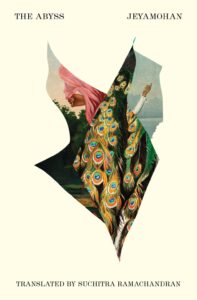
[Transit Books; 2026]
Tr. from the Tamil by Suchitra
“According to the old tales of the Puranas, there are seven worlds under the ground we stand upon: athalam, vithalam, nithalam, kapasthimal, mahathalam, suthalam, padhalam. Seven abysses, seven circles of hell raging below us […] When you climb the hill to Pazhani, you have to cross all seven abysses before you reach the lord’s abode. Get what I’m saying?”
The Abyss recounts a brief period in the life of Pothivelu Pandaram, a husband, father, and human trafficker. To be precise, he manages several people with disabilities and forces them to beg for alms at shrines and religious festivals. Some of the people under his control—he refers to them as “items”—were bought or traded, while others resulted from forced unions organized by Pandaram himself. The novel begins when one of his “items,” a Malayali woman named Muthammai, gives birth to a son, who, like his mother, is severely physically disabled: “The old woman lifted the baby up in the light for Pandaram to see. An uncanny creature, drenched in blood. One leg not even the size of a little finger. A piece of flesh hanging where an arm should have been. A big, misshapen head, twice as big as the body. One eye.” Pandaram considers the birth a sign of divine grace, as disabled infants work a treat at religious festivals. Indeed, the newborn spends most of the novel passed out or crying on a “polythene sheet in the sun” outside of temples. The novel draws to a close when Muthammai is made to produce another “sprog,” this time under especially tragic circumstances.
The Abyss narrates Pandaram’s journey to Thai Poosam, a Hindu festival described in the work’s glossary as “celebrated by the devotees of Murugan in January, commemorating the day when Lord Murugan received a golden spear from his mother Parvathi to vanquish his enemies.” Murugan is, as the glossary informs us, “the handsome one […] represent[ing] the perfect human form.” Almost as soon as Muthammai has given birth, Pandaram rounds up his “items” and travels to the temple town of Pazhani for the festival and what he expects to be a bonanza of almsgiving.
The irony of profiting from people with physical disabilities at a festival celebrating the god of bodily perfection is difficult to miss, but remains provocative. Similarly, the reader will quickly pick up on the obvious disconnect between Pandaram’s faith and his choice to abuse religious institutions and the vulnerable people these institutions are meant to protect and uplift.
His hypocrisy is hardly surprising: looking towards a temple, “[Pandaram] reflexively slapped his cheeks lightly with his fingers; then, crossing his hands in front of his face, slapped them once again. It was a devotional gesture that was meant to convey fear, worship, and self-censure, all at once; although, at the moment, Pandaram was too absent-minded to feel any of it.” In times of plenty, Pandaram is literally going through the motions, at least as far as religion is concerned.
By following the protagonist and eavesdropping on his conversations, the reader comes to know Pandaram’s trade, his motivations, and his personality. It seems that his professional success mostly relies on a strong knowledge of various religious calendars, an ability to negotiate with corrupt public officials and other traffickers, and perhaps most importantly of all, his seemingly innate disregard for people of lower status. For example, when an employee finds the silent reproach of the “items” unnerving, Pandaram admonishes him, saying, “These creatures? They have no souls. No brains either. You have some of both, don’t you? Why do you talk to them like they are your equals? Get going.” Pandaram remains untroubled by the comment. Instead, he enjoys the beautiful singing of one of the “items,” Mangandi Sami, and reflects on the keen business acumen—or divine providence?—that prompted him to buy Samy:
Pandaram tapped to the beat on the roof of the van. The moans of pain, the curses and abuses in the van had all died down. The song seemed to carry the van along. Seventeen years back, Pandaram had purchased Mangandi Samy in Pazhani for eight rupees. He was only a stump, with only one arm, no legs and a little head on top. He had a face that always seemed to smile, with tiny, twinkling eyes. Pandaram believed that Mangandi Samy brought him luck.
Pandaram is a kick down, kiss up kind of guy, and, given his trade in human souls, he would have felt right at home in the work of Nikolai Gogol, especially his novel, Dead Souls, which centers on a rascal’s scheme to acquire dead peasants in order to defraud a bank. Like his spiritual brother Pavel Ivanich Chichikov, Pandaram spends a lot of time on the road, mostly for business, but also for more personal matters, like finding a proper husband for his eldest daughter (his criteria? “The boy should have a government job. That is necessary.”)
The novel’s author, Jeyamohan, likewise displays a Gogolian ability to portray the grotesque without losing sight of what is vitally human and real. I would venture that Jeyamohan achieves this harmony through an almost unprecedented reliance on dialogue: between Pandaram, his network, and his “items.” I’ve been thinking about this a lot, and I can’t recall reading a novel so reliant on conversations as a means of characterization, plot development, and world building. Suchitra’s rendering in English translation is highly colloquial and earthy, making it a joy to read. To name a bold but characteristic example, someone laments, “she’s gone, […] Me, her father, and you, her mother that bore her—to her we are two pubes growing on her asshole. Did you know that?” Since I’ve already mentioned hair, watch out for the running gag about the global market for tonsured locks; it’s a good one. Suchitra’s afterward to the novel suggests the linguistic nuances of the original Tamil, which may only register on a second or third reading. On the first reading, you might be carried away by the strange dynamism of the novel’s conversational tone and forget who exactly is talking and in what language.
Jess Jensen Mitchell is a translator and literary scholar. She recently finished her PhD at Harvard and she is a 2026 resident at the Kolegium Tłumaczy, hosted by the Polish Book Institute.
This post may contain affiliate links.