


[Other Press; 2025]
Tr. from the French by Ruth Diver
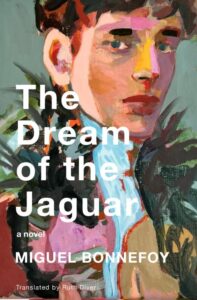
Peasants in Maracaibo, Venezuela are said to believe that a jaguar is born to every litter of kittens. To protect her other children, the mother cat must chase the jaguar away. The result is, for the jaguar, a forced self-emancipation. “We are all sons of a dream of a jaguar,” Ana María tells us in the final pages of Miguel Bonnefoy’s The Dream of the Jaguar (Le Rêve du Jaguar), translated from the French by Ruth Diver. The magical realist novel examines the weight of national and familial myths. Sadly, there is little magic to be found.
Divided into four sections, each titled after a character — Antonio, Ana María, Venezuela, and Cristóbal, — The Dream of the Jaguar traces the genealogy of the Romero family of Maracaibo. Its plot is that of myth and legend, and its omniscient narrator is not always reliable. He is, as the novel’s final pages ham-fistedly reveal, none other than Cristóbal, the youngest Romero. This is a book that insists on explaining itself: don’t you see, each member of the Romero family, and Venezuela itself, is a child of a dream of a jaguar.
The novel is fundamentally concerned with Venezuelan history, from the world historical discovery of petroleum in Cabimas in the early 1920s through socialist land reforms at the turn of the millennium. In the tradition of magical realism, in which narrative is intrinsically bound up with the narration of historical events, the most intimate moments of the Romero family occur at major junctures of Venezuelan history. The fictional world in The Dream of the Jaguar is that of precise coincidence; it is, Bonnefoy writes, “at that instant, when the dictator was at an altitude of ten thousand feet…that Ana María felt her pelvis rip apart ten thousand feet below.” Ana María gives birth to her daughter, Venezuela, just as the U.S.-backed dictatorship of Marcos Pérez Jiménez falls and shouts of “Viva Venezuela” can be heard echoing the newly liberated streets.
These days, Venezuela has a permanent place in the news. The Dream of the Jaguar coincidentally entered Anglophone literature in the same month that the U.S. military escalated its war on alleged Venezuelan “narco-terrorism” by seizing an oil tanker. Just over a month after the novel’s release, the U.S. bombed Venezuela and abducted its president. Trump now claims that the U.S. plans to control Venezuela’s oil “indefinitely.” As magical realism can suggest, the age of colonial resource extraction is with us yet.
Theorists have long disagreed on magical realism. Some call it an aesthetic, universally available to all. We might think of this definition as a marketing tool, a hashtag used by publishers or on BookTok: García-Márquez-core. Others identify magical realism as an emphatically non-European aesthetic mode informed by the historical experience of both colonialism and neo-colonialism. It is a tool, however imperfect, to resist European modernism. Alejo Carpentier’s 1949 novel The Kingdom of This World (El Reino de este mundo), which takes the events of the Haitian revolution as its focus, and which served as the primary influence on Gabriel García Márquez’s landmark 1967 One Hundred Years of Solitude (Cien años de soledad), both follow this second tradition. This is true even as Solitude’s global success has inadvertently led to the genre’s marketability. In fact, blurbs and copy for Bonnefoy’s novel often invoke Márquez.
In the novel, Antonio Borjas Romero, the family patriarch, edges out more complex characters like his wife, Ana María. A strange ease lubricates everything he does. This is the mark of myth, and each fable and story that is told feeds his legend: abandoned at three days old on church steps, Antonio goes on to become a doctor, aids a revolution, and founds a university. While the narrator is clearly sympathetic to Ana María, he affords Antonio’s exploits far more narrative space. Antonio’s myth is a black, devouring hole. Pages are devoted to Antonio’s rather dry pet project (the founding of the University of Maracaibo), while Ana María’s life’s work — helping hundreds of women obtain abortions and other kinds of reproductive care — fades into the background. The novel is at its best when it devotes its attention to Ana María. The text’s strangeness shines when she, for example, retreats into the solitude of her house ahead of her daughter’s birth, feeling “as if she were about to deliver the first woman in the world.” When Ana María dies, “no one knew what [had become] of the first woman doctor of Zulia,” and her funeral, despite her supposed celebrity, is a subdued affair.
The heavy weight of family mythology falls on the shoulders of their daughter, Venezuela, and her adopted brother, Pedro Clavel. Venezuela, raised to become a doctor just like her parents, yearns to “let go.” Here, Bonnefoy literalizes this weight in the form of a family heirloom, a gold, bejeweled penguin which Venezuela raffles off to pay her way to Caracas. “To leave, she had to free herself of the weight of the gold, and that gold was the penguin,” repeats Bonnefoy. Cracks emerge and form a gap between the ease of myth and the grittier texture of reality. Successive paragraphs and pages contradict each other. When Venezuela holds her raffle, for example, the narrator insists that her storytelling abilities, “tenacity,” and “zeal” are responsible for her success. A page later, however, the narrator reveals that the raffle’s winner had purchased every raffle ticket sold in a bid for her attention.
The simultaneity of the real and the miraculous, in which the miraculous intersects with the real, is magical realism’s trademark. Glimpses at the frayed edges between the two form some of the most thrilling parts of the genre. And yet, in The Dream of the Jaguar, the ease of myth threatens to smooth away historical texture. When Antonio and Ana María enlist in the fight against the dictator Jiménez, for example, this “elegant couple expecting their first child” easily “organized the circulation of messages, moved money around from unknown sources, falsified names and dates, altered addresses and gathered evidence, all in the most profound clandestinity,” all without falling prey to the state’s violence. Yet, in the following paragraph, Antonio is quickly identified by the police as a suspect, and goes into hiding before he is eventually forced to turn himself in. In falling under the spell of mythology, Bonnefoy reveals a disinterest in history.
In his pursuit of magical realism, Bonnefoy deploys lists. The novel thus forces heaps of objects and descriptions into the reader’s open palms until they overfill and fall, clanging, to the ground. Here’s how he describes the madam of a brothel where Antonio worked as a teenager: “Her hands smelled of rice powder, cinnamon blush, nail polish, false eyelashes, pomegranate-colored rhinestones, hair-removal wax, and local corruption.” Local corruption? It is as if Bonnefoy cannot help himself. This is not to say that the novel is void of the occasional, delightful detail. I am particularly fond of how Policarpio, the penguin, “reache[s] up his wing to protect his face” when a child throws a projectile into his enclosure, or how the newly disenchanted Cristóbal discovers that corruption is so commonplace that it too “stand[s] in line at the supermarket.” Bonnefoy’s use of magical realism adeptly conveys the surreal speed with which capital penetrates space. After OPEC imposed an oil embargo in 1973, Venezuelan oil boomed, resulting in a complete transformation of Maracaibo. Entire avenues, stadiums, and malls “sprout[ed] up like mushrooms” overnight, leaving the city “unrecognizable” for anyone who left for even two weeks.
To Ruth Diver’s credit, the novel’s rhythms and textures are adeptly translated. As an award-winning translator working primarily on twenty-first-century Francophone literature (of the Hexagon and the Middle East), Diver has developed a niche of translating historical novels like Bonnefoy’s. Admirably, Diver also often chooses texts which reckon with gender and sexual violence, such as Adélaïde Bon’s The Little Girl on the Ice Floe (MacLehose Press, 2019), Emmanuelle Bayamack-Tam’s Arcadia (Seven Stories Press, 2021), or the forthcoming English edition of Gisèle Pelicot’s memoir (co-translated with Natasha Lehrer).
Corniness abounds; the less I tell you about Antonio’s notebook of transcribed love stories, the better. Particularly clumsy are (some of) Bonnefoy’s descriptions of women. See, for example, Eva Rosa, Ana María’s mother, who “looked like one of those women with sensuous and lively eyes, full hips and exuberant breasts, whose round belly could accommodate a thousand children.” Or Fauna, whom Cristóbal meets at a magnolia plantation: “She had fine skin, delicate fingers, and an obvious penchant for reverie. The years of labor hunched over the flowers in the magnolia fields had not subdued her voluptuous curves or the innocence in her eyes.” As I read the pages which contained these descriptions, I fought the urge to abandon this review. Instead, I wrote “ew” in the margins. Perhaps the French reading public has a greater stomach for such sexualization — the novel, after all, won the Prix Femina and the Grand Prix de l’Académie Française, both prestigious literary prizes, in 2024 — but such an emphasis on a woman’s fertility (or, in Bonnefoy’s words, her “opulence, overflow, prodigality”) nauseates. The result is a greatly diminished story. And in some senses, then, the feminist commitments evidenced in Diver’s prolific oeuvre are ill at ease with this translation.
After Venezuela leaves Maracaibo for Caracas and then Paris, she meets the Chilean Ilario Da, formerly imprisoned and tortured by Pinochet’s regime (readers of Bonnefoy’s Heritage (Other Press, 2022) will be familiar with Da). The two have a child, who, at Venezuela’s insistence, is named Cristóbal, “in honor of the man who carried Christ and the one who brought the church to America”: Christopher, or Cristóbal, Columbus. That Cristóbal grows up to be a voracious reader with colonial fantasies should come as no surprise, given his namesake. “Because he was both Latin American and European,” Bonnefoy writes, he soaked up “the stories of the adventurers who had long ago disembarked to America,” and, spared by his parents of his family’s history, was “unaware of anything to do with dictatorships or migrations, revolts or pogroms.” Instead, his imagination was “bursting with cyclops and saints, similar to that of a colonist in New Amsterdam.” Bonnefoy himself grew up in France to a Venezuelan mother and a Chilean father, and has made a career of writing fiction born of the cultural riches found at this intersection. It is tempting, then, to read Cristóbal as an author surrogate.
If Cristóbal is similar to a “colonist,” he is not the only one in his family. Venezuela’s work as a cultural envoy for her country has her, in Bonnefoy’s words, “accomplishing the same task as the chroniclers of the Western Indies had on their return from America.” Thus, Cristóbal follows his mother’s footsteps when he examines his grandfather’s dead body at his funeral, and compares him to “descriptions of Patagonians he had read in the Dutch accounts of Sebald de Weert, who told of bodies so large that their fists could hold a bull.” A captain with the Dutch East India Company, de Weert is best known for his “discovery” of the Falkland Islands. After circumnavigating the globe, his crew told of encounters with “giants” in West Africa and Patagonia. These tales were turned into a popular publication, complete with sketches, which helped fuel Dutch colonization in the 17th century.
In the final pages of The Dream of the Jaguar, Cristóbal considers where to begin his novel, which he conceptualizes as a love story “of a man for a country.” It comes as no surprise that he decides to begin his story with the abandonment of three-day-old Antonio on steps of a church. Cristóbal’s novel, we’re meant to understand, is the magical realist one we’ve just read. And Cristóbal’s influences, and indeed his imagination — as Bonnefoy himself writes — is that of a colonist. In those distant, non-European lands, in “the world of his ancestors,” there lay “plains of dolphin women and rivers shaped like salamanders.” Is Bonnefoy suggesting that we read these European colonial narratives as magical realist texts?
Written in French, but deeply of Venezuela, Bonnefoy’s is a magical realism of the Third World written from the First World. The Dream of the Jaguar, like its author and its narrator, is “located on the border between” these two definitions of magical realism. By seeking to equalize colonialist fictions with a genre which resignifies colonial pasts, Bonnefoy is in danger of instrumentalizing magical realism to reify colonial aims.
Sam Karagulin is a reader, writer, and translator. He works as an assistant editor at The Yale Review. He lives in New York with his cat, Blue.
This post may contain affiliate links.