


[SJP Lit; 2026]
Tr. from the Japanese by Polly Barton; Charlotte Goff
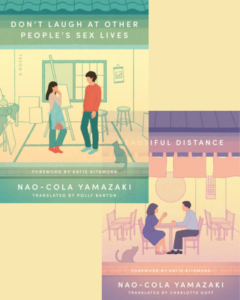
There was no guidance around which freshly translated novel by Japanese writer Nao-Cola Yamazaki (they/them) to read first. I was told that these books could be read as a unit, a pair, or separate, one indifferent towards the other. I don’t read book jackets or summaries before starting a novel. I like to slowly garner the context, the plot, the characters and see how the author wants us to understand where their literary devices overlap. In spending time with Yamazaki, translated into English for the first time by Polly Barton and Charlotte Goff, I noticed that the literary devices I was used to interacting with, the denouements and the climaxes, were not as central to these stories. I slowly gave myself over to the text, realizing that it was okay to be sucked into an authorial vacuum for a bit. It was okay to encounter a protagonist with little backstory, but with such a rich present that you forget you know nothing about his parents, his childhood, like in Don’t Laugh at Other People’s Sex Lives (tr. Barton). In Beautiful Distance (tr. Goff), Yamazaki keeps us grounded inside a hospital room, hellos exchanged day after day between a dying wife and a living husband. Writers often feel pressure to write something that encapsulates the world. To write something that stings us with these huge truths through complicated plot lines and narrative devices. But writing like Yamazaki’s proves that you can encapsulate the world in much smaller ways: maybe through two people attempting to find love, to find themselves through others. Or maybe through two people who have already found love and must prematurely grieve the other’s impending absence. Somehow, magically, wonderfully, Yamazaki is able to conjure entire universes dwelling in the space between two people.
I began with Don’t Laugh… maybe it was the cheeky title, something told me it was the lighter of the two, and I was right. Don’t Laugh… follows a relationship between an art student, Isogai, and his tutor, Yuri, who is married and several years older than him. In the opening paragraph, I sensed the wonders of emerging adulthood, the period when perspectives are changing due to new experiences, new firsts: “A sky so low that it was like looking up at a pair of dangling feet, and through it passed a flock of birds. It was strange to think of warm-blooded creatures hanging there, suspended in the air like that.” Warm-blooded creatures. Animals, humans. The novel is told in first-person, through Isogai, and there are several of these types of reflections throughout the novel. Witnessing the world, nature, through a different angle and then thinking about how that angle of the world warps the way we inhabit space. Though this novel centers around an intimate trope—older teacher, younger student—it is surprisingly matter-of-fact. Intimate scenes are not embodied but neither are they performative. They simply happen, and during a time when the protagonist is trying to figure out the limits of his own body. During their short courtship, as Isogai is leaving Yuri’s studio, he looks up at the sky, again, enclosed by branches:
It struck me that I didn’t have much of a grasp on where the boundaries of my own being lay. Where the air touched my skin—was that the boundary of my body? But then what about my hair, and my nails? And what did it mean for my body to age and deteriorate? Was I me only because I’d been temporarily and spatially delineated from my surroundings?
The cascading questions remind me of my own journal entries as a young person. Pining to understand who we are in our environment and to the people we choose to surround ourselves with. When we are young, we can be so shapeless, and, in searching for shape, we allow others to influence who we are. In a way, it feels safer to be told that we are a certain way, or we occupy a certain space or that we feel certain things that we don’t necessarily know how to name or understand. When Ishigo describes what he thought his preferences were for women, he comes to a new realization: “In falling for someone, I came to understand that all of my tastes and preferences were kind of irrelevant. Your feelings took on the shape of the person in front of you—that was how it worked. I was never going to turn into someone who just so happened to precisely cohere with my fantasies. Rather, my heart had molded itself to the form of this particular person.” This is one of the more intimate realizations in the novel and yet, it still feels detached, practical. Feelings are presented as these things that you may not choose. You don’t quite understand where they emanate from or if they should be trusted. I love the youthful confidence of the line, “that was how it worked.”
So often the teacher-student dynamic ends in flames. A relationship doomed from the beginning only crescendos into more lies, loss or some other upheaval or uncovering of secrets. Yamazaki doesn’t play into that expectation. Slowly, their presence in each other’s lives fades, leaving Isogai to sense, “very keenly, that I was no longer necessary to her.”
In Beautiful Distance, the idea of necessity lingered in my head. What happens when the person you believed you would die with is now dying sooner than you? Yamazaki takes the cancer narrative and creates all these new ripples inside of it. Delicate ripples that, because of their repetition, become all the more devastating when they stop repeating. The husband says, “here I am,” each time he walks into his wife’s hospital room, and his wife answers, “here you are,” until she no longer does.
Rereading excerpts from Audre Lorde’s The Cancer Journals, I’m struck by the embeddedness of her prose, how deeply it sits within her body. Growing angry at her right breast “because I felt as if it had in some unexpected way betrayed me, as if it had become already separate from me and had turned against me by creating this tumor which might be malignant.” A first person cancer narrative is different from a first person cancer witness narrative, and yet both The Cancer Journals and Beautiful Distance share some overlap. Lorde describes cancer as having the power to provide a new sense of self, and I believe this can happen both for the witness and the holder, the one facing their own mortality. Yamazaki’s prose does not linger in the body as Lorde’s does. Where it lingers is on the outskirts of the body: in the relationship between husband and wife, in the friendships the wife had that are now coming to an end, in the wife’s love for her sandwich shop, her want to provide food and delight to her community.
Death and ritual are sisters, but Yamazaki is curious about the rituals of life before death. What does it mean to wash a loved one’s face when they no longer can? Or clip their nails or clean out their ears? Yamazaki writes, in unadorned language, “Cleaning your own ears can feel pretty satisfying, but I realize it feels a million times better to clean the ears of the person you love. Why has it taken me so long to do these things for her when they feel this good?” Even in these moments, Yamazaki never lets us forget that time is passing and that time will never bend for us. As spring comes, hydrangeas begin to bloom. Yamazaki writes: “We’re not allowed to bring fresh flowers into the hospital… Perhaps, if I draw attention to the changing seasons, all I’m really doing is underlining the things that she can’t experience anymore.” The novel is written from the husband’s perspective, and this witnessing allows for these poignant, oblique observations about time lost.
I couldn’t stop thinking about how Yamazaki maybe set rules for themself—a rule of representing death in a way that had never been done before, a rule to never use metaphors or clichés, to find newness in something so known, so terrifying, so beautiful. I say that because this novel made me very sad, but in a way that felt new to me. Witnessing death is tracing the skull of your dying wife with your eye, as the husband does. Mourning is realizing, softly, that “my wife will never wash her face again. She has suddenly become a sort of exalted being. Standing and facing her now feels like standing and facing a god.”
With softness, with care, Yamazaki breaks us and reforms us into better people, better readers through their creations. Both novels flex the narrative skill Yamazaki possesses, though their subject matter and literary voices are so different. The common thread I see throughout both is the care Yamazaki has for their narrators and the concentric circles that surround them whether it be their youthful anxieties about how to love or their adulthood woes they were not yet prepared to experience.
Alia Spartz received her MFA in Fiction at the University of San Francisco. Her writing has been published in The Rumpus, Write or Die, and Full Stop among others, and she has received support from the Tin House Writer’s Workshop. She lives in San Francisco and is currently at work on a novel.
This post may contain affiliate links.