


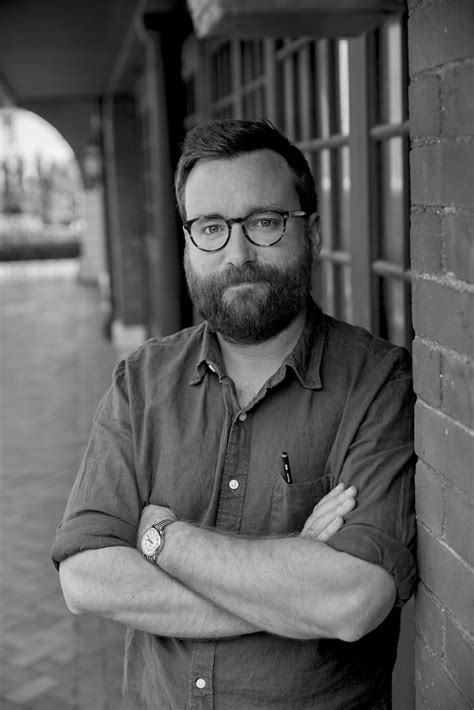
St. Louis, the hometown that Devin Thomas O’Shea and I share, is a lot like many cities in the U.S. That is to say, it’s a beautiful place, full of history and people who care about it, and it’s also a place that has suffered decades of inequality, mismanagement, and neglect. Against this backdrop of blight and disregard, work like Devin’s that honors our city with dedicated, close attention seems like nothing so much as a transformative act of care. Through years of reporting and archival research, he’s unearthed chapters in St. Louis history that range from the wonderfully weird to the deeply disturbing. In his new book, The Veiled Prophet: Secret Societies, White Supremacy, and the Struggle for St. Louis, he narrates how the members of a clandestine organization with roots in strike-breaking and racial violence–and symbolized by an anonymous figure clad in a white robe and hood–have orchestrated some of the most destructive chapters in the history of St. Louis and the country at large. Earlier this year, we connected over email to talk about the book.
When thinking about St. Louis, when reading your work, I often find myself wondering–would any city under the scrutiny of sustained, careful attention like yours reveal stories as horrifying and fascinating as the ones you uncover, or is there truly something unique about St. Louis? Parts of your book make a powerful case for the latter.
That’s a tough one — every city is the hivemind project of everyone living there, and everyone passing through, and everyone viewing it from afar, but what’s genuinely novel about St. Louis is that it’s geographically in-between and often overlooked.
The city has a lot of history and high symbolism; it’s older than the United States by a lot, being Native American, then French, then Spanish before it became American. For most of St. Louis’ existence, it’s been on the Western frontier, but primarily it’s a Mississippi River city, and that has made it a big part of the Americana zone Mark Twain wrote about.
For this book, it was important to recognize that St. Louis was also the northwest exit from the Southern plantation system. It was the last slave city before free soil, and outside of the Dred Scott case, that is an under-discussed aspect. Not recognizing it gives us a warped idea of what St. Louis is, and how power has historically worked between it, the state capital in Jefferson City, and the rest of the country.
At the same time, St. Louis also became very industrial early on, which is Yankee behavior. It has a history of municipal socialism thanks to the German 48ers, as well as a great deal of crude capitalist extraction. The Civil Rights struggle was intense and fascinating in St. Louis, as are the mass poisonings committed by the Army Chemical Corps, and the companies that helped refine uranium for the Manhattan Project.
If St. Louis is abnormally interesting, it’s because every other American city can see versions of itself in us. I think it is novel, but you could apply the same attention to any of our mid-sized neighbors — Cincinnati, Pittsburgh, Minneapolis, Indianapolis, Lexington, Kansas City, Memphis — and write a book about how they tell us an important story about who we are.
One of the most impressive things about this book, in my opinion, is its incredible depth and breadth of reference. You tease out the connections between the Veiled Prophet and historical nodes as varied as the partition of Palestine and the assassination of Martin Luther King, and cite writers ranging from Mikhail Bakhtin to Jonathan Franzen. Can you talk a little bit about your research process?
That’s very nice of you to say. I think my biggest journalistic-writerly skill is that I can consume and process a whole lot of content, even when that content is pretty boring. The hard part is then narrativizing all that information.
I read widely because a set of questions organically came up as I was researching — why did the 1878 patriarchs of St. Louis want to make this Islamic monarch their club mascot? Edward Said helped clarify that. Why was the Veiled Prophet so threatening and violent in the first year he appeared? Elaine Parsons’ book titled Ku Klux helped me understand, as did Philip Foner’s The Great Labor Uprising of 1877. How big did the Veiled Prophet Society get? Who was their most influential member? James T. Fisher’s Dr. America came in, as did Henry Berger’s St. Louis and Empire, and Douglas Franz and David McKean’s book on Clark Clifford.
I was also aided greatly by the Missouri Historical Society’s Research Center. The story goes that some ladies began meeting for tea sometime in the 70s or 80s, and because they were interested in the Veiled Prophet Queenship, they began to compile every newspaper article that mentioned the Veiled Prophet. All this was scrapbooked in these big leather volumes, and so I benefitted enormously from that material, which was a jumping off point to dig deeper in certain archives.
You explain in the book that the Veiled Prophet parade has its origins in the krewes of New Orleans Mardi Gras and, at one point, allude to a similarly named organization in upstate New York–the Veiled Prophet Freemasons–of which Harry Truman was a member. As you were researching, did you come across any other groups or societies in other parts of the country that operate similarly to St. Louis’ Veiled Prophet?
Yes, there were tons and tons of Veiled Prophet Society-esq clubs in the 1800s and early 1900s. The Golden Age of Fraternalism takes place before the Civil War, and that conflict destroys a bunch of those institutions. In Reconstruction and The Gilded Age, clubs come back in a big way, always based on Freemasonry but adapting to different social mores.
In the 1880s, for example, Kansas City saw what the Veiled Prophet was doing for St. Louis — acting as a Ku Klux symbol while dodging the federal suppression of the first wave of the Klan — and invented their own version of the Mardi Gras krewe. The Priests of Pallas (POP) put on the POP Ball, and King Ki Ki headed up the party as their krewe leader. There is some dispute, but I don’t think the triple K is an accident. Ku Klux began as a minstrel group which morphed into a secret society. All these clubs are the same kind of social technology that evolves, and riffs off its predecessors. Unions like the Knights of Labor began as secret societies because they were a way of pooling collective resources, and coordinating efforts while keeping secrets from the boss.
So, the social technology of a secret club can be used to hoard wealth, and rig the government so as to benefit the rich at the expense of everyone else, or it can be used by the working class to fight collectively, taking advantage of our considerable power through solidarity.
An interesting and sometimes repellent motif of the Veiled Prophet’s history is its insistence on the significance of the “Queen of Love and Beauty,” the young woman chosen by the society each year to serve alongside the masked man. I was disgusted to learn that the first debutante chosen for the position was sixteen years old, and that the Queen not only had to be a virgin but was forbidden from marrying for one year after the ball. You make the point that this exertion of control over the daughters of the city reinforced the power of the Veiled Prophet. I’m so intrigued by this idea that the Prophet alone isn’t enough, that he needs to seal or compound something through the body of a teenaged Queen–what are your thoughts on the importance of young women to the society?
Yes, it seems crazy that the VP is a symbolic strike crusher, a monopolizer of the economy, the Klansman who keeps African Americans disenfranchised, and he is an icon of the patriarchy.
On the other hand, this makes a lot of sense in terms of control. The debutante ball is designed to limit who the daughters of the rich are allowed to socialize with, with the goal of keeping two-dozen powerful St. Louis families intermingled through marriage.
But it’s also about policing any inkling, or curiosity, about interracial relationships. It severely discourages the pursuit of a sex life outside of marriage, and in general, becoming a debutante is a reward given to the daughter in exchange for submission to her father — all the debutantes make this literal in their bow to the Veiled Prophet.
The Prophet is concerned with virginity, especially in the mid-century, because, I think, that’s what happens in a hyper-patriarchal, conservative, repressed society. We can see the obsession with policing sexuality reflected in our current politicians and modern patriarchs, who want to check genitalia before soccer practice, and arrest people over bathroom etiquette, and bar trans athletes from enjoying their sport.
Those kinds of guys crow about freedom and liberty, but they want to control people’s bodies, and get in the middle of patients and doctors, because they want to impose their personal morality upon everyone. The Veiled Prophet knows best — he’s the two-faced father who’s a kind Santa Claus character, and on the flip side he’s the dictator; an “iron fist tucked inside a velvet glove,” according to their own literature.
Thousands of women have passed through this VP ritual, and everyone now knows that Ellie Kemper paid a very heavy price for her queenship. Now the cost of becoming the Veiled Prophet’s Queen of Love and Beauty is sky-high — responsibility for putting these girls in this position lies with the parents, but the debutantes also retain a lot of power through their participation. If they go along to get along, they lend this ceremony their approval. If they revoke their presence and object on the basis that they don’t want this to hurt their future, then the thing would fall apart.
On the other hand, by participating, they get close enough to the “Grand Oracle” to unmask him, which would put them in a legacy of very brave women who stood up to the VP — Gena Scott, Jane Sauer, Laura X, Jacqueline Bell, etc.
You’ve got so many great lines in the book. Some made me laugh, some made me see history in a new way, some left me profoundly moved. There’s one in particular that’s stuck with me, from your memories of attending the Veiled Prophet fair in downtown St. Louis when you were a child, and a McDonnell Douglas AV-8B Harrier II Jump Jet flew over your head during the air show: “Like future military targets in the Middle East, the festival crowd was meant to be shocked and awed by the 120-decibel power of these weapons.” Arms manufacturing is one of the industries the Veiled Prophet organization has most consistently involved itself in–can you talk about some of the contours of that relationship?
Thank you for saying so — it was important to me that this book is not one bad thing after another, and that the VP story is funny and absurd.
I had an upsetting moment in the research a couple years ago, especially around the 1980s and the VP Fair, where I realized how much of St. Louis’ economy is hooked up to the military industrial complex. I knew that McDonnell Douglas was a big part of the economy, but so is the Olin Corporation, which manufactures ammunition, and the chemical companies of St. Louis — Monsanto and Mallinckrodt — also held many defense contracts for dynamite, napalm, Agent Orange, etc.
This thing is well-documented in Pynchon — technology and capital are one entity. Weapons like missiles and rockets are the perfect nihilistic commodity because you fire them off, they explode, they obliterate whatever they were shot at, and then you have to build another missile, and rebuild whatever was blown up, bury the dead, etc. It’s an endless cycle of production and consumption, destruction and death, which only leads to the demand for more weapons, and that’s extremely profitable compared to a consumer commodity like a car or an ironing board.
But that’s a larger problem than St. Louis — the United States is the arms dealer of the world. If, tomorrow, our beautiful country magically became a real democracy, and we all got to decide what the economy would be tooled to do, I doubt we’d collectively agree to have a for-profit health care system, and hundreds of thousands of Tomahawk missiles.
Another of the most powerful moments in the book comes when you’re describing the event that spurred the Veiled Prophet society to take shape—the Great Railroad Strike of 1877. During that amazing demonstration of coordinated labor, a Black worker stood before the crowd and asked white workers: “Will you stand with us regardless of color?” The white workers said, “We will.” That kind of racial solidarity between workers scared St. Louis elites so much they made up an entire cult complete with its own mythology to police the city’s marginalized. Can you talk about some of the ways that the Veiled Prophet and other agents of power tried to keep Black St. Louisans down and out, and some of the ways that they fought back?
The 1877 strike was authentically novel for its time, and newspapers noted how rare it was as a multi-racial general strike. That diversity was also the wedge point where the strike was broken, with reactionary white workers turning away hundreds of Black strikers at one point. In that late-1800s, early-1900s period, one of the biggest enemies of working-class power was the racial segregation of unions, and the refusal of white workers to cooperate with their Black counterparts.
But in general, the white leaders of St. Louis in law, finance, real estate, and law enforcement created a hyper-segregated city which kept St. Louis’ Black community contained to certain neighborhoods. For a while, that was not a problem — there was a parallel, very successful Black St. Louis centered in the northern part of the city around The Ville. Black St. Louisans could get a high-quality education at an all-Black institution, from high school to law school to medical school, and then work at Homer G. Phillips Hospital, or a Black-owned business. This was also the high period of cultural production for Black St. Louis, starting with Scott Joplin, then Josephine Baker, Miles Davis, Chuck Berry, etc.
Crisis in capital sabotaged Black St. Louis in the mid-century, with deindustrialization hitting those African-American neighborhoods first. Mill Creek Valley, which Vivian Gibson wrote a beautiful memoir about, was a working-class Black and Bohemian neighborhood that was eradicated by Urban Renewal through crooked politics. The Pruitt-Igoe housing project is a whole other sabotage, including a clandestine radiological experiment conducted by the federal government. White flight was the abandonment of St. Louis City for the shattered network of suburban counties, which then produced enormous wealth inequality, which then came to a head in 2014 in Ferguson.
Late in the book, you note the waning influence of the Veiled Prophet in a city that is hemorrhaging jobs and businesses at a clip. You write that “The largest threat to the contemporary Veiled Prophet Society is the fact that individual billionaires are powerful all on their own. They don’t need the coordinative influence of a group.” And yet the VP marches on, with the “Prophet” renamed in 2024 to the “Grand Oracle,” and secret societies, as a form, still seem attractive to elites the world over. Just this summer, I know you took note of the story that broke about Peter Thiel’s “Dialog” club. People who don’t seem to need secret societies are still getting something out of them. What do you think that might be?
VP Saint Louis, the contemporary version of the club, still does a lot of the same work that any fraternity does for its members. You pledge, you get hazed, then you become initiated into the secret knowledge of the organization. The difficulty of pledging binds neophytes together, and then you’re transformed into a member, reaching the status of those who had tormented you, receiving the privilege of hazing new members.
Initiation means an elevated version of yourself, and now you have these more established mentors. Plus, you inherit the prestige tied to the history of the club. There’s an incredibly powerful, emotional thing going on there — acceptance, a support system, a legacy, access to the resources. Judges, politicians, university presidents, financiers, and executives have some limits on how cozy they can be in public, but in the club, that’s all blended together. Every member ends up with access to credit, legal help, political capital, economic prestige, etc.
I think it proves that the dog-eat-dog individualism of neoliberal capital — which many of these guys profess to believe in — is fundamentally a rule for thee, not me. The rich know that it’s important to network, and to move in coordinated fashion in pursuit of shared goals. Members of these clubs influence each other by just being in the same room, going to dinner, getting drunk, partying.
Thiel is the perfect example of a guy who professes deranged ideas, seems horrible to hang out with, but understands that he can exert power by becoming a facilitator, much like his friend Jeffery Epstein. Sharing a secret together, having dirt on someone for something they did during a ski trip, or out on a yacht, is a powerful tool.
I give readers the resources to go and see if their boss is in the club (check the last names of the VP Queens in the Index), but the book isn’t very interested in the current crop of VP Saint Louis members, or what it feels like to be in the Veiled Prophet Society.
Similarly, the obsession of the Veiled Prophet society with the poetry of Thomas Moore and Walter Scott that gave them their guiding aesthetics and mythemes seems to have echoes today in the obsession by certain segments of the political right with art forms like classical Greek architecture, Norman Rockwell paintings, and even, hilariously, the “pre-woke” concert stylings of bands like Alien Art Farm. Do you see a continuity here in this kind of reactionary pull towards artistic nostalgia?
Yes, that’s a great point — young men are very impressionable, and I know this because I used to be one. There are lots of well-funded interests who come to young men and sell an idea about the way things used to be, often peddling an unchanging version of masculinity from the past, where men were straighter, and stronger, and braver than they are today.
That story tries to explain what’s wrong with our current society, which demands you work yourself to death, and are disrespected constantly. You’re downwardly mobile, and receive very little cash for any effort you make, plus every industry feels like some version of a Ponzi scheme. You can’t seem to find love, or contentment, or respect, which we all crave, and when you look around for a reason why, someone says it’s the wokes that did this — social justice is to blame.
I found Mark Fisher to have a much better explanation in Capitalist Realism, which argues that depression, and a sense of worthlessness, and anxiety, and future-lessness is all quite profitable for this system. Discontent means you need to keep paying for looks-maxing classes, and testosterone supplements, and Patreon subscriptions to influencers who turn your anger — which is valid, and the only sane reaction to our world — into misogyny, homophobia, hatred for the perceived outsider.
There are many guys who feed on anger in one form or another — Joe Rogan, Clavicular, Andrew Tate, Nick Fuentes, Donald himself — but they will never deliver what we’re seeking when we are trying to “become a man.” Ultimately, those guys do not want to change the current system in your favor — they would prefer it stay the same, or intensify, or become more tilted toward them.
The fantasy for being a Roman patrician, or a Call of Duty operator, or an Arthurian Knight is a male fantasy like those that Klaus Theweleit wrote about in his book about the male psychology of the Nazis, and their fear of communism. It’s a reaction that has everything to do with insecurity that’s pumped up, and exploited by capital interests.
As the rate of profit falls, as wealth hoarding continues to this absurd extent, as more and more of your neighbors and family are deprived of dignity and rights, there is no amount of Being a Man that will help you control that system, especially as an atomized individual.
The only thing that can change those dynamics is the recognition that we are far more powerful as members of a diverse collective, which needs to move in a coordinated pattern, which requires a lot of bravery. There are many roles in the counterforce; membership in the union, becoming a shop steward, marching on the picket line, teaching, listening, protecting.
Solidarity is the only real way to keep the people you care about safe, which is often the valid, good feeling young men are pursuing at the root of all that chivalry-manhood fiction. They want to defend someone who needs defending, and the boss wants to trick you into defending him instead of your neighbors.
In the final pages of the book you also note that Trump’s reelection has laid bare the authoritarianism and bigotry that have always characterized American politics and the activities of the Veiled Prophet, even if those ugly drives were hidden for much of our history under a veneer of “respectability.” It’s become a cliché of Trump’s second term to say that American empire has gone “mask off,” which, to me, has some obvious resonance with the Veiled Prophet, and your point that “The veil is a mirror darkly; a reflective surface where the public is invited to look upon the Prophet, and not know.” Maybe America needs its mask to function as it was designed to, just like the Prophet does? What do you think?
I do think living in Idiocracy is a problem of our era. It seems like it’s all out in the open, and being done in the most crass and absurd fashion. Most presidents had to keep the machinations of the state, and the power of the ruling class, dressed up in a certain dignified, official way. What we’re living in now is hack and on-the-nose.
In reaction, it seems as though class consciousness is on the rise, and has been for many years. The Democratic Socialists of America continue to grow, and socialism is more popular and favorable to the public than it has been for the last century. That’s a huge shift, but there is still a very long way to go before there is a genuine threat of FDR-scale reform for all of this — a Second Bill of Rights, a New Works Progress Administration, a New CIO, a New-New Deal.
I think a lot of us are surprised (I am, at least) by the tolerance of the American public, who is watching the desecration and defacement of all these national shrines — both literal and metaphoric. The president is openly cheating the stock market, we’re spitting with rage at every other country in the world, committing a genocide in Gaza. Everything American has become a crude, cheap joke. And yet many want Barack Obama or Liz Cheney to come save us instead of fixing any of the fundamental economics that lead to this — that’s where the battle line is, I guess.
You and I both know the struggles of local papers these days, and it seems more important than ever that journalists and writers document the places where they live, especially outside of big urban centers. Do you have any advice to aspiring local historians on how to get started telling the stories of their communities?
Yeah, this model of writing-editing work as low-paying passion project labor is killing us. It’s especially got to change if we are going to complain non-stop in the national media about declining attention spans, and falling literacy rates.
My advice is to find some way of researching that you genuinely enjoy, make a good connection with an editor at an outlet you respect, and try to write in a way that will move the needle, but I can’t say that’s easy, or that that is what I do. Everyone in our profession should look into joining a union like The News Guild. If you’re a St. Louisan, The United Media Guild.
I think the onus for fixing local journalism lies with bigger entities than individuals. There should be a robust public fund for every city to have at least one or two alt-weeklies like the Riverfront Times (RFT) which are not all that expensive to run. As I wrote about in a mention for The Drift, in this stage of digital capital enclosure, the RFT was more valuable as a porn-recommendation site than a local news outlet, and so St. Louis lost a staple of the media ecosystem. The local social fabric is now poorer because of that. The free market will not find solutions for this, and intervention is long overdue.
On the last page of the book, you write: “It is, in fact, very easy to find beautiful things happening in St. Louis every day, and there are a billion reasons for hope in St. Louis’s future.” What’s one thing giving you hope for St. Louis’s future right now?
In the day-to-day, St. Louis is very cosmopolitan. It’s full of punks, chefs, people from all different faiths and backgrounds. It’s hated and sabotaged by our Republican state and federal government, and many want to fix St. Louis by making it whiter and richer, which won’t work.
St. Louis is an African American city, with a proud and historic Black community. It’s a city with a lot of working-class history, and it’s a refuge for the LGBTQ+ community. This place is a million things at once: Bosnian, Afghan, Mexican, Indian, Korean, Chinese, on and on.
St. Louis is architecturally, historically, and culturally rich, with many moments in the city’s history where the spirit of democracy tried to break through — in the 1877 Railroad Strike, in the Communist Party organizing in the 1930s, in the Civil Rights Movement of the 1960s and 70s, in the Black Lives Matter movement after 2014. These were all efforts to design a city where working class St. Louisans enjoy safety and stability. The Veiled Prophet is the symbolic counterforce to that spirit.
What encourages me is that the city is moving away from the car-dominated model, back toward the walkable urban center it was in 1900. St. Louis is cheap as hell to live in, especially compared to Chicago or New York. There are tons and tons of creative people writing poetry and painting — St. Louis has a long tradition of making sculpture out of the decay and dilapidation of the built environment, which is exemplified by Bob Cassilly, The City Museum, the half-built Cementland. The bike culture here grows more and more every year.
The food in St. Louis is also unbelievably good. Our culinary scene punches far above our weight, as does the local theatre, and the music scene. Bands like Lobby Boxer, Space Quaker, and Freckles make stuff that I really love, and it’s all the most special because they’re making it down the street.
Griffin Reed is a writer from St. Louis living in Chicago. She’s the Managing Editor of Boulevard.
This post may contain affiliate links.