


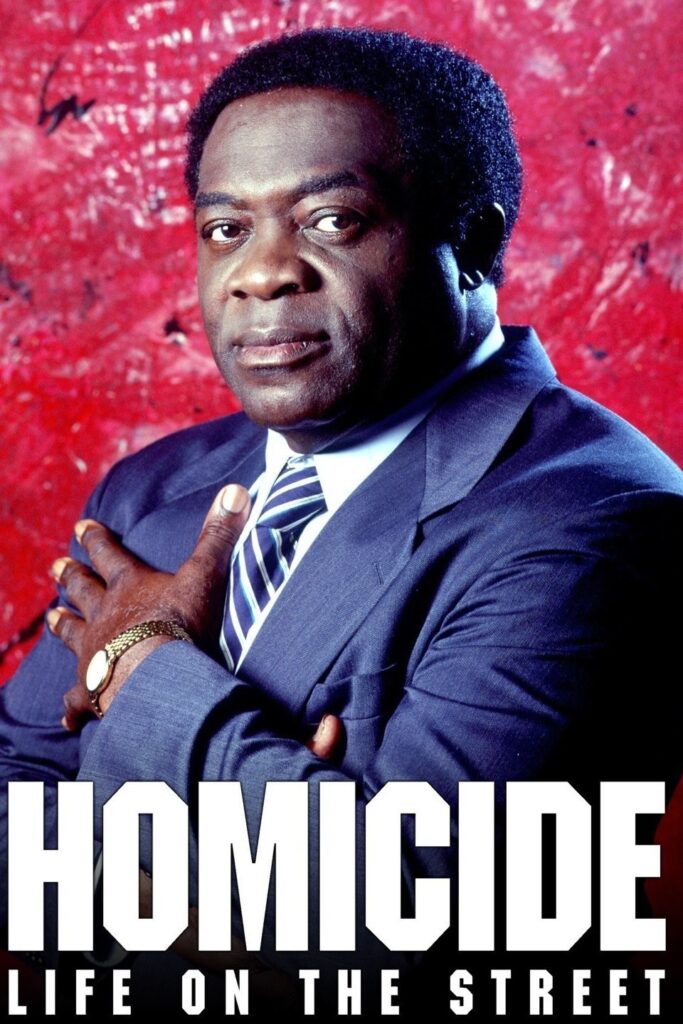
In episode two of season four of Homicide: Life on the Street, which aired on October 27, 1995, detectives and partners Tim Bayliss (played by Kyle Secor) and Frank Pemberton (played by Andre Braugher) are having a conversation about how many times they have had the tragic duty of informing family members that their loved one has been killed. Bayliss makes the observation that “it didn’t used to be like that,” though his reference points are television shows like I Love Lucy and The Dick Van Dyke Show. “People weren’t so violent back then, there wasn’t so much killing,” he says, and then adds, “shows are a reflection of the time, Frank.” You can easily imagine the episode’s writer, Jack Behr, grinning at his own meta dialogue. Pemberton responds, acknowledging the way mainstream media can overlook uncomfortable or violent aspects of the past, by asking, “did any of these shows feature guys in white sheets running around burning crosses and lynching people in their front lawns?” The conversation ends.
If shows are indeed a reflection of the times they’re in, then Homicide is a significant point in television’s cultural ascendance, aesthetically and critically, while also being a crucial lodestar in the medium’s relationship to law enforcement through the dominant genre of modern television: The Cop Show. At any one time in recent decades, around one-quarter of shows broadcast on network TV alone are cop shows, or police procedurals, while others peg the ratio closer to half of all network shows. They are legion, and they are popular. Law & Order, NCIS, CSI, the Chicago universe, and Criminal Minds, just to name a few, are some of the most-watched and longest-lasting TV franchises. Jarret S. Lovell writes in his book Good Cop, Bad Cop: Mass Media and the Cycle of Police Reform that “in a given week of prime-time viewing, the typical audience member will watch 30 police officers, 7 lawyers and 3 judges but only 1 scientist or engineer and only a small number of blue-collar workers.” There’s a word for all this: copaganda.
The word gained new mainstream awareness amid the George Floyd protests in the summer of 2020, as outlets like Teen Vogue and Refinery29 wrote explainers of what it is and how it works. In that context, though, the word was applied largely to videos on social media, shared by law enforcement themselves and police supporters, to help bolster their image at a time when protesters were calling to defund police departments. As Palika Makam wrote for Teen Vogue, “Cops don’t need your help promoting their image; they already have the funding, power, and protective policies on their side to do it themselves. Instead of uniting us, copaganda serves to undermine the movement for Black lives.”
According to scholars Jessica Hatrick and Olivia González, copaganda refers to “both fictional media that normalizes the power, presence, and violent practices of the police, and to the media produced by police forces themselves,” and it can incorporate “on-screen representations — depictions of policing — and behind-the-scenes processes — via the people, organizations, and power dynamics shaping why and how stories about policing are told.” They peg the term’s origins to writer Greg Beato in 2003 discussing Hollywood’s “malignant copaganda that glamorizes police brutality and normalizes the idea that the only good cop is a bad cop.” The word “copaganda,” then, is now an effective shorthand for this kind of positive-image media: cops as protagonists, who are generally competent at their jobs and, even when they fall under the moniker of antihero, work to better their communities through their work.
Homicide is, for me, something of an apotheosis for the cop show. First of all, it is simply great TV. It has one of the genre’s greatest-ever ensemble casts: Braugher in his breakout role, Yaphet Kotto as the lieutenant, and detectives played by Ned Beatty, Melissa Leo, Daniel Baldwin, Clark Johnson, and Richard Belzer, another breakout who would go on to play the same character, John Munch, for 15 seasons on Law & Order: Special Victims Unit. It was ostensibly created by Paul Attanasio, Oscar-nominated writer of Quiz Show and Donnie Brasco, though it was developed by director Barry Levinson (Rain Man, Bugsy) and showran by James Yoshimura and Tom Fontana, who would go on to create Oz for HBO. The series is based on David Simon’s book about actual Baltimore police, and Simon would write some episodes (and, of course, soon create The Wire) alongside a team of TV veterans. Directors including Levinson, Martin Campbell, Alan Taylor, Whit Stillman, Barbara Kopple, Uli Edel, Gary Fleder, Mary Harron, Matt Reeves, and Kathryn Bigelow would stop by throughout the show’s run, and it was noted for its distinct cinematography, usually by Jean de Segonzac, who incorporated jump cuts and shaky cam into his 16mm on-location shooting (alongside a signature move of repeating the same moment three times, using three different takes to underline it).
In short: it was the pinnacle of TV craftsmanship and collaboration, as if created specifically to emphasize and leverage the medium’s strengths. All of which, of course, ostensibly makes it an even more effective vehicle for copaganda. How do we come to terms with the undeniable pleasures of this blatantly ideological genre?
***
Homicide’s bread-and-butter, I’d argue, is the interrogation scene. Most episodes feature at least one extended sequence inside the station’s interrogation room, “the Box,” a common enough trope in police procedurals which Homicide treats like it’s the fundamental building block of drama itself. One of the show’s most acclaimed and remembered episodes, “Three Men and Adena,” is set almost entirely in the Box. These scenes serve multiple purposes. They serve as acting exercises, perhaps first and foremost, for both the series regulars (especially Braugher, who breaks out in part because of his masterful intensity in these scenes) and for notable guest stars to make their mark. Structurally, these are also key turning points in most investigation plots. Whether successful or not in garnering a confession, these scenes typically push the story to its conclusion, often through rather explosive performances, and hinge on the ability of the detectives to goad the truth out of the accused by any means necessary. It’s amusing at times to watch how they trick a criminal into admitting something (as when they fool a suspect that a photocopier is actually a polygraph machine, a trick based on real life that was repeated in The Wire), but more often, it can be jarring to see the unethical lengths they go to and the supposed expectation that we, in the audience, approve of these tactics as long as the ends justify the means.
For instance, episode six of season four, Bayliss and Pemberton are trying to intimidate a skinhead who doesn’t want to give them information so they tell him they don’t actually care who’s really guilty, meaning they don’t mind pinning it on him. “What we’re gonna do is we’re gonna twist the facts, we’re gonna taint the evidence until you are guilty!” Bayliss tells him. “You think cops are capable of anything, don’t you? Remember Waco, Mr. Kruger? Well, we’re gonna execute you and not even think about it when we kiss our loved ones goodnight.” It works; the skinhead talks. It helps in this case, certainly, that the target of their charade is a Nazi, who follows up this encounter by calling Pemberton the n-word (and Bayliss punches him out as a result). Who cares how they deal with this guy? This violent demeanor, though, is how they treat practically every single suspect, whether they’re sure of their guilt or not. It is their modus operandi for getting information or attaining a confession. Every detective in the series is doing it for (more or less) the right reasons and wants to do a good job. Even so, if you took a tally of situations that could be called police brutality throughout the series, it would be a long list.
If you’re thinking that efforts like this are liable to confuse the reality of how effective such strategies are, you’d be correct. A 2015 study found that viewers are more likely to believe police departments are much more effective in solving crimes than they really are. Most episodes of Homicide feature the whiteboard tracking open (names in red) and shut (names in black) cases, and it’s (literally) unbelievable how many are written in black. The same study found that viewers are more likely to think police only use force when necessary, and that police brutality and misconduct is not a real problem and does not lead to false confessions. They also looked at existing surveys and experiments on responses to crime TV and found that viewers generally have a more punitive view of punishment for crime from watching these shows. As Alec Karakatsanis writes in his new book Copaganda: How Police and the Media Manipulate Our News, “The goal of copaganda is not just to maintain the punishment bureaucracy — it is to make any alternative to it seem so terrifying that the public cannot imagine safety without it.”
***
It is useful in this context, then, to consider the aesthetics of a show like Homicide, which is aiming for realism of a certain form. The handheld camerawork on the streets of Baltimore puts us on the scene, even as the jump cuts and repetitions are inherently artificial flourishes (which the series used less as it went on, as the network wanted higher viewership). The overall effect, though, is one of rough and gritty verisimilitude. This deliberately unpolished facade, of course, hid the very deliberate decisions that went into this style, and the intention—mirrored by many cop shows, including the original Cop Show, Dragnet—of using advice and input from real-life officers to juice the authenticity. (Apparently, even the filing cabinets on the set were filled with real police reports.) This purposeful melding of style and narrative would work together to grant the show its distinct believability, which cannot help but have ideological and political consequences. One fascinating episode, for example, centres around a crime which may have been committed by a fellow officer, and all but Pemberton are invested in protecting the officer as one of their own. The tone is deeply cynical—Pemberton responds by forcing a confession from an innocent man to prove his point—even if the other officers are depicted as at least understandable in their desire to downplay the crime for the better of the department.
The show is also keen to depict these characters as complex and morally conflicted, because that makes for good television; so much of the show, especially early on, is more focused on their unrelated and tangential conversations about pop culture or conspiracy theories, as well as the interpersonal relationships between them all. This is the power of television, and the workplace drama in particular, as the specific job they do, however abhorrent, can recede into the background and we come to see them as fully-rounded individuals navigating each other in familiar ways.
As the framing for a piece of copaganda, though, the consequences are not trivial. As Hatrick and González put it, “when copaganda normalizes the power, presence, and violent practices of the police, it normalizes the state’s monopoly over violence and maintains the social order of racial capitalism,” and “copaganda encourages audiences to empathize with law enforcement and with the ideology that policing and police violence are necessary.” Put simply, if my good TV buddies Frank Pemberton and Tim Bayliss are abusing their power in the Box, it’s got to be for a good and justified reason; when the criminal confesses, that feeling is vindicated. Representation matters, but the politics of representation matter more.
At the same time, the pleasures of copaganda are obvious. I can simultaneously hate cops and binge Homicide, and it’s not simply a matter of cognitive dissonance or the suspension of disbelief. The show, like the best TV, is primarily interested in storytelling that is emotionally and visually compelling. It exists in an alternate universe, and one that is absurdly alternative in the way it understands the police. We know it does not represent the world you and I live in. In their bizarro-Baltimore, every cop is doing their best to be good, every broken rule or abuse of power is acceptable because it works, and the bad guys are punished appropriately.
This is a fantasy, of course, and (at least for me) the pleasure of a show like Homicide does not arise from being able to buy into the fantasy for a moment, or that it is easy escapism with resolutions to crimes that appease the anxious citizen. Instead, it’s a way to engage with the wider culture of what it means to enjoy art that we find to be “problematic”—perhaps extremely so. There is room to be entertained by a cop show while critiquing the ideological messages that underpin it, just as there is room to enjoy anything else that could be considered a “guilty pleasure” with caveats or footnotes. In fact, laying bare the unreality of these alternate worlds can be a tool. As scholar Tiara Sukhan has said, “The fact that they’re able to see the gaps between what they’re seeing on television, and how they think the world should actually be — even being able to see those gaps and articulate them is useful on some level.”
Either way, I’m almost done with my binge of Homicide, and I can’t wait to start The Wire.
Jake Pitre is a writer and scholar based in Montreal, Canada. He has been published by The Globe and Mail, The Atlantic, JSTOR Daily, and elsewhere.
This post may contain affiliate links.