


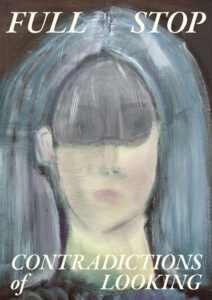
The following is an introduction to the latest issue of the Full Stop Quarterly, edited by Full Stop Fellow Keely Shinners. You can purchase the single issue here or subscribe at our Patreon page to get every issue and more.
I approached art through writing. That is, once I had decided to become a writer, I was determined to write and, crucially, determined to make a living as a writer. My first job in this regard was at an art magazine in Los Angeles. Once a week, for about a year, I would walk to my editors’ Spring Street apartment, play with their cats, and transcribe interviews. In the evenings, they would take me to gallery openings—for which I was perennially underdressed. I encountered odd objects: citrus trees doused in fluorescent light, a telephone that phoned a poem, a twenty-four-hour porno marathon. Afterwards, we would go to Canter’s deli for matzo ball soup and toffee milkshakes. I was nineteen. I was enamored.
Since then, the art world has taken me in, so to speak. I have worked for commercial galleries and non-profits. I have edited, curated, lectured, and reported. I have written dozens of exhibition texts and reviews. Indeed, were it not for art, I may not have made a living as a writer after all. The art world has brought into my life my most cherished friends. It has also given rise to some enemies. I have been moved and non-plussed. Panicked and delighted. From time to time, disillusionment will creep into my relationship to art. Then I will encounter some surprising smudge or scribble and be thrown into a state of wonder once more. I’m still enamored.
It is because of, not despite, these contradictions that art interests me. That is to say, I like the fact that art means many things. Mediums, for one, of which many expressions are covered in this issue—paintings, photographs, sculptures, textiles, murals, movies, cartoons. But more than that, I like that art can function contradictorily. It can be, at once, a vehicle for political activism and a laundromat for racketeers. It is a site where pure aesthetic inquiry can take place, and yet it is evermore bogged down by institutionalism and industry. It is through art that culture speaks and fights against itself. It is a matter of grave importance and an excuse to party. It is through art that visions of the future can be tested. Yarns spun. Truths revealed. Jokes made.
“The gap between your boundary and mine is where our meaning arises,” says Elle Nash in her essay that’s included in this issue. I like to think about art in this way—as a gap in which an excess of meaning abounds. How we cope with this gap, this excess, is how our meaning arises. Using the texts compiled in this quarterly as a base, I have theorized three modes, or attitudes, that one may adopt in relation to the gap: performance, violence, and witness.
In Helen Quah’s profile of Cecilia Vicuña, she meditates on the Venezuelan artist’s performances as methods for communion with the ancestors, the natural world, and the body—culminating in what she calls “an erotics of making.” Ben Albertyn’s historical survey of performance in moving image art from the midcentury to now considers the ways in which performers lend a certain je ne sais quoi to the the category of film that falls outside of “traditional narrative cinema.” In her review of Suzanne and Louise, a photobook by the French writer and photographer Hervé Guibert, Samantha McColloch thinks about portraiture as an act of performance, a theater constructed by both onlooker and looked- upon. Together, what they suggest is that the gap that art begets is one in which mysteries flourish—ambiguities that can be mined for poetry and intrigue.
Ambiguities, however, tend to unsettle. This is why art can occasionally serve as a catalyst for violent acts that seek to suppress the unsettled feeling. Christine Hume takes up the mantle of this subject in her essay on the censorship of artworks that address women’s reproductive health by vigilantes and institutions alike—namely Joanne Leonard’s Journal of a Miscarriage, which has been pulled from exhibition no less than three times over the past fifty years. Elle Nash looks at two further examples of censorship: Alasdair Gray’s Horrors of War and Leo Tanguma’s Children of the World Dream of Peace. “To omit these representations of violence in our past and present,” she writes, “removes our chances of encountering them and, consequently, erases their meaning.” On that note, in her review of A Child in Palestine, Yasmin Desouki celebrates Naji Al-Ali’s cartoon character, Hanthala, who has become a symbol of Palestinian resistance throughout the world, outliving his creator, who was assassinated in London in 1987.
“What is our responsibility to face scenes of violence? What does it mean to look, and keep looking?” These are questions that Julia Rensing asks Tuli Mekondjo, the multidisciplinary artist whose work bears witness to the injustices of German colonial rule and South African occupation in Namibia, her home country. Using methods of concealment—embroidering, embellishing, painting over—she tries to “make sense of the violence, but also to explore how we can mend the trauma.” Michael Tymbios is another artist who deals in images with fraught legacies—skies, islands, stone pines—images which he paints in order to “stay with the problem.” Tymbios “has made a practice of ‘staying with tension,’” writes Lucienne Bestall, “working with the contradictions not only of image-making, but of bearing witness—to the landscape, to violence, to loss.” Sophie Calle is an artist who has made a career out of bearing witness to her own life—its absurdities, heartbreaks, and banalities. In Rebecca Schultz’s review of the artist’s monograph, Overshare, she traces Calle’s revelations and obfuscations, searching for the messiness of honesty that offers something of an antidote to life in an image-mediated world.
How do we contend with the contradictions inherent to life in an image-mediated world? The writers gathered in this collection sit with the problems, the gaps, the excesses. They bear witness to the contradictions of looking.
Keely Shinners is a writer, editor, and performer based in Cape Town. They are the author of the chapbook The Agonies and Ecstasies of Saint Marguerite (2025) and the novel How To Build a Home for the End of the World (2022). Their essays have appeared in the Chicago Review of Books, Electric Literature, and e-flux, among other publications. Previously, they served as the Editor of ArtThrob and the Chairperson of the Association for Visual Arts.
This post may contain affiliate links.