


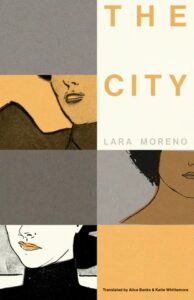
[Open Letter Books; 2026]
Tr. from the Spanish by Alice Banks and Katie Whittemore
The eponymous term “the city” means little without proper context—and on first glance, means even less when used as a book title. Yet in this case, readers soon find, with the author’s guidance, that the versatility of the phrase is exactly what makes it perfect for this novel.
From Open Letter Press, The City by Lara Moreno, translated by Alice Banks and Katie Whittemore, follows the lives of three women in urban Madrid up until the very start of the COVID-19 pandemic. Oliva, a native Spaniard, Damaris, an immigrant from Colombia, and Horia, a seasonal worker from Morocco, represent the various echelons of Madrid society.
The book is a stunning portrayal of womanhood, modernity, and the struggle for survival amongst various odds, centered around three women in different stages of life. It is in their dissimilarity that the reader can see how they are all alike at their core. These women are resilient yet vulnerable, desiring more out of their lives. They struggle against city life, learning to find a balance between their own desires and the desires of the people around them.
As a Colombian myself, I especially resonated with Damaris’s character, seeing how natural disaster and poverty push people to lengths they do not anticipate. There is a kind of ‘natural disaster’ in each woman’s life, from the actual earthquake that irrevocably changes Damaris’s life, to Oliva’s struggle with domestic abuse, to Horia’s son going missing as he attempts to reach her in Spain. Something shakes up their lives that they cannot ignore, and they must continue the practice of daily life while fighting each battle internally, having to rely mainly on themselves for emotional strength.
For example, Moreno describes a fight between Oliva and her partner Max, framing it almost like a battle. She writes “war broke out over [Oliva’s] head…faced with an attack, flight is an appropriate and natural reaction. Flee, even when it is from one’s home. Avoid the shrapnel.” Here, Moreno illustrates Oliva’s decaying relationship, which is shown to be as disastrous as a physical battle.
Each one has children of varying ages and needs—Oliva has a young daughter, Horia has a teenage son, and Damaris has two adult children. Motherhood is highlighted in each of the women’s stories, but it does not define them or usurp their identities as people. Damaris reflects on this when thinking how close both she and her mother were to dying in the catastrophic earthquake she experienced in Colombia, saying “nobody ever wants their mother to die, because a mother pushes you out of her womb and your husband does not,” showing the intrinsic link between mother and child and how it drives both individuals to do anything for each other. This role both distinguishes the women and brings them into thematic communion with one another.
Oliva and Horia are highly focused and present in their children’s lives, with motherhood being their major if not primary motivation. Damaris, contrarily, feels more mothered by her own children, as they ask her to come back to Colombia and wonder if she needs to stay at her job in Spain. The dynamics each woman has with her child is complex and nuanced, showing the varying ways that motherhood can present itself even in the same geographical and cultural area.
In accordance with a more modern literary style, the tales of these characters are told to us through fluid streams of consciousness reminiscent of Virgina Woolf and Sally Rooney. This is a literary fiction novel with the pace and energy of a thriller. By using omniscient narration with no quotations marks, allowing it to move quickly between characters, The City wrests control of the reader’s attention and holds it tight until the final page of the novel. Moreno adjusts to the changing emotional states of her characters, allowing us to feel the distinct voices of the three women while the style remains firmly Moreno’s.
The writing reaches its peak in its description of Oliva’s life and her struggle with the verbal and emotional abuse she endures at the hand of her partner, Max. I felt anxious and scared alongside her as she navigated her way through his ever-changing emotions; my heart raced with her and for her. Through Oliva’s narrative voice, we see the manipulation and guilt Max inflicts on her when she attempts to set boundaries: “I want to live the life that being with you lets me live, I need it. No one’s ever gotten me to see what you make me see…I’ll die if you leave me.” Moreno depicts the manipulative and toxic with care, empathy, and detailed attention, illustrating how such a situation could someday end up befalling anyone, even the reader.
This writing style sets The City apart from other literary fiction of similar subject matter. Instead of being mainly internal and contemplative, it manages to make the everyday thoughts and struggles of those characters visceral. It is a feat that a novel in translation is able to sustain such a style successfully. It speaks to the talent of the translators and author that the sentences were able to remain coherent even when translated out of the original language.
This is highlighted in the narration discussing Oliva, saying that she “doesn’t differentiate worry from sadness…Nor the battle from sadness…She senses the hole, the hollowed-out gut. But it’s butterflies, not blackness. One must go on. One must make an effort,” displaying repetition and an extended exploration into the despair that Oliva feels. Though the word “sadness” appears multiple times, there is a slow build toward its meaning that builds nuance and allows the reader a window into how Oliva views the world and internalizes her situation.
The role of the city of Madrid is both central yet understated in the novel. The city is present and alive in the lives of the women, who go to their favorite markets and know their neighborhoods intimately, but it takes a background role to the struggles of the three characters. Each woman has a favorite spot she frequents or a routine road she takes, but outside of those details we get little description of the city. I was left wanting a deeper understanding of how each of these characters see the soul of their city, how the people in it make Madrid what it is. There was some color lacking in establishing the culture of the city and how it feels to live in it.
At the beginning of the novel, Moreno does write that “Madrid isn’t a city that tries to conceal or cloak its ugliness. This imposing cavern, this labyrinthine warren of bloodied rabbits might be its most sophisticated act of improvement.” This visceral interpretation of the Spanish capital is intriguing, as it does not refer to a certain place but to the energy of the city overall, but such descriptions or telling details are not found in many other places in the book. The novel fails to consistently keep the city in mind, which is ironic for a book titled The City.
Horia, toward the end of the book, describes that “Madrid sounded like an atrocious monster…like the lethargy of idle hours,” associating it with her fear and anxiety over her missing son. This could be an example of the reason why there isn’t as much Madrid-based description, as the author could be pointing our attention toward viewing the city as the main characters see it, imbued with their own emotions at any given time.
The final portion of the book features the beginning of the COVID-19 crisis, though the novel ends before lockdowns truly start. Each of the characters has weathered her own challenges and is beginning to come out of the other side of them, but we never see this come full circle. This causes the ending to feel abrupt and sudden, like the television has unexpectedly gone black from lack of electricity. The book is fabulous at building and keeping momentum, so such an ending leaves readers feeling dropped into an abyss rather than feeling satisfied. Though one would likely not expect a perfect fairytale ending, there could have been more of a well-rounded conclusion rather than one that left me wondering if there were missing pages in my copy of the novel.
In a relatively slim volume, Moreno has crafted three distinct worlds and worldviews that readers can sink their teeth into. The women feel like they could step off the page at any moment, that they could easily be real people one encounters on a street corner. While the term “the city” is unspecific, it perfectly describes a bustling environment that contains multitudes of people, each with their own story. The book illuminates the private struggle women are constantly facing, and the larger community that contains all of those struggles within it, knowingly or unknowingly.
Danielle Bartholet (she/her) is a senior year Writing, Literature, and Publishing student, minoring in History and Journalism. She serves on her college newspaper, The Berkeley Beacon, working as the Deputy Projects Editor and Operations Managing Editor. Her reporting ranges from a variety of arts and culture pieces, to coverage of Emerson’s student government, to interview pieces, sports features, and more. She can also be found working for Her Campus Emerson as its Vice President, and as the Marketing/Communications Director for Page Turner Magazine. Outside of her roles, she spends time working on her original fiction projects, and making short form vlogs for her social media. Her writing has appeared in Houston Family Magazine and PaperCity Magazine, publications in her home state of Texas, as well as Black Swan Literary Magazine, Full Stop Literary, EM Magazine, and Front Porch Magazine. She also runs a Substack, “Scribblings” in which she posts personal essays and snippets of her creative writing.
This post may contain affiliate links.