


[Haymarket; 2026]
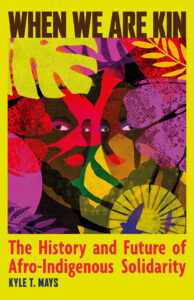
When We are Kin is a roadmap of the complex histories and the untrodden futures of Afro-indigenous Solidarity. If you have no background in the history of Indigenous and Black resistance to settler-colonialism in the United States, Kyle T. Mays’s books are a solid introduction. When We are Kin is a guide to Afro-Indigenous solidarity and struggle in the present day through a scientific analysis of past failures and successes, and propositions for how to handle a struggle for liberation in the future.
Mays roots his understanding of history through historical materialist analysis. Historical materialism is a means of understanding our present-day conditions as a direct biproduct of our material reality, not abstracted ideas. This is also the way that I understand the world, and a way that we—as readers and members of our own communities—can change the conditions around us. This book is a good way for any reader to begin their journey of critically interpreting the world around them.
Through a historical materialist lens of Afro-Indigenous solidarity, Mays critiques identitarian preconceptions we might have of Afro-Indigeneity. As any good Marxist would, Mays does not take the dash between “Afro” and “Indigenous” as something natural. Rather, he argues that real historical conditions create solidarity and contradictions between groups of people. Liberal identity politics assume all people of color must be natural allies, but, if you have organized in your community, you know this not to be true. There are all kinds of tensions between ethnic and racial groups that can make it difficult for all of us to fight against our true oppressors. Mays will argue in this book that those in power want us to be divided, so that we are more easily controlled and exploited.
Kyle T. Mays is an Afro-Indigenous (Saginaw Chippewa) academic, intellectual, educator, and organizer living on Turtle Island (United States). Mays is a professor in African American Studies, American Indian Studies, and History at the University of California, Los Angeles. He is the author of Hip Hop Beats, Indigenous Rhymes, An Afro-Indigenous History of the United States, and City of Dispossessions. If you have not read An Afro-Indigenous History of the United States, you should. Afro-Indigenous History goes more in-depth into the history of Afro-Indigeneity than When We are Kin, something that, as a reader, I was left wanting more of after finishing it.
In his new book, Mays switches his focus to the past, present, and future. The focus on so many temporalities can leave your head spinning, but Mays’s writing style makes it digestible. I noticed a sense of desperation in Mays’s tone throughout the book. His desire to organize his community in the right direction seeps through the pages. When I describe this book as a guide, I mean that literally. Especially in the book’s last chapter, Mays speaks directly to his Afro-Indigenous reader. While his strategies for organizing focus on the historical context of Afro-Indigenous people in North America, many of his comments remain mutually compatible with organizing within other communities.
A revolutionary intellectual uses their own experience, and the privilege of higher education, to uplift their community and all oppressed peoples. As intellectuals and political organizers, using our own experiences is one of the most important tools we have to understand our surroundings. In When We are Kin, Mays encourages his own Afro-Indigenous brothers and sisters to do the same.
“No two oppressed groups are natural allies,” writes Mays in the chapter “A History of Black and Indigenous Solidarity.” There is no romanticism for the solidarity that has, at times, existed between Black and Indigenous people on Turtle Island. Black communities, organizations, individuals advocating for reparations for American chattel slavery sometimes do not recognize the contradiction that Black enslavement took place on land colonized and settled through the genocide and ethnic cleansing of Indigenous peoples. Mays acknowledges this uncomfortable problem.
I had a limited understanding of what reparations could look like before reading this book. It would require twenty trillion dollars in reparations to “completely” pay Black Americans for the 250 years of slavery perpetrated by white American settler-colonists. And since post-Civil War reconstruction, propositions for land as reparations or cash as reparations have floated around without sticking .
Mays encourages the reader to “imagine something better.” He recognizes the brutality of the trans-Atlantic slave trade, while also challenging the “right” for Black Americans to have the land they were formerly enslaved on. Was that land not also a product of settler colonialism? This question forces the reader to reassess assumptions regarding inherent rights to land if a group is not indigenous to it.
In community organizing, we encourage folks to imagine a future without capitalism. It is hard to do. Mays challenges other Indigenous and Black Americans to confront their own views of capitalism, and he does this without alienating his audience. Instead, Mays meets people where they’re at. New stories that might seem on the surface as “progressive” victories, he criticizes as attempts to reform a system designed to exploit the most vulnerable. The United States is a settler-colonial project, and without deconstructing that project any reforms become a Sisyphean boulder to keep pushing up the allegorical hill of progress.
Liberal politicians often sideline the question of Indigenous sovereignty. We cannot fall for this trap. Mays uses the example of Senate Bill 796 in California, passed by Governor Newsom, in 2021, which returned a portion of beach that had belonged to a business-owning Black family, the Bruce’s, in the early twentieth century. While the land was returned to the Bruce family, the bill proved more of a virtue-signaling gesture than an act of reparation. Mays points to the fact that the “Tongva still live here” on what is now called Manhattan Beach. The Tongva are an Indigenous people native to the Los Angeles basin. Their land has been largely urbanized to create the sprawling cityscape of Los Angeles. Without a theory of anticapitalism underlying reparations, inequality will remain as a defining feature within the United States.
“Modern notions of tribal sovereignty [are] often neoliberalism with an Indigenous face,” Mays writes. Tribal sovereignty, he explains, has a complicated history in the United States. For most tribes, sovereignty looks like extensive federal control of tribal lands with little autonomy. When this is the standard for tribal sovereignty, tribal leaders both do not see an end to capitalism nor an end to the U.S. empire.
The Agua Caliente Band of Cahuilla Indians in Southern California exemplifies the problematic relationship between tribal sovereignty and racial settler colonialism. In the 1960s the city of Palm Springs completely evicted the Black and Latine residents of a one square mile area of the city called Section 14. The land has been continuously occupied for the last five-thousand years, but when the United States colonized that area of California in the nineteenth century, they redistributed land and introduced conservatorship laws that meant the Agua Caliente Band could lease the land out to others. Throughout the twentieth century, Black and Latine working-class communities thrived on that land until they were rapidly evicted in what amounted to collusion between the city and the tribe. Mays uses this to exemplify the limits of reparations and landback within a settler colonial framework, something that Mays also explores within the context of reparations for Black Americans.
Mays uses the example of Black Wall Street, a Black business sector of Tulsa, Oklahoma that existed in the early 1900s. Between May 31 and June 1, 1921, white supremacists carried out a terrorist attack against the Black community in Greenwood, where Black Wall Street once stood. White supremacists massacred over three-hundred men, women, and children. Black Wall Street is now a nostalgic surrogate for the capitalist aspirations of some in the Black community. For Mays, this nostalgia is a romantic and dangerous vision for what Black Liberation should look like that ignores the systems of oppression that would remain.
Although When We Are Kin is a relatively short read, Mays contributes to important discourses in an era when liberals and leftists alike are reckoning with the impact liberal identity politics has had on our analysis of exploitation in the United States. Mays reckons with his own identity through the text. While Mays has done extensive investigation into the histories of reparatory justice, he is more interested in this book in providing a resource for future Afro-Indigenous solidarity. In other words: praxis. You might have heard people say “that works in theory, but what about in practice?” Praxis is the answer to that; it is the idea that we must turn our ideas into actions.
Mays’s last chapter, “Toward Mino-Bimaadiziwin”, offers solutions to the historical problems of Afro-Indigenous solidarity. Mays develops his ideas into praxis. Mays lists actionable steps the Black American and Indigenous community can do to build solidarity:
The good life doesn’t mean we all become at least middle class, have stable jobs, and can live paycheck to paycheck while the American empire goes on as is. No. The good life means an end to settler capitalism, a return of all Indigenous land, and an end to antiblack racism and the hyper-exploitation of Black people.
I believe Mays’s intention for the last chapter is to provide a starting point and also an end goal. Many of the ideas he tackles, including decolonization, nationhood after revolution, and what future spaces of Afro-Indigenous solidarity might look like, would each require books to themselves to fully unravel. This makes this last section feel slightly tacked-on, rather than a fully fleshed or thought-out conception of future resistance to U.S. empire and settler colonialism.
In subsections “Regional Gatherings” and “Data, Evidence, Research,” I found that a spiritual reconnection and intellectualism will be fundamental to “connect and reconnect.” Mays writes “We need a revolutionary enthusiasm that is meant to build community based on love and a desire for freedom.” Later he writes, “meeting together is great… but when dealing with rampant misinformation on social media…it is our duty to provide evidence based on research.” Combatting anti-intellectualism is a huge challenge for the modern-day left, in Afro-Indigenous spaces and beyond. For myself, I find a lot of Latine Tías and Tíos posting misinformation on Facebook because of a lack of digital education. Looking out for our elders who might not have had access to computers growing up is just as important as learning self-defense.
Mays also promotes martial arts and self-defense as an important aspect of Afro-Indigenous solidarity building, for the purpose of protecting our communities. By quoting leaders of the Black liberation movement like Huey P. Newton, the Black Panther Party’s main theorist of collective defense, he establishes the importance of community preparedness in a context of rising fascism within the U.S. Unlike some academics in area or ethnic studies, Mays does not shy away from the reality that self-defense is necessary in a country that monopolizes violence.
I would love to see Mays extend this section into a longer work that spends more time scientifically analyzing what he only has time to do in one- or two-page increments. Some of his historical examples left me with questions about modern-day implications as an organizer. In a practical sense, this text’s length and accessibility lends itself well to a pedagogical setting for a wide range of ages and academic experiences. I hope that this book receives the laurels it deserves and the distribution to the audiences it is attempting to reach.
Armie Chardiet is a translator, writer, editor, and aspiring professional hobby-jogger based out of West Philadelphia, near the old trees of Clark Park and the rolling hills of the Woodlands Cemetery. Free Palestine, from the river to the sea.
This post may contain affiliate links.