


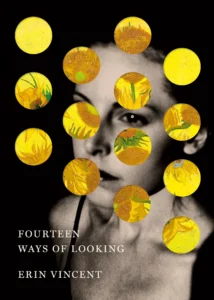
[Deep Vellum; 2026]
I was a dramatic adolescent, hellbent on making glamorous the little glories and miseries of my life. She still lives inside me despite the subtle ways I was taught to distrust her. Reading Erin Vincent’s lyric memoir helped me see my young self with kindness, even respect. As I sit now in the numbness of mid-life, I recall with admiration the high school freshman dreamer who wrote heartsick lyrics and recorded them in her bathroom, leaving a cassette tape on the chair of an upperclassman in a band, hoping he would launch her to songwriting glory. Through Vincent’s memoir, the tenderness with which she treats her own dramatic longing, I see nothing embarrassing about the ways my young self tried to be alive. At least she felt something, at least she wanted something. Vincent’s fourteen-year-old self grapples with a far greater obstacle than hoping for stardom. Her adolescent psyche, housed inside her developing body, is faced with an immense tragedy far beyond what my own ever confronted. Both grief and adolescence pine for glamour. Vincent’s writing captures all three.
Fourteen Ways of Looking is a book-length catalogue of obsession. When fourteen-year-old Vincent’s parents are killed in a car crash she begins to notice and then scour the world for iterations of the number fourteen. The book curates her list-like observations of this number in literature, in history, in her own daily movements. Sometimes the entries build in a sequence, leaping and landing in obvious connection. Sometimes the entries feel isolated, orphaned on the page, until connections echo across the chasms of pages and entries accumulate into themes. All the entries are divided by lines of backslashes bending, like Vincent, perpetually toward the past. Akin to Natasha Trethewey’s Memorial Drive in its circling of tragedy with memory, and like Melissa Febos’ Girlhood in its gentleness toward the crucible of the age, Vincent’s work critiques the expectations laden upon young girls and grievers alike. In its cataloguing lyric form, however, Fourteen Ways of Looking is unlike any other work I’ve encountered. Her childlike, mystical search for significance develops over decades, leaving readers with a fascinating portrait of tragedy’s permanent mark on a psyche.
Vincent unzips and bares grief’s spiraling need for sense-making and its deeply self-referential nature. Every appearance of this number must mean something about her, about these specific deaths, making them matter in the world. She notes that it was fourteen stairs that Patty Smith slowly ascended after her final phone call with Robert Mapplethorpe the night he died. In another entry, we are reminded that John Lennon and Yoko Ono were together for fourteen years, that Ono’s 1981 album has fourteen tracks. “Number ten is titled ‘No, No, No’ and begins with four gunshots followed by Ono screaming,” says Vincent. “N is the fourteenth letter of the alphabet. At fourteen when I was told my mother was dead, the only words I could utter were ‘No! No! No!’” These progressions of facts give the effect of a madwoman in front of a bulletin board connecting semi-sensical evidence with red string.
“Novelists should be like scientists dissecting the cadaver,” says Vincent. Her refrain in these observations, “at fourteen, at fourteen, at fourteen,” is the pulse of this body she dissects, more a conspiracy theorist than forensic expert. Inspired by Bach, she attempts to calculate the sum of the mystical numerological values of the letters in her name. “Could my name equal 14?” she wonders. She calculates, but her name is one too many. Even in this, Vincent concludes with a stretched significance—“At 14, I was too much for most people.”
Too much for most people: adolescent girlhood at its core. Vincent gives voice to this age’s unique propensity for romanticization, a phase of life when daydreaming is a balm and an experiment. In one entry, Vincent describes reflecting on the night of her parents’ deaths and wishing she had been wearing a black evening gown and, instead of saying “No! No! No!” saying movie-script lines like, “It’s gonna be a bumpy night,” or “I’ve got a feeling we’re not in Kansas anymore.” She likens herself to fourteen-year-old Anne Frank whose diary entries in hiding from the Nazis express a deep desire to be famous, or to Beryl Bainbridge who, at fourteen, was expelled from school for writing a smutty poem. Reflecting years later, Bainbridge says and Vincent notes, “I was my best at 14 when we’re blank sheets of paper, soaking up every experience. Everything is so strong then.” Later, Vincent mentions that at fourteen she tried her own version of art therapy after her parents died by taking melodramatic photos of her hands. These fourteen-year-old girls span time and place, yet it is easy for me, like Vincent, to place myself among them. Brokenhearted at fourteen over an unrequited love as real as it was ordinary, I pictured myself in an emo music video on a train in Amsterdam instead of a school bus in suburban Ohio.
Melodrama, while often disparaged, especially in teenage girls, helps people make peace with the smallness and singularity of their pain in a large and isolated world. Melodrama leads Vincent to follow an entry about the roving hands of men over her fourteen-year-old body at her parents’ funeral (under the pretense of comforting her) with a fact about fourteen wolves released in Yellowstone National Park. Without melodrama, there is no poetry, no recourse. Melodrama drives Vincent in mid-life to see what mysteries can be uncovered in the fourteenth minute of a never listened-to recording of a tarot reading her mother paid for before her death. Melodrama leads Vincent to believe that, like her mother, she will die at forty-one, her life an inversion of the number with which she obsesses. In one entry, Vincent makes note of fourteen-year-old Mabel Normand, a silent film actress who was believed to be the first person to break the fourth wall in a film. She then proceeds to break the fourth wall in her book. “I have never written without my mother,” she says, “her death looming over me. … As I write this book, I wonder, will I be fourteen for the rest of my life?”
As I look back to my own fourteen-year-old self, I am palimpsest with my present through Vincent’s literary viewfinder. Vincent seems troubled by her stagnation, understandably so given, for her, the age’s connection to personal tragedy, but there is also something beautiful about her young self’s acuteness of emotion. Though fixated on death, fourteen-year-old Vincent is brilliantly, devastatingly alive. I wish for her a release from grief, but an immortality to her youthful flare for feeling. I consider if I too will, against the numbing slog of aging, retain my adolescent self’s acuteness of emotion. I hope, in gentleness, can I?
Samantha Strong Murphey has an MFA in poetry from NYU and has been supported by Bread Loaf Writers’ Conference and Vermont Studio Center. Her work has been published in places like Rattle, North American Review, RADAR and Mom Egg Review and is forthcoming in The Missouri Review, SWWIM and elsewhere. Her manuscript “Bad Prophet” was a finalist for the Trio Award from Trio House Press. She lives, writes and teaches in Dallas, TX.
This post may contain affiliate links.