


[Balance; 2026]
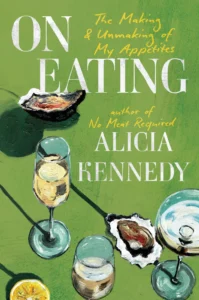
“We have such a deep hatred of taking food seriously [in America],” Alicia Kennedy says in an interview in Hazlitt. “It’s seen as such a frivolous interest.” Kennedy, the food and culture writer of the popular newsletter, From the Desk of Alicia Kennedy, has long dedicated herself to expanding the scope of food media, a traditionally rather limited genre, its subject’s ephemerality often lending itself to a sense of frivolity—a fascinating result of the commodification of reproductive work; eating is, after all, biological necessity, though one might easily forget this in the velvet booths of its opulent modern industries. Across Kennedy’s oeuvre, she insists that our relationship with how and what we eat does not end at the candlelit dinner table, but begins there, its history at once intimate, systemic, and ever relevant to contemporary cultural and political ideologies. In her first book, No Meat Required, Kennedy traces the history of veganism in the US, a tradition that has, in recent years, been white-washed and commercialized, overtaken by juice influencers and technocrats touting bleeding, lab-grown fake meat. On Eating retains the critical position Kennedy takes in No Meat Required and, across her internet and magazine writing and expands its scope, suggesting that food is as much a product of one’s cultural, familial, and personal history as it is a fraught capitalist system. The two seemingly disparate categories inform and affect one another, inform and affect one’s appetites. Like Rebecca May Johnson’s genre-bending epic on the under-considered relationship between cooking and thinking, On Eating is, as Johnson writes in Small Fires, “a text that allows cooking into the frame of critical inquiry and in which critical inquiry is shaped by cooking.” Appetite is not some trivial, base impulse; it is the result of all the systems and experiences that make us, and, crucially, appetite is also what we choose to make of those circumstances.
In a 2011 article in LA Weekly, Jenn Garbee writes of the navel-gazing formulaic nature of the food memoir as a genre, one whose pedestrian subject matter, she claims, inherently falls short of literature’s transcendent gravitas. Ruby Tandoh defends of the genre’s cliches in The Guardian: “I like the similarities that shine through the differences,” she writes, insisting on the value of the “fuzzy, tactile, indefinable things” of food and appetites which food memoirs prioritize over those more “weighty issues.” It is not quite between these two poles, which could loosely be defined in Cartesian terms—food as a subject of the body, while the mind presides over the austere manors of real ideas—that On Eating is oriented. Rather, this book aligns itself with the feminist argument that there is not such a clear line between the two: a person or a book or a doctrine contains both simultaneously, in equal, teeming measure.
Organized as a memoir-in-essays, Kennedy titles each chapter, barring the first and last, using the same formulation as she does in her popular newsletter, From the Desk of Alicia Kennedy: “On Apples,” “On Lamb,” “On Sugar,” etc. These are not, as this titular tradition suggests, definitive theses but roaming, expansive essays. The clarity of Kennedy’s prose, both conceptually and technically, has always been particularly striking to me, and here she blends personal narrative with rigorous research, resulting in the effortless tone of a singular, certain perspective.
In an early chapter, Kennedy highlights the tension between the indulgence of taste and the careful restraint of critical thought. These ideas are organized around chocolate, a favorite treat of Kennedy’s since childhood—sweet, frivolous, celebratory. She describes the overwhelming nature of her affinity for chocolate, which, as a child, prompted her to close her eyes during the introductory scene of Willy Wonka and the Chocolate Factory, for “[c]hocolate was being made,” she writes, “…and it stirred within me too strong a craving for the taste.” A box of Godiva truffles served as the ultimate luxury for Kennedy as a child, when her grandfather would gift them to her after dance recitals. “Oh, I can taste it right now,” she writes, dipping into the primal, instinctual pleasures of flavor, the chemical reactions of sugar. But she quickly interrupts her hedonistic nostalgia: “Chocolate, first true object of my longing and love, was the way I learned about exploitation in the global food system.”
It would be easy to claim upon first glance that this chapter posits a relationship between pleasure and guilt—the risks of excess, indulgence as punitive affliction. (Kennedy is Catholic, after all.) But Kennedy condones the harms of systemic recklessness as she reveres the recklessness of embodied pleasure, of desire and luxury. The foul player here is not the body’s lustful desires but the oppressive systems that allow such desire to be exploited, commodified, devalued.
Kennedy awakens to the harmful structures of the food system as she works through college, begins baking recreationally and then professionally, and navigates her first romantic relationship. “All of this laid the foundation for me to figure out how to align my actions with my beliefs,” she writes in a clear delineation of the book’s—and her own—ethos. It’s chocolate that “open[s] a portal to a new life,” though it quickly becomes clear that, really, it’s Kennedy herself and, as she writes, “extreme dedication to making myself someone of whom I could be proud.” This intense sense of conviction is in part a result of her interest in chocolate—if one can choose one’s indulgences based on both rigorous moral values and attention to flavor, to the particularities of one’s pleasures—if in fact one begets the other—what other worlds could such intentionality open up?
If “On Chocolate” introduces Kennedy to the meticulous process of choosing one’s appetites and choosing one’s fate, “On Oysters” unravels the certainty of her convictions, her control. In devastatingly lucid prose comprised of short sentences and blunt imagery, Kennedy tells the story of her younger brother’s death. “We’d walked by [the funeral home] once and agreed we’d prefer to be cremated; as I brought in his shoes, the shoes he’d wear wherever he was going, I knew I wasn’t keeping his wish. They were so heavy in my hands. He’d be in boots. We’d longed to be dust.”
At this point in the narrative, which moves chronologically through her life from childhood to the present-day, Kennedy has been vegan for several years, working as a freelancer writing reviews of vegan restaurants for The Village Voice. In the “nihilism of [her] grief,” the certain edges of her convictions dissolve; she begins to wonder why she should never again eat a mozzarella stick, why she should deprive herself of the “satisfying pull” of cheese on a Paulie Gee’s pizza. At a party just weeks after her brother’s funeral, she’s enticed by the oysters in ice, recalling her brother’s distaste for seafood of all kinds and her equal but opposite love for it. “I wanted one, … desperately. I wanted to taste sea, taste life.” It is here, in the senselessness of grief, that Kennedy’s careful delineations and strict intentions begin to lose their hard lines. She wants an oyster, so she eats one. She eats many. Her choice is both based on instinct and desire, and also influenced by grief. Kennedy has no interest in eating animals (even her wildest gastronomical fantasies exclude meat), and oysters are sustainably grown and harvested, and local to Kennedy’s Long Island; Kennedy’s deviation from veganism certainly isn’t a great repudiation of her values, but rather an adaptation of them. A diet can be constructed of this sort of intention, too, an intention which is a lack of intention, a relinquishing of (some measure of) control, an ethos which is not prescriptive but personal and shifting and alive.
Kennedy embraces mystery and instinct, pleasure and unknowingness, too, in “On Martinis,” utilizing the messy inducements of alcohol to explore those unwieldy humannesses which can neither be understood nor governed entirely. Of Kennedy’s drink of choice, she quotes the writer Robert Simonson: “The two central facts about the Martini are: it’s the most famous cocktail in history, and we don’t know where it came from.” As Kennedy tries to understand her brother’s death, her own grief, and the complicated dynamics of her family, martinis—gin, olive, never dirty— open up opportunities for conversation and self-knowledge while simultaneously allowing room for that which remains inarticulable. And it is only while holding this empty space between this knowing and not-knowing that she and her family can “revel in our aliveness” together. Martinis are where Kennedy most takes the stance of imbibing for pure pleasure—there is perhaps no easy explanation for some things—for death, for grief, for the smoothing over and opening up that alcohol allows. There is only experiencing. No answers, she writes, “just ongoing conversation.”
Kennedy slowly rebuilds her life and her appetites. While the first half of the book traces her upbringing, the latter half is more mature, certain, focused. This is Kennedy as an adult, cultivating experiences, traveling new places and developing an understanding of herself, of who she is, her identity, her life beyond the circumstances into which she was born, sharpening her values and her interests as she finds freedom in a life beyond the Long Island home she had feared, in her younger years, was inescapable. “On Plantains” takes as its subject this fruit which is not indigenous to Puerto Rico but has become “a symbol of the national identity and its cuisine” as an entrance into Kennedy’s relationship to the archipelago, both past and present. In “On Grapes,” Kennedy connects the adaptable and unpredictable nature of both sustainable wine making processes as well as the flavors of those resulting wines, to her relationship with her husband, one which “continue[s] to surprise” both of them.
“On Bread” finds Kennedy elucidating the democratic qualities of the ubiquitous carb, a food of “necessity, not luxury.” Bread is a staple in almost every cuisine, whether wheat grows in its climate or not. “Wheat is a fast-growing, high-yield grain that is endlessly versatile as an ingredient,” Kennedy writes. “Chances are good that the whole global population would’ve been eating it with or without colonialism.” Kennedy traces the wide-ranging history of growing and eating wheat across the world; a near-universal culinary ingredient across cuisines, bread and wheat are the “most traded crop, globally, of all,” traversing the limitations of its natural habitat. Still, as Kennedy argues, it grows in specific environments and climates and not in others—the tropics, for instance. It is from a place. As the book tightens into its conclusion, Kennedy returns, as she does across these essays, to the relationship between food and place, between place and the self—that we all come from somewhere, that that somewhere both influences and is influenced by us; that there is no revoking these places that are irrevocably a part of us, but there are opportunities to cultivate what remains, and lies beyond. “One can neither eat nor write their way away from their own story, their own place, their own origin.” I pictured the endless hills of my own Northern Idaho: wheat fields in August, gold and dust and whatever was beyond it which seemed to have nothing to do with me. Kennedy seeks, across her newsletters, podcasts, lectures, and books, to understand the relationship between being shaped by her life and shaping it herself. She cannot deny that which remains uncontrollable, but she refuses idle acquiescence to her circumstances; instead, she chooses to invent her own definitions of freedom from the exact ground upon which she stands.
On Eating follows in the traditions of Ruth Reichl and Diana Abu-Jaber’s personal memoirs of cooking and eating, but expands the genre further; Kennedy incorporates the feminist perspectives of essayists like Chris Kraus and Kate Zambreno, and the critical reportage of Michael Pollen’s The Omnivore’s Dilemma and Mark Bittman’s Animal, Vegetable, Junk, with an Anthony Bourdain-esque sense of hunger for culture and experience. The result is a memoir that insists the mechanisms of the global food system are as much a part of our individual lives as the flavors we taste, the tables around which we gather; Kennedy is interested in the confluence of these spheres and the intention and integrity with which we each can imbue the decisions we make within them: “The choices in how we source ingredients, approach our precious resources like water and coffee, and consider how to share the joy that is always attainable through food and gathering around a table will always matter.”
Like Kennedy, I do not find boring or inconsequential the quotidian details of that which sustains us, whether tangible or ideological; still, I admit that memoir, and in particular the forced symbolisms rampant in food memoir, often strike me as a little too clean, a little too straightforward (the other place that made me, after all, is poetry). To construct a life, this random and roving thing, a “shifting phantasmagoria,” per Didion, from which we pluck out the stories we tell ourselves, within the limited confines of narrative seems so laughably false that I struggle to suspend my disbelief; or I get bored. But On Eating takes these fabrications as its very subject, and Kennedy considers this relationship between shape and shapelessness, choice and circumstance, control and abandon, with sharp clarity and a balance of rational thinking and embodied experience that comes across as both meticulous and natural. It is precisely this fabrication—this fashioning, this constructing, this “making and unmaking”—that has led Kennedy to the life she’s always wanted—or as close to it as our warming, wary world will allow her. A gorgeous testament to the power we have to direct our lives both personally and politically, to shape our realities—to affect the world as it affects us.
Emily Alexander is from Idaho. Her poetry has been published in Narrative Magazine, Conduit, and the 2023 Best New Poets anthology, and she has written essays and criticism for The Rumpus, Write or Die, and Cleveland Review of Books. She works in restaurants and lives in Brooklyn.
This post may contain affiliate links.