


[Rescue Press; 2025]
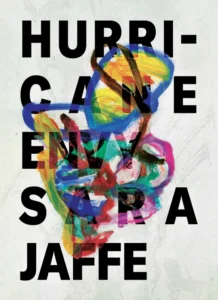
A whorl of streaky, vibrantly colored brushstrokes somewhat obscure the title and author’s name. To make the words out, you’ve got to look closely or look again. Hurricane Envy is a collection of fifteen short stories published by Rescue Press, an independent publisher of “chaotic and investigative work.” Jaffe is a co-founder of New Herring Press, the author of the 2015 novel Dryland (Tin House), and an instructor at the Pacific Northwest College of Art’s Low-Residency Creative Writing MFA program. The stories range from two pages to twenty-one pages; typically follow an unnamed young adult-ish character; are rooted in realism; and often avoid neat or obvious endings. Jaffe seems most interested in metafictional storytelling, queer parenthood, human spiritual connection to music, experiencing atrocity from a distance, and feelings of belonging or unbelonging. The title of the book, Hurricane Envy, is not the title of any one story in the collection but a sort of thematic thesis for many of the experiences of Jaffe’s characters. The phrase is taken from the seventh story—“Stormchasers”—in which the narrator asks: “How many demerits for hurricane envy?” or how might our selfish connections to place, to one another as people, be damaging?
Jaffe’s stories reward the impulse to look more closely. Each piece holds layers of meaning to sift through or catch. At first glance, the eleventh story—“Unsafe is not a Feeling”—appears simple in its rapid unfolding, a single scene in which an anxious character narrates their experience of a therapy session. The story is four-and-a-half pages, avoids narrative arc, and is anchored by the repetitive (possibly obsessive) nature of the narrator’s observations: “My therapist looked less tired than I felt,” “My therapist put down her pencil and sat up straight,” “My therapist snapped back to her typical implacability.” But, a curious reader, in looking past the narrator’s personal hurricane of thoughts, wonders what has happened in the world just before the present moment of this story. The first sentence of the piece quietly incites this question as it distracts from it—“On the morning after, I happened to have a therapy appointment.” There is never an explicit confirmation of what may have occurred the previous day; instead, readers are invited to fill in that gap. To do so, requires thoughtful attention to the details of the narrator’s fears and the therapist’s questions. The therapist asks if the narrator is afraid of being taken away in the night and forced to wear a “yellow star” and “pink triangle” on their coat. The narrator acknowledges it is something they have worried about since “Ohio, then Florida, then Wisconsin were lost to us.” A reader wonders if the event occurring the previous day was an election or new legislation in the United States.
On the fourth page of “Unsafe is not a Feeling”, the narrator gets to the source of their unexplainable anguish through a resurfaced memory of the “Black Door”—a door through which only Black people could exit their high school or “you would get jumped.” Back then, when faced with the knowledge of the “Black Door,” the narrator’s wish, as a white person, was for a “White Door that was worse… A really bad door, a decrepit door that got stuck, that you had to duck to get through, that led to the basement where rats and snakes lived.” The narrator’s teenage awareness of racism made them crave punishment, both personal and for every white person. But Jaffe seems to know that it is never the white person who gets punished.
Jaffe’s careful crafting of the final moment of “Unsafe is not a Feeling” points at the reality of government-sanctioned brutality and racial violence. There is a burst of familiar imagery—“flashing lights, caution tape, something wet on the ground”—as the narrator pictures the scene of a white cop shooting “the black kid in the elementary schoolyard.” The narrator experiences this memory as a feeling of self-loathing, “I hated the white cop, and I was closer to him.” This feeling is, again, reiterated in what may be read as the syntactic distortion of a slogan of the Black Lives Matter movement—I can’t breathe—the last words of Eric Garner, George Floyd, and so many other Black people killed by police officers in the United States. In the final moments of the story, the therapist attempts to get the narrator to calm down by taking deep breaths, and the narrator ends the piece with that linguistic distortion— “‘I can’t,’ I said, breathing.” The self-loathing remains, the privilege, the irony, the wanting to be punished, wanting to make someone else’s suffering disappear. Everything spirals together and there are no easy endings, Jaffe implies.
Hurricane Envy’s representation of white guilt, while not especially novel, is intelligent and rhetorically alluring. The pleasure comes from Jaffe’s transparent refusal of narrative closure. In “Stormchasers”—the aforementioned story from which the collection’s title is culled—the narrator, now living in an “easy…beautiful” place wishes they still lived in their previous “flood zone” city currently being hit by a hurricane. This set-up mirrors the same sort of situation many of Jaffe’s characters find themselves in—persons of some privilege who are paralyzed by a complicated guilt about living in more comfortable circumstances than others around them. The narrator of “Stormchasers” creates a system of demerits for what they and their partner determine to be bad behavior. At a certain point in the story, the question is asked, “How many demerits for hurricane envy? How many demerits for admitting the selfishness—the self-centeredness, the poor-me-ness—of that construct, but refusing to denounce it, thus denying this story that feather in its cap?” In “Stormchasers”, the narrator’s admission of selfishness, yet refusal to denounce that selfishness, is acknowledged as a means of sidestepping the closure that stories often ache for.
And yet, conveniently, all stories must come to a close. The final piece of this collection—“Why I Am Not a Storyteller”—grapples with this problem. The narrator has a cat who is often found wandering other people’s properties. They become used to receiving calls from neighbors who have “found” their cat. Once this set-up has been established, the fourth wall is broken, and the reader is directly addressed:
If up to this point you’ve been reading with even a swab of attention—tuning in to the shape and scaffolding of the narrative, as it were, the tones accumulated—you’ll get a sense that we’re about to land on a particular day, a particular call, a call that was substantively different from the others in some way…
The narrator describes a call happening either on or after October 7th, 2023 (the day Hamas led an attack from the Gaza Strip into Israel), in which someone recognizes the name on the cat’s collar as Jewish, and their phone call evolves into one “across difference” between the man who found the cat—a Jew who worries mostly for the safety of Jews, it seems—and the narrator—a Jew with a “Free Palestine” sign in their window. After the conversation ends, the narrator’s cat comes home; and the story swirls into a list of actions the narrator has taken in their life including: staring at “the photo of Yazan Kafarneh, taken while he starved to death,” calling “Congress members,” protesting “at the county offices,” as a kid—dropping “coins in the Hebrew School Tezedakah box for trees to be planted on what they called empty land,” and standing at “the wall of the Warsaw Ghetto.” The list of actions circles into further reflection:
And my kids have food, whatever they want. And I wish my house were papered in posters, and that someone, offended, would knock on my door. And I pause when deciding which pics to repost. And south of Rafah there is nowhere to go. And as much as I rail against resolution in fiction, all stories are granted the relief of an ending.
“Why I Am Not a Storyteller” seems to say—when we think of world events as a kind of story, we expect to see every incident come to some conclusion. We see ourselves as the main characters. We narrate the story from our points of view. We envy those in the midst of a hurricane, wondering “what if this was my big story to tell, what if this was about me?” Hurricane Envy, posits that stories let everyone off too easily. By acknowledging the privilege her narrators have, Jaffe’s uncertain endings subvert, ever-so-subtly, that implicit imbalance.
Willow Campbell (they/them) is a Creative Writing candidate with the Northeast Ohio Master of Fine Arts Program through Cleveland State University. Their work has appeared in venues such as X-R-A-Y, Cleaver Magazine, Your Impossible Voice, and Cleveland Review of Books. You can find them on Instagram: @unbroken.blue
This post may contain affiliate links.