


[Crop Circle Press; 2026]
Deep in rural nowhere, a shadowy organization called The Agency has assigned a small group of people to a strange project. The project’s aim is to broadcast a message using a line of radio towers. From here, things get more complicated. Our narrator, a linguist by profession, has been instructed to create the language in which this message will be transmitted. She is not instructed what the content of the message is supposed to say, or who the intended (or unintended) audience may be. Complicating matters further are the three other people involved in the project. There is Jenny, who is nebulously a mathematician, plus a computer scientist, and an engineer. The Agency, who has brought these four individuals together, has instructed them that they are never to discuss their work with the others.
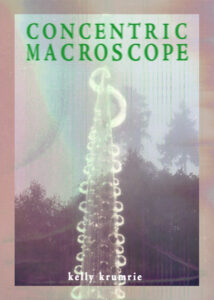
Immediately it will become clear that the book’s title is the key to unlocking its structure. Written as a series of punchy paragraphs, many as short as one sentence, Concentric Macroscope is a series of stories and ideas that wrap around each other, building with increasing complexity. The effect is like the rings of a tree, radiating outward from a central point, but perhaps the better comparison would be, fittingly, a radio tower. The book is anchored along a couple of sturdy themes (language, connection, loneliness) and each punchy little assertion weaves a latticework between them. In between, negative space and the sky. What may appear to be the sort of “wan little husk” that has come to occupy a sizable chunk of literary fiction reveals itself to be a feat of meticulous engineering.
Perhaps it may be best to approach a book titled Concentric Macroscope by beginning at the center of its strange geometry. Kelly Krumrie‘s impossibly complex, and dizzyingly plotted novella of ideas is the newest in a very specific lineage that encompasses both linguistic philosophy and avant-garde art. She is not the first contemporary writer to place themselves on this family tree, but she may be the first to succeed at it. Krumrie stacks up against twentieth-century titans like Marguerite Duras and David Markson. On this side of the millennium, Concentric Macroscope stands on equal footing with zeitgeist-capturing, decade-defining works like The Argonauts and The Department of Speculation.
Concentric Macroscope is a densely woven tapestry of tone and texture, akin to experimental films like News From Home and Last Year at Marienbad. The events of the novel are not linear in a chronological sense, but do deepen each other as different threads surface and disappear. Characters gain, lose, and regain, their names as we orbit different intersections of past and present. Readers will have to connect the dots, but the end result is a slow accumulation of the different facts, scenes, characters, and details, adding up to our total understanding of the novel. Krumrie pulls off dozens of “lightbulb” moments per page as these connections are forged, and telling the events in simple chronological order would deny readers one of the most immensely gratifying reading experiences of my adult life.
With the novel’s interest in language, and its recursive, axiomatic style, one almost has to assume that it rests in the shadow of Ludwig Wittgenstein’s 1918 Tractatus Logico-Philosophicus. The Tractatus is a series of 525 statements, with each one reinforcing and building upon the statement before it (like a group of concentric circles). The abbreviated gist is that Wittgenstein believed there was a direct relationship between physical reality, and that the world was changed by our ability to describe it. For example: there are a number of medical conditions that were believed to stem from supernatural or religious sources, which we would now call neurological conditions. One must coin a term before they can use it. Or, in the case of Concentric Macroscope, one must invent the language before it can be used.
Almost immediately, the narrator of Concentric Macroscope reckons with the impossibility of her task. Surrounded by engineers and computer scientists, our linguist narrator feels unequipped. She supposes that if anyone wants to be perfectly understood, they should communicate with math instead of words. As such, language begins to take on a spiritual sort of air. Language is malleable and limiting, something done on faith. This is what Ludwig Wittgenstein meant with his famous assertion that the “limits of my language mean the limits of my world.” If you do not know how to talk with, or about, something, then how can you expect to understand it? “We don’t know how to communicate with the unknown,” Krumrie tells us. “Gods; the dead; plants, animals, minerals; inhabitants of other planets or space; the interior and secret mind of the person beside us.”
Disconnection and alienation are the most present themes in the novel. The linguist, the computer scientist, the engineer, and Jenny, are instructed never to reveal anything about themselves, and never to share the nature of their work with each other. The Agency, which has brought them all together, is attempting to keep them atomized and isolated. Just down the road, in the nearest town, people begin to wonder what exactly is going on up there at those radio towers—but it’s not as if they can just ask. This, too, is a concentric circle in our story. By the end of the novel, our core group of characters can see that The Agency has begun to clear another section of forest nearby, though they are unsure of that clearing’s purpose. Their project is a circle within the larger circle of The Agency. As the mood surrounding the project becomes increasingly paranoid, our narrator begins to wonder: “Is the purpose of this experiment to solve a problem? Or to create one?”
Problems will always arise when the tools intended to solve them are imperfect. How can we communicate with each other when we cannot know even “the interior and secret mind of the person beside us.” In direct contrast to the isolation our narrator feels at the foot of the radio towers, our narrator begins to meditate on her past, and about a previous relationship with “the man from the gallery,” before she joined The Agency. The man from the gallery is interested in the visual, and represents a time before the narrator had been given this impossible task and this obsession with language. Sex is connection with another person, an act entirely outside of language. Still, language is the only thing of which our narrator can be sure. “A sentence is a thing to be followed” the narrator repeats at various times, like a mantra. “I’m tired of being led by men,” she says, only once.
For all of its erudition, its avant-garde structure, its heady metaphysics, Concentric Macroscope is a moving book. The aching is palpable. The reader travels through the building and collapse, collapse and rebuilding, of meaning. The line breaks in between each of the book’s individual axioms does not pad the length, but instead draws visual and physical attention to the disconnection our narrator feels as a result of language’s imperfections. Geometry creates a concentric circle, but language splinters.
Stories about language, and certain subcategories of science-fiction, are stories about human loneliness, and Concentric Macroscope is no different. So often, science fiction wrestles with ideas like solipsism—raising questions about sentience, asking if we live inside of some grand simulation, or otherwise wondering whether or not we are alone in the universe. And who wouldn’t find some comfort in supposing that human beings are not alone in the universe, and moreover, that we will be able to establish contact with whatever else is out there?
As a reader in the year 2026, I couldn’t shake the notion that the book can be seen as an allegory of artmaking in an era of suffocating tech and artificial intelligence. With her novel, Krumrie has created a system of characters and events that has been sent out into the unknown, not knowing what she will receive in return. I, for one, am grateful to have heard the message.
James Webster is a writer, reader, and the co-owner of Recluse Books, an independent bookstore in Fort Worth, Texas.
This post may contain affiliate links.