


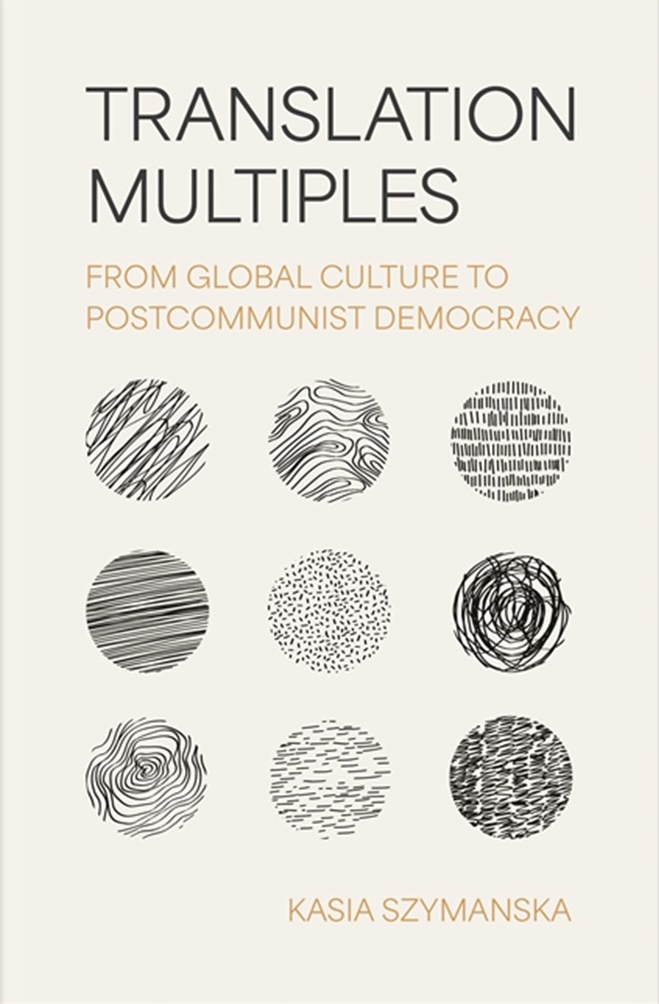
In her new book, Translation Multiples, Kasia Szymanska writes about literary works made from two or more translations of the same “original” text. I first met Kasia in Oxford, U.K, where she taught me with good humor and infectious curiosity in a seminar called “Spaces of Comparison.” In the years since, as a reader and writer of translations, I’ve thought of Kasia often. Her work reminds me that multiplicity in translated literature is a problem in the best sense. Kasia and I talked about her new book over email and a shared google doc.
Fiona Bell: How did you come to this project? Were you drawn to a particular set of multiples, or was the process more deductive, beginning with the theoretical problem of the multiple?
Kasia Szymanska: I started out with two or three cases of my favourite translation multiples, thinking I might eventually write about them from a more theoretical angle – mostly because no one else seemed to have done it. Back then I didn’t even call them that, so I had to come up with a snappy name for this whole practice as I went along. But the more I poked around and read, the more I kept stumbling across conceptual books that gather different translation variants, or poems that play with the idea of translation plurality. And that got me wondering: what are these authors trying to say? Why do they choose to multiply translation variants in such a playful, creative way – and why now? And, more broadly, what does all this mean for translation itself?
But what really made this project feel so vibrant and fun was how it grew through other people feeding me examples and telling me about their own “translation multiples.”. A few people would say things like: “Oh, this reminds me of another book/poem – have you come across it?” In a way, the book almost has multiple co-authors (which is why the acknowledgements section is so long!), because it simply wouldn’t exist without the generosity of people who shared their reading fascinations and experiences with me. All of this made me realise that “translation multiples” form a much more capacious category than I’d initially assumed. At various points, people would come up to me and say, “I know a translation multiple of a Cameroonian poet,” or “There’s an early modern Dutch translation multiple of Boethius.” It turns out to be a surprisingly widespread artistic practice – a way of thinking about translation’s creative power that isn’t tied to any single national tradition.
Several chapters center on Poland in the 1990s, where translation multiples developed in response to Soviet writing and publishing legacies. For post-communist Poland, and maybe also for anglophone readers today, how does capitalism determine the practice(s) and valuation of translation? I think it’s common to assume, “translations just aren’t valued by the anglophone marketplace,” which maybe leads us to take for granted how capitalism shapes translation. How is the “multiple” treated under capitalist publishing, and why?
Ah, that’s such an interesting question! You’re right that the last couple of chapters look at this practice against the backdrop of Poland’s economic transformation when the shift from a state‑run publishing system, controlled by a handful of public institutions, moved rapidly toward what we might call a U.S.-style free‑market model. That sudden change reshaped the literary landscape. It sparked a boom in translation multiples and, more broadly, in multiple translations of various “foreign classics,” often produced by newly established or newly independent publishers that mushroomed in the early 1990s. They worked fast, sometimes chaotically, and really bent over backwards to fill the gaps left by the communist publishing legacy. Paradoxically, this scramble actually fuelled the growth of literary translation and helped cement its strong position in Polish publishing culture. Today, roughly 25% of books published in Poland are translations, a figure that’s broadly in line with many other European countries.
When you compare that to the U.S. and UK markets, where translated titles hover around 3–5% of all publications, the contrast can look a bit bleak. But here I’d point less to capitalism itself and more to the global dominance of English. Because of its position as a lingua franca, English‑language publishing tends to export literature rather than import it. Back in the 1990s, Lawrence Venuti famously linked this to anglophone ethnocentrism; whether we call it that or a form of imperial navel‑gazing, it’s also tied to the sheer economies of scale of global publishing in “world English”, which overshadows many other literary ecosystems. But even countries with strong translation cultures and long‑standing book markets (like Germany, Italy, or France) still translate primarily from English. And that doesn’t exactly help with what English PEN calls bibliodiversity. The gravitational pull toward English is strong, and the whole picture is far more complex than I expected when I first started working on this project!
Now, when we think about the potential of the “multiple” under capitalism, things do get a bit murky. In theory, free‑market publishing should be democratic and open enough to allow translation multiples to flourish. In practice, theEnglish‑language market is narrow and highly competitive, and economic pressures often work against the idea of pluralist dialogue through multiple translations. One obvious factor is that publishers want their translation to be seen as the new, definitive, authoritative version, the English Dostoevsky, so to speak. That kind of canonical positioning (reinforced by reviewers and critics quoted on the cover) drives sales and institutional uptake. This is also why translation multiples tend to be more experimental or transgressive, and why they often end up with independent presses that operate under different constraints. But even there, practical economics get in the way. Producing multiple translations is expensive: more pages, more editing, higher printing and shipping costs. From a market perspective, there’s simply no incentive to publish more than one version of a text. And then there’s the issue of intellectual property. Copyright holders (especially literary estates like the Brodsky or Brecht ones) can block or tightly police new translations, refusing permission for additional versions.
In that sense, the system can create local monopolies around certain texts, not entirely unlike state‑controlled publishing. Ideally, of course, we’d want multiple translations of many authors so we could really explore their multifaceted nature. But in reality, aside from a handful of well‑established writers who get translated repeatedly, most authors available in English, and especially those from less frequently translated traditions, exist in just a single version.
You offer many observations about the emotions involved in reading translations: the translator’s frustration or disappointment with a single equivalent, the (perhaps transgressive) pleasure of multiples, or the boredom or fatigue that the average reader may feel when reading multiple translations. How does the body—the reader’s body, the translator’s body, or wider networks of bodies—appear in your case studies, and in your argument?
Another brilliant question, thank you! I think this argument plays out across my case studies on a few different levels. One of them is the deeply personal – and sometimes even bodily or visceral – response that creators of translation multiples often have to the original text. Many of these projects become entangled with their own life stories and experiences. A striking example is Douglas Hofstadter’s 1997 Le ton beau de Marot, which gathers 88 translation variants of Clément Marot’s poem about a “sick damsel” (Ma Mignonne [My Sweetie]). While Hofstadter was working on the book, his wife Carol was diagnosed with a brain tumour and, in a painfully literal way, came to embody the bedridden “sick damsel.” As her illness gradually limited her movement and cognitive abilities, Hofstadter dedicated one version to her (“Carol Dear”) and invited her to contribute her own response, which became the final piece in the sequence (“Chickadee”). The dialogue between these two translated poems becomes a tribute to his late wife – her body no longer present, but her translation still alive, resonating within the long chain of multiples that outlives the original in the same way poetic form can transcend bodily constraints.
Readers’ reactions, though, are just as complex. I kept circling around questions about how people actually experience the pleasure (or discomfort!) of reading translation multiples. Is it boring, difficult, or too demanding of our attention? Does it provoke a sense of loss, chaos, or anxiety? Or can readers settle into something rhythmic, harmonious, even mantra‑like? Do people enjoy following variations the way they enjoy listening to different covers of a favourite song, or watching multiple adaptations of a beloved book – all familiar yet always slightly different? Do we crave the comfort of repetition and familiarity, or are we also open to novelty, experimentation, and difference?
One honest answer is that translation might as well work a bit differently from music or film. Most people don’t go to the library to borrow four different translations of Anna Karenina and read them back‑to‑back – that’s the domain of translation scholars. As Jess Jensen Mitchell put it in her review of my book for Hopscotch Translation, perhaps only “true devotees and a certain strain of conceptual artists have the patience to stay with a given work across page after page of different translations.”
But then, there’s another side to this. I’ve used translation multiples in teaching, in interactive workshops, and in “translation slam”‑style readings where the audience hears and/or reads the variants aloud and shares their first reactions. Every time, I’ve felt that the collective performance of these multiples – through our situated, embodied voices – creates a different kind of participation and bonding. That network of bodies becomes a reading community in its own right. In other words, unlike the solitary experience of reading a single, authoritative original, translation multiples feel inherently collective, plural, and community‑building. There’s a sense that unity really is strength.
Translation is gendered: the translator has historically been imagined as a feminized reproducer of the masculine “original” text. Does the translation multiple—or, perhaps, a pro-multiple readerly sensibility—offer us new ways to think about sexuality, kinship, or reproduction?
I hadn’t really thought about this angle before, but it’s definitely something that translation multiples – subversive as they are! – have the potential to push forward. If we think about the old, patriarchal model of the creative, masculine‑coded original versus the derivative, feminine‑coded translation, the hierarchy rests on the idea that a single translator serves one authoritative master text and is meant to reproduce it as faithfully as possible in a neat one‑to‑one ratio. With translation multiples, the tables turn. Translators start challenging the original’s legacy, responding with their own bursts of creativity, filtering it through their own artistic idioms, and effectively fracturing its supposedly untouchable ego into a constellation of splinters. Once you multiply the variants – each one constituting a possible, legitimate version in their own right – the myth of the singular authorial figure inevitably starts to wobble.
In the book, I look at both female and male creators of translation multiples, all of whom share this pro‑multiple sensibility. What’s striking is how powerfully they communicate this way of thinking about translation to their readers. The message is no longer: this is the one authoritative translation of this text. Instead, it becomes: look, many other scenarios are possible. And the relationship between those plural translations and retranslations begins to look differently: more like coexistence, collaboration, and solidarity (all traditionally feminine‑coded), rather than rivalry, hierarchy, and monopoly (traditionally masculine‑coded). And because multiples create space for many voices, they also become an inclusive platform for perspectives that might otherwise be sidelined, especially those quirky, queer, marginal, or stylistically “outlier” idioms that wouldn’t easily find their way into print in a single‑translation model.
But you can also see a parallel in real‑life translation scenarios. Think about Google Translate’s well‑documented gender bias when translating professions into gendered languages (e.g. Romance or Slavic languages). “Doctor” defaults to masculine forms; “nurse” defaults to feminine ones. That happens because the models learn from historical data in which those gender distributions were the norm. But if we only ever accept the mainstream, single translation option, we risk misgendering people or reinforcing our own biases without noticing. This is where drop‑down lists of translation options in tools like Google Translate or DeepL become interesting. They’re a small but practical example of what translation multiples can offer: a way of capturing a broader spectrum of identities and possibilities. Being presented with several legitimate options already nudges us toward a more plural, less hierarchical way of thinking about language.
If you could set a reading challenge to the translation-multiple-curious, what would it be?
Ha! How about this: find a short poem (or just a few lines of one) that already has several existing translations. Arrange these translations chronologically and read the whole sequence out loud yourself. Then rearrange them – this time not chronologically but alphabetically by the first letter of the opening line, or according to any other principle you like – and read them again in that new order. Does anything in your reading experience shift?
Now take it a step further: cut the sequence into separate slips of paper, label each with the translator’s name, and hand them out to different people. Ask them to read their versions aloud, one after another, from different corners of the room—making sure they include the translator’s name as part of the reading. How does that experience feel? Does it feel different now?
Fiona Bell is a writer and translator from St. Petersburg, Florida. Learn more about her work at fiona-bell.com.
This post may contain affiliate links.