


This essay was first published last month in our subscriber-only newsletter. To receive the monthly newsletter and to support Full Stop’s original literary criticism, please consider joining us on Patreon.
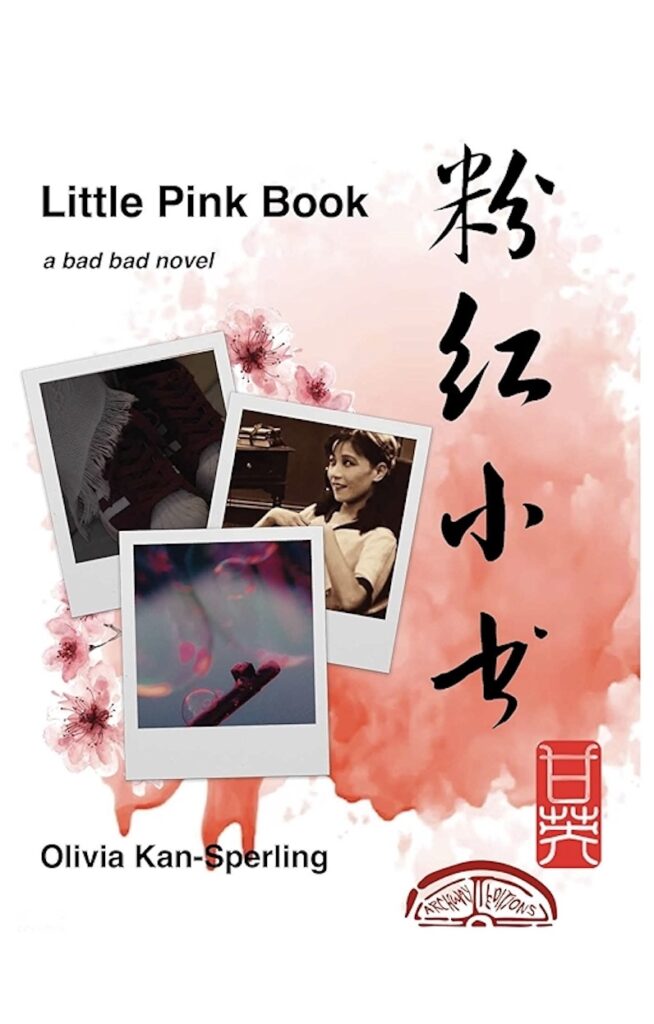
Olivia Kan-Sperling’s Little Pink Book (Archway Editions, 2025) was originally conceived as a companion piece for video-artist Diane Severin Nguyen’s fake documentary In Her Time, which follows an actress as she takes on her first leading role in a film about the Rape of Nanking. Kan-Sperling’s novella was commissioned by Nguyen to be a fanfiction rather than a critical text for her exhibition of the same name at the Rockabund Art Museum, a formal engagement with the “aestheticization of sexual violence“ in both nationalistic films and genre romance literature.
The novella, subtitled “a bad bad novel,” opens with the crux of its conceit. The prologue takes place in a nightclub where there’s a bad boy making crude sexual advances towards Limei—an innocent, sensitive barista, bedroom pop star, and eventual actress living in Shanghai. It’s a set-up heavy with notes of soft-core rape fantasy. The as-yet unnamed man grabs her hip as she turns to return to the dance floor from the rooftop, pushing her against a wall. He rips her dress and “her hands flew up to cover her chest, suddenly exposed to the cold night air . . . he caught them deftly . . . [pinning] both her wrists behind the small of her back.” The prose evokes a sense of desirability in both man’s aggression and Limei’s submissiveness; Limei “[allowed] her eyes to shut,” as he caresses her face, and she felt “like he could see her.” The sequence overtly takes its cues from the “dark” romances of fanfiction and genre fiction, wherein Limei plays the role of the soft, submissive protagonist.
As the novel commences, Limei’s characterization further establishes her as an archetypical romance novel protagonist. She is “the most skilled latte calligrapher at Soft Filter Calligraphic Coffee Shop,” beloved for her unique creations. She was once “the singing, dancing, and acting idol of her whole [high school] class,” and she now dreams of becoming a singer (her parents lament this waste of her talents in electrical engineering). Limei’s physical appearance is often described with the same set of adjectives: skin pale and “lily-white,” “thin hips,” “flawless body.” This characterization is undeniably that of a prototypical Mary Sue, an amalgamation of all the generically desirable traits for a main character and often, by extension, the reader.
In short, Limei is a lonely country girl in Shanghai with no one to confide in except her blog. But when she uploads a video of herself singing her song “Peach Skin Nights,” she comes to the attention of talent agent/”rude boy” Kuai Shilei, who shows up at the coffee shop, tips Limei 500 RMB, and slips her a business card for his company Rose Lily Entertainment. She meets him at another coffee shop, where he tells her he’d love to sign her to be an actress and invites her out to the nightclub, where the scene from the prologue ensues. These recognizable genre tropes promise a story that catapults the main character to stardom amidst a whirlwind romance.
Yet the tropes contained by Little Pink Book do not come to fruition in the conventional sense; there’s no payoff in the romance nor in her stardom. Rather, the stilted dialogue between Kuai Shilei and Limei almost invites second-hand embarrassment. Limei expresses her sensitivity, saying, “You know . . . every night I eat a peach-shaped bun” (a predilection gleaned from the protagonist of her favorite film, Goodbye, Dragon Inn), and Kuai Shilei’s response is a flat “Haha cool.” He goes on to state that he’s usually not into the many women who lust after him, but the pure vulnerability of her bedroom pop music video stirred him to genuine emotion. Two pages later, Limei wakes up to find out she’s been raped. Rape fantasy culminates in real rape. Limei posts a new song called “Dove’s First Flight,” recounting her desire to be washed clean of this traumatic experience and regain her innocence. When she signs with a different talent agency, she is given the opportunity to perform this song over a historical montage of 30s wartime Shanghai for a Dove Soap advertisement. In the wake of the commercial’s viral success, Limei fantasizes about the moment Kuai Shilei might “weep in regret” out of desire for her. She desires reconciliation to no avail, reading like a deluded character trapped in the determinism of conventional narrative. Kuai Shilei, ever the leading male, surprises her with a bouquet of flowers after Limei’s interview on a TV special, appearing decidedly unaffected; he’s “leaning rakishly,” and “cinches one arm tightly around the small of her waist.” His commentary on the commercial is glib and patronizing: “Pretty dark for Dove Soap, haha. Adding the political angle, that war stuff, is smart, smart . . . And the art direction . . . the collage aesthetic . . . wow, how postmodern? Do you know ‘postmodern’? Right, no, you’re like twelve haha. So postmodernism is like when . . . “ Limei’s stardom has resulted in her song about her being raped used for calculated commercial purposes. The novel’s leading man fails to provide the cathartic reconciliation that its form and language appear to promise. He’s unmistakably not obsessed with Limei, and Kan-Sperling can’t resist a subtle jibe to “alternative” masculinity; is it sexy and romantic when the guy mansplains postmodernism?
A common criticism of contemporary literary fiction, especially of the so-called internet novel, is that it performs satire without teeth; it incorporates all the elements of the subject it aims to comment on without seriously engaging with it. The result is a type of banal irony, as David Foster Wallace once framed it in his essay criticizing television as a medium, the oft-cited “E Unibas Pluram.” In her n+1 essay “Toward Pop Literature,” Kan-Sperling invokes Sally Rooney as an example of this exact tendency in contemporary literature. Rooney’s characters can be mouthpieces for Marxist quips and climate saviorism, but the incision of their social criticism does not win out against “a nice little bourgeois marriage plot.” Kan-Sperling further argues that contemporary literary fiction’s “preferred aesthetic mode of judgement” is relatability. It tends to be character driven and dealing with recognizable experiences in content, and equally “naturalistic” in prose style; there is nothing impeding the reader from “mind-merging with the narrator.” Rooney’s novels may be so successful for this particular reason; they’re socially aware yet engender this mind-merging tendency. Her famous protagonist Marianne of Normal People is smart, beautiful, scholarship-winning, thin with no appetite, and the jock/tortured-artist love interest Connell agonizes over his desire for her throughout the entire novel. Though her novels’ engagement with class is undeniably informed by Marxist ideology, the characters and narrative are structured to invite identification and satisfaction in a manner quite adherent to the genre romance.
Conversely, Little Pink Book incorporates every trope and desirable trait one could imagine for a protagonist of a romance novel but subverts the self-insert incentive through a disorienting pastiche of tropes. Limei’s qualities are highly recognizable in a twofold manner. First, she is the Mary-Sue heroine to the rich, bad boy love interest; second, her characterization contains a variety of signs that are typically associated with authenticity (i.e., the ethos of hipsterdom). Kan-Sperling presumes that the most desirable quality one could possess in the eyes of her readers is authenticity, and goes to great lengths to establish Limei’s complicated interiority and individuality within the marked plainness of her situation. The walls of Limei’s room manifest a physical Pinterest board of her inclinations: “There was the cute face of Faye Wong, the cloudy face of Maggie Cheung, and the blonde face of Natassja Kinski.” She collages images of her favorite films, In the Mood for Love, La Chinoise (a delightfully recursive reference, given the novella’s title), Blade Runner, Goodbye, Dragon Inn. She most admires her images of Ruan Lingyu, a prolific Chinese silent film actress who infamously committed suicide at the age of twenty-four. Limei read that 100,000 people attended her funeral service, with three women committing suicide “during the event out of sheer inspiration.” Limei’s peculiar interests are distinctly at odds with the girl we have met in the prologue, who could have been lifted straight out of an enemies-to-lovers fanfiction. As a bedroom-pop star, Limei is pensive, complex, as indie as indie gets, her videos recalling the low production music videos of viral hits like Clairo’s “Pretty Girl” or Lana Del Rey’s “Video Games.” Her taste in films takes after white hipsters that loiter at Metrograph, and her fascination with Ruan Lingyu has much in common with Tumblr sad girls fetishizing Sylvia Plath’s depression. Kan-Sperling superimposes her paradigm of indie-ness onto her Chinese Mary-Sue, implicating the notion of authenticity as not so distinct from the triteness of genre romance heroines. The text explicitly insists on Limei’s unique, complicated individuality, but the reader is encouraged to question this perception of her. To remove any ambiguity, when Limei sees a doctor for insomnia, she is told that her dreams are so “tedious, obvious, elementary . . . it’s a wonder you even have a subconscious at all!”
Limei’s peculiar manifestation of Chinese cultural signs also begs the question of the novel’s seemingly flagrant Orientalism. Her cafe applies “traditional Chinese calligraphy to latte art,” Confucian proverbs appear as epigraphs to various parts of the novel, and the title is a pun on Mao’s Little Red Book. China’s commodified cultural and countercultural exports are undoubtedly in vogue: mass produced toys and boba shops on the one hand, the resurgence of Hong Kong/Taiwanese New Wave cinema and glib adulation for Chairman Mao on the other hand. The novel is laden with references legible to the latter specifically, name dropping Chinese writer Eileen Chang, Japanese filmmaker Satoshi Kon, Japanese fashion label Hysteric Glamour, and many more in order to draw attention to Western compulsions toward East Asian culture. Kan-Sperling here comments on how Western sinophilia has become a new, homogenized mode of expressing individuality.
If there are Western sinophiles who express their own authenticity via the consumption of Chinese and other East Asian countercultural goods, Kan-Sperling writes to draw attention to the absence of value placed on individuality in Chinese thought. She cites Byung Chul Han’s essay “Shanzhai: Deconstruction in Chinese,”in which Han argues that Chinese thought has never recognized the idea of originality and authenticity. Specifically, in Chinese art history, a forgery is thought to be just as if not even more valuable than the original by virtue of the connoisseur’s being unable to detect its replication. Western art institutions decry the same realization as a scandal and deems the replication worthless compared to the original. Crucially, because these artworks do not claim originality or identity, they do not possess soul; “the viewer subjectlessly enters” the artwork because it is inspired by and inhabited by no unique artistic perspective. As such, when replicas or shanzhai knockoff culture perpetuates itself, it acts out a natural cycle of subjectless interpretation and opens an avenue for subversive playfulness, or as Han claims, even anti-authoritarian energies. Contemporary shanzhai knockoff culture itself emerged in the cell phone industry, where fake Nokia and Samsung phones were sold as “Nokirs” and “Samsings.” When fake phones outpaced the so-called originals in design and adaptability—one even becoming capable of identifying counterfeit money—shanzhai culture expressed its potential to be playful and even undermine established economic power and monopolies. Thus, when Little Pink Book appears to invite the reader to mind-merge, it is rather to “knock off” popular literature, to execute its formal and thematic tropes in a subversive manner. In the market for contemporary literature, there is nothing more natural than the rabid success of genre romances.
Little Pink Book insists that it is an “unoriginal” work; its prose is overtly referential to the language of fanfiction, the narrative itself partially derived from the subject matter of Nguyen’s documentary. The novel, in both form and narrative, is a subversive continuation of popular literature that already exists, a literary practice of the shanzhai ethos. Han writes that there is no finality to Chinese art: “The more it is admired, the more it changes. It is regularly overwritten by connoisseurs and collectors . . . it presents itself as a palimpsest.” Paintings can come to bear calligraphy; the image appears besides the text. Little Pink Book heeds this practice formally; it shifts between Limei’s dreams and reality, story and screenplay, polaroid images and text. Its criticism appears simultaneously as its execution, the plot points contrived to the point of self-parody. Right before Kuai Shilei shows up at Soft Filter Calligraphic Coffee Shop, Limei thinks, “A handsome stranger to take me away from here . . . now that would be a surprise!” The main character herself can’t help but feel the inertia of determinism. In the nightclub with Kuai Shilei, she “sensed she was inside a scene that would move forward no matter what.”
Prose style too is a means of conveying the novel’s self-awareness and self-critique. Syntax repeats incessantly, via parallel clause structure in close proximity. Within one paragraph we read that Limei has “slender, delicate, and nimble fingers” and that she is known for her “imaginative, sensitive, and expressive creations.” Words repeat as well, often even within a sentence: “Limei was unique and tonight was also unique.” Such adherence to rudimentary structure reinforces the subject’s banality. Alliteration also recurs throughout the text, often with Limei’s name (“Lily-white Limei,” “limpid Limei,” “listless Limei”) as well as liberally within sentences (“she smoothed the soap over her slippery, silky, satin skin,” the alleys of Limei’s street are “decorated with discreetly dancing laundry lines”). The abundance of adjectives used as well as their phonetic qualities feel superfluous. When Kuai Shilei makes a request for a custom poem on his drink after entering the coffee shop rudely (via Limei’s perspective), she “seethed around, swirling.” The sequence of the verb and adjective are inverted, disorienting the reader that expects to read the grammatically sound phrase “she swirled around, seething.” Kan-Sperling satirizes the trite language associated with popular literature by both “abusing” it (as stated in the novel’s end note), and subverting it, effectively producing an oblique spoof.
Kan-Sperling’s dedication to experimenting with form extends to the physical printing of the text. The color of words themselves are part of the text’s experience; “velvet,” “wink,” “atmosphere,” “skin,” “blushing,” and “chaste,” among other words, appear in pink rather than black, insisting on their commodified girlishness but also appearing at certain points of vulnerability and rawness. The word “blood,” for example, is written in pink in the moment that Limei sees it on her sheets and realizes she was raped. If purple prose is decadent without substance, Kan-Sperling’s “pink” prose is artificial and without deep emotion yet simultaneously filled with innuendo; the Oriental Pearl tower is “pulsing” and “pink,” headphones provide “protection against [the] penetrating sound” of cicadas, the chairs in the cafe where she meets with Kuai Shilei are “rock hard.” Kan-Sperling makes this tension explicit when Limei enters the Oriental Pearl Tower: “Having been injected into this bubblegum bubble, Limei felt slow, cold, sticky. This usually sweet and nice shade—the color of girls and fun—felt, suddenly, claustrophobic. Pink was also the color of insides, and this was too much, too much inside.”
This tension is also the central conceit of the book; the replication of the commercial—pink as pop culture—also belies a raw, visceral desire for feeling. Pop culture itself is worthy enough a subject by virtue of its hypnotic pull and ubiquitous relevance; this shanzhai fanfiction does not claim an authenticity or individuality outside of it but accepts it as a natural, cultural reality. Thus, its only claim is that it perpetuates the process of pop culture through continual mimesis and subversion, organically creating the possibility of something new. Han draws a parallel between the processes of nature and the ethos of Chinese art and philosophy, asserting that “nature provides the model. The organism also renews itself through continual cell replacement. After a certain period of time, the organism is a replica of itself. The old cells are simply replaced by new cell material.” Traditionally, Western concepts of originality in art are not equipped to consider whether creativity is possible under conditions of continual reproduction; it presupposes an authentic source of spontaneous genius. Kan-Sperling experiments with the literary value in replicating existing attributes of popular literature, taking after what Han describes in Chinese art as “operating exactly like” nature instead of “depicting nature as realistically as possible.” Han asserts that Chinese artists trust that by doing so, “successive variations” will “produce something new, clearly without any kind of ‘genius.’”
Little Pink Book unabashedly reproduces the genre romance, laden with tropes recognizable to anyone familiar with fanfiction or fiction in general that invites the audience to self-insert for purposes of pleasurable escapism. Yet these elements are overwritten such that they are not able to provide this mindless pleasure. Limei’s paradigmatic authenticity is made to be ill-fitting; her relationship with Kuai Shilei feebly trails off rather than culminating in the promised cathartic reconciliation. The novel’s “abuse” of the form’s clichés and contrived plot devices make a decidedly bad genre novel but an earnest inquiry into the possibilities of language and the concept of popular literature.
Jade Gu is a tech worker and writer living in Brooklyn.
This post may contain affiliate links.