


[New Directions; 2026]
In 1922, Russian poet Osip Mandelstam wrote that “Europeans are now cast out of their biographies, like balls from the pocket of the billiard table.” What he seems to mean by this rather cryptic formula is that the First World War (known at that time as “the Great War”) and the Russian Revolution of 1917 deprived people of any sense of predictability and shattered an illusion of control over one’s life. A hundred years after Mandelstam, a certain novelist named M does not lament the loss of biography but, on the contrary, attempts to break out of it. Having left her home country after it started a war against a neighboring state, M feels burdened by the identity of an “exiled novelist.” When she gets stranded in an unnamed European town on her way to a literary festival, she decides to join a traveling circus and disappear. Her story is told in Maria Stepanova’s novella The Disappearing Act, a work that, like Mandelstam’s essay, explores the connection between biography, identity, and the inner workings of narrative.
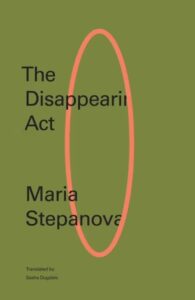
Like Stepanova’s previous books, Holy Winter 20/21 and In Memory of Memory, The Disappearing Act is translated by Sasha Dugdale, a prolific poet, playwright, and translator. She did an excellent job of conveying Stepanova’s prose, which oscillates between lyricism and irony. Having read the text in both Russian and English, I can attest that the Dugdale’s translation does not feel like a faint shadow of the original but rather stands as a work in its own right. The only detail that those who know both English and Russian may question is the book’s title. Original Fokus or Фокус (circus or magical trick, hence English “hocus-pocus”) gave way to The Disappearing Act. If the Russian title only vaguely suggests the setting of the novella and hints at the protagonist’s intention, the English version seems to undermine the story’s intrigue by revealing its outcome from the very outset. Perhaps the change in the title was not the translator’s idea but the publisher’s. But let’s pretend we do not know what to expect from Stepanova’s book and turn to the text itself, which, indeed, has a lot of surprises in store.
The Disappearing Act belongs to a category of texts vaguely defined as autobiographical. The novella’s protagonist shares with Stepanova not only the first letter of the name but also many biographical details. Similarly to M, Stepanova, one of the most renowned contemporary Russian writers, left the country in 2022, soon after the beginning of a full-scale invasion of Ukraine. The writer also shares with her protagonists an interest in the “stories of other people, which she collected like postage stamps, attempting to arrange them on paper in their single correct order”—a clear allusion to Stepanova’s previous prose book, In Memory of Memory, which explored family history against the background of the twentieth-century historical catastrophes. Attentive readers, no doubt, will find in the novella many more apparent and not so apparent allusions to Stepanova’s biography, but that is hardly the point. In The Disappearing Act, the biographical details seem to be mere raw material that is reworked to produce a text that one can read and enjoy (if such a frivolous verb is appropriate in this case) even without knowing anything about Stepanova’s life and literary career.
The novella’s plot is driven by a series of accidents and chance encounters. The novelist M goes from one city to another to perform at a literary festival. M needs to change trains halfway, but the connecting train disappears, and the car she believed the organizers sent to rescue her turns out to be intended for someone else. The protagonist finds herself in a small European town she has never been to before, without any plans or ideas for reaching the festival or returning to the starting point of her journey. To make matters worse, her phone dies, and the charger gets lost along the way. At that point, M stops even trying to get herself out of this unfortunate (or perhaps fortunate?) situation, rents a room in a local hotel, and engages in a quasi-romantic affair with a guy with a ponytail she met on a train. When following him through the city streets, she, by sheer chance, stumbles upon circus workers who are desperately looking for an “assistant for a magic act” to replace a recently deceased coworker. That is when the transformation begins.
What complicates the plot is a number of inserted narratives. They are mostly M’s recollections of the books she read and the stories she heard, as well as of her own past experience. These short narratives, some only one paragraph long, provide both metacommentary on the novella’s events and justification or explanation of some of the protagonist’s decisions. Perhaps the most striking of them is a story of a French linguist captured by “the desert people.” His new owners cut off his tongue, depriving him of the ability to express himself in his cherished French. At the end of the story, the former linguist manages to escape only to realize that he does not belong in the world that used to be his own, and disappears back into the desert. This seems to be a rather straightforward reference to M’s situation, who finds it problematic, to say the least, to continue writing in a language that has become associated with military aggression. However, Stepanova does not stop at drawing the superficial parallels between the emigre writer and the captured linguist. The most important takeaway from this story seems to be the realization that self-transformation, whether voluntary or not, is a painful process that requires symbolic and social death. And while, in the linguist’s case, this transformation was involuntary, under some circumstances, people may find social death a much more appealing perspective than carrying on as before. Or at least M seems to believe so.
I have already mentioned one reason why M wants to transform herself. While M unequivocally opposes the government’s war, she still finds it hard to draw a clear line between herself and what the narrator calls “the beast,” i.e., the state apparatus and the society it controls. As the narrator puts it, similar to the boy from the old tale “who was sitting inside a sea monster with only a stump of tallow candle,” M has spent so many years inside the beast that it is unclear whether she has not become one with it. Or perhaps M was born already inside the beast, which renders any attempts to treat them as separate entities even more suspicious. However, as an emigree writer, M is expected to provide an account of the beast’s habits and physiology, “as if she too had bitten, even half-swallowed, and the fact she had been left lying in the grass, relatively untouched, was only an accident.” Here, we approach the second aspect of the protagonist’s identity that bothers her so much, namely that she is never a mere M but always a “novelist M.” M is a novelist even though she does not write anything at the current moment and is not planning to do so in any foreseeable future. Perhaps you might say, notes the narrator, that M “was a novelist ‘on occasion’—and the occasion was usually at the end of one of these journeys, when readers gathered to meet her and talk.” M is a novelist only because others choose to see her as such. And the only way to escape that position is to find yourself in a place where nobody knows you.
When considered in this light, an awkward romantic affair between M and an unnamed man with a ponytail turns out to be one of the central elements of the novella. When M first sees him on a train, she finds him attractive but takes no further action. Then she sees him again on the street and, “without even knowing why,” starts following him. When a man notices the stalker and approaches her with the most obvious question “Why are you following me?,” M retreats only to bump into him again on the next day. This time, however, the man is proactive: unexpectedly, he invites M to join him in an escape room, and she agrees. The scene in the escape room, peculiar for how it betrays unspoken erotic expectations, ends in the most non-climactic way possible: not able and, frankly speaking, not willing to find a way out of the room, they are rescued by the escape room’s worker, who informs them that their session is over. And so is their affair. Sitting in the cafe after the failed escape, M learns that the man with a ponytail actually knows who she is. Moreover, he had “been at a literary festival not long ago where she’d appeared” and knows the title of her recent book. M momentarily loses any interest in pursuing an affair with this man who turns out to be her reader. “So it was not about her at all, not about M, but a traveling novelist from a far-off country who had kindled in him a respectful interest.” What disappoints the protagonist the most is precisely the failure of her own attempt to escape the identity of the “novelist M,” an opportunity that the encounter with the ponytail man seemed to promise.
But despite her romantic failure, M still finds a way to transform herself. While pursuing the man, she gets acquainted with the performers of Peter Cohn’s Circus. Surprisingly to M, they speak Russian, her native language, which she feels is compromised by the war. For that reason, when offering herself as a substitute performer, M decides to speak English with them. It is in this “apparently neutral, mercifully hygienic” language that they arrange that M will be put in the sarcophagus and sawed in half—of course, not actually, but this is the trick or fokus, as the Russian language and the original title of Stepanova’s book have it. The next day, already having parted ways with the man with a ponytail, M comes to the circus and performs the trick of the “miraculous reunion of two halves of human flesh.” This trick, the narrator informs us, could have reminded the novelist of the widespread motif from Slavic mythology: a dismembered person first being repaired with the help of water of death and then revived with the water of life. “But M was no longer with us to explain how it had all worked, only the noise of the applause that seemed never-ending, and someone’s child in the front row screaming, ‘Again! Do it again, please!” M not only wins over the audience of the circus but also finally escapes from herself. Hundreds of eyes are looking at her, seeing not the novelist but some other unknown person.
Ironically, M transforms herself by trading one public-facing occupation, that of a novelist, for another, that of a circus performer. There seems to be at least two possible explanations for this. The first one is rather straightforward: even after deciding to abandon her previous way of life, M is still trapped in the mindset of a creative worker for whom audience appreciation is the ultimate marker of success. But there is another way to read this scene. Perhaps it suggests that even the most radical act of self-transformation requires a recognition of the Other, whether a potential romantic partner or the anonymous public. If so, it is highly revealing that the transformation takes place in the circus, a space of spectacle where the audience’s gaze consumes the performers. M’s gesture turns out to be not only radical but also dialectical: it strives to overcome what Hegelian-minded writers would call an alienation of self not by returning to some imaginary “authenticity” but by pushing this alienation to the very extreme.
In The Disappearing Act, the circus, as a space of escape and self-reinvention, has a symbolic double: the museum. Early in the novella, we learn that the idea of killing time by visiting a museum appears to M “absurd… and even, for some reason, dangerous.” Later on, M realizes that her distaste for museums stems from a story she once read about a man who, forced into the museum by a sudden summer rain, finds himself trapped there. After finally escaping the building, he ends up in an altogether different place: a city that he left many years ago and to which he never hoped to return. But this city is not a place of memories or nostalgia but the “actual, genuine place, with its executions and political slogans, where he could be devoured without a second thought.” Stepanova alludes to Nabokov’s story “The Visit to the Museum” (1938), one of his most brilliant takes on emigration and nostalgia, in which an unlucky Soviet emigrant finds himself transported to Soviet Leningrad and has to find a way back to Western Europe. Both Nabokov’s story and Stepanova’s usage of it suggest that attempts to restore what has been lost and return to the imaginary paradise of pre-exilic existence are not only futile but also potentially dangerous. In choosing the circus over the museum, M effectively chooses transformation over restoration, fully aware that, in her case, transformation means severing all ties to her previous life.
After her successful performance, the circus’s owner offers M a permanent position in their troupe. Tomorrow, the circus is leaving the town to continue its tour, so the protagonist has only one night to make a decision. The next morning, M packs the essentials, including a pair of trousers and three changes of underwear, but excluding her phone, her book, and her passport, and goes to where the circus is supposed to be waiting for her. However, by the time she arrives, the circus has already left, and all that awaits A, as the protagonist is now called, is an empty lot with a can of cigarette butts and a yellow stray dog. That is how novella’s penultimate chapter, number 22, ends. The book’s last chapter is chapter number 0. It consists of the single line: “Perhaps the caravan was waiting for them around the corner.” “Perhaps” is crucial here. If narrative, as Paul Ricoeur and others have argued, is indispensable for the production of a person’s identity, then, to complete the act of disappearance, A needs to escape narrative itself. And this is precisely what she does at the end of the novella, going where neither the narrator nor the readers can follow her.
Konstantin Mitroshenkov is a historian, literary scholar, and translator. He is currently pursuing a PhD in Slavic Languages at Columbia University.
This post may contain affiliate links.