


[Dalkey Archive Press; 2025]
Tr. from the Norwegian by May-Brit Akerholt
Autofiction is a type of performance art. Recently, I was unsurprised to find Sheila Heti’s Alphabetical Diaries for sale in an art museum’s gift shop, as I consider Heti a major contemporary artist whose medium just happens to be writing. Autofiction invites a reader to imagine the main character is the writer themself, a construct which effectively creates intimacy, immediacy, and credibility, regardless of the extent to which the content is factual. Though the term “autofiction” was coined by a man, Serge Doubrosky in 1977, and though the genre’s most successful exemplar is Karl Ove Knausgaard, autofiction is persistently tainted with the feminine. Rachel Cusk prefers the term “self-terrain” and Sheila Heti makes the defense that “All writers use their lives. Look at Proust—it’s all fucking autofiction.” I can sympathize with the embarrassment of being conflated with fictional characters, as well as the unfair implication that writing from one’s life betrays a lack of imagination. Yet, I admire writers unbothered by the mortifying and misogyny-laced assumptions that accompany even a hint of the autobiographical. This construct is a choice, after all, one that comes with many benefits alongside its drawbacks, not least of which, for me, is its function as a litmus test for sexism and misogyny.
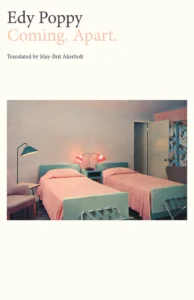
Norwegian writer Edy Poppy claims autofiction outright. Her Instagram bio reads “Autofictional writer and performance artist.” And Poppy embraces shame as a primary goal of her writing: “I want to write until I blush. Because I believe that’s where the most interesting writing, the most challenging formulations, are hiding: in total degradation,” declares the narrator of the first story in Coming. Apart. She writes resolutely about abjection in love and sex; the collection’s seven stories cover incest, stalking, and self-harm, showing what female sexuality looks like when women are allowed to be as complex and flawed as men. Annie Ernaux, Anaïs Nin, and Mary Gaitskill spring to mind as predecessors.
Edy Poppy’s birth name is Ragnhild. She grew up on a farm in Norway and moved to France when she was seventeen. In an interview for Literary Hub with Siri Hustvedt, Poppy says, “Suddenly I discovered I was a woman, feminine. Or rather, other people made me aware of it.” With gender imposed on her more insistently in French culture, she rebelled. She cut her hair, and began to wear men’s clothing, and chose the artist name “Edy” for herself, for its similarity to the masculine name “Eddy.” At this time, she met her first husband, Cyril, who the character Lou is based on (in Anatomy. Monotony. and Coming. Apart.); the characters Vår and Ragnhild are stand-ins for herself. In Anatomy. Monotony., Vår is writing a novel whose protagonist is named Ragnhild. In the first story in Coming. Apart., “The Last Short Story,” Vår reappears and refers to Poppy’s own novel: “When I wrote Anatomy. Monotony., I wanted Ragnhild to be a sympathetic character: the reader should like her because she represented me . . .” Now, Vår wants to write more honestly. The story ends with a sun burn, and Vår “tearing off thin layers of dead skin, dead hide.” This metaphor of shedding past selves is replicated throughout the collection via clothing articles shed from women’s bodies: socks thrown into a corner, underwear on the bathroom floor, a skirt on a chair.
The focus on sartorial details is where I most feel the influence of Marguerite Duras on Edy Poppy, whose books arrived to her childhood home via a book-club-by-mail her mother subscribed to. She remembers reading The Ravishing of Lol Stein at age fourteen, while through the window she could see her family working in their cornfield, she recounts in an essay for The Irish Times. Consider the narrator of Duras’s The Lover, standing on the ferry wearing her mother’s threadbare silk dress, a man’s brownish-pink fedora, and gold lamé shoes. Or, the way Duras’s narrator in The Lover (Pantheon, 1998), translated by Barbara Blay, describes her purchase of the hat: “Suddenly I see myself as another, as another would be seen, outside myself, available to all, available to all eyes, in circulation for cities, journeys, desire. I take the hat, and am never parted from it. Having got it, this hat that all by itself makes me whole, I wear it all the time.” This character is utterly defined by the strange costume, to self and others.
Likewise, the young woman in Poppy’s “Dungeness,” the longest story in this collection and distinguished by its inclusion in Best European Fiction (2015), is known by a dotted skirt and green knee socks. The story begins in a city, where the woman meets a man whose name no one can remember. The new couple move to a boat shed on the coast, near the nuclear plant. The young man constantly observes the woman: “She reminds him of a small child, or something that’s fading away.” The raw, windswept atmosphere of Dungeness suits her. She steps on fish bones with her bare feet, braids broken rushes together, finds Orion in the sky. One day she follows a local man into his fishing shack and obeys him “like a dog obeys his owner” as he tells her to take her panties off, lie on his table, and spread her legs. She tells her lover about it and “days pass, but he can’t get the story out of his head.” Their relationship degrades. He pushes her down into the mud, assaults her, “tears off her skirt, pantyhose, and underwear.” He lets her go, she gathers her clothes, enters the boathouse, and “comes running out again, fully dressed, wearing a beanie, warm jacket, a grey knapsack on her back . . . She runs along the shore, until he can’t see her any longer.” In her absence, he bakes a fish pie, sleeps for days, starts breaking into empty summer houses, and receives mysterious visits from the woman’s mother who arrives in a yellow Beetle. He pauses in front of one boathouse, imagining he might see her “lying on the table, perhaps, in her green knee socks, her dotted skirt.” And then:
Spring:
One day her mother opens her suitcase and dresses in her daughter’s clothes: the green knee socks, the dotted skirt. He stands passively watching as she walks out the door, down to the sea in her stockinged feet . . . From a distance, there’s hardly any difference between mother and daughter.
The costume fools the young man into having an erection. But no, the woman he loved, who wore these eccentric articles, is gone. Within each coupledom, clothing represents a tug of war for power. In “Repeat Ad Libitum,” when Nusch asks, “What’s the alternative to being together?” László answers, “To be alone.” Nusch has left László before—and returned. As he waits for her this time, he fears “losing his individuality,” and goes to great lengths to establish a sense of control, including cutting up and boxing her clothes. The story “Boils” shows a cozy yet claustrophobic domesticity, featuring an older couple beset by painful boils on their bodies, and a long stretch of rain trapping them indoors. Judith tries on dresses for Bror, saying “it’s important to dress up for each other on a day like this…” Bror tries to tell Judith, “I want to be by myself a little more.” Too polite to insist, he says, “Perhaps it isn’t all that important after all.” The story ends with Bror shooting Judith full of holes with his hunting rifle, her blood “pumping out of the flowers in her dress…”
Edy Poppy has performed as “Blaue & Poppy” along with her second husband, German artist Julian Blaue. “The Criminal Complaint Performance,” performed in Kristiansand, Norway on May 9th, 2018 and uploaded to YouTube, is based on an event which occurred in the couple’s personal lives in 2015. While on vacation in Rio de Janeiro, the couple were assaulted by two men in a park. In the police station, after they cleaned the blood off the camera which was returned to them, Blaue took a photo of Poppy looking “like a ghost,” while their baby slept on her lap. Crimes against tourists had risen, one officer explained, during Brazil’s preparations to host the World Cup and Olympics, because social services had been cut, and favela houses torn down. The “stage” is set with a line of objects: folded clothing and accessories. Poppy becomes emotional when she puts on the first item, the dress she wore that night. A photo of her happily wearing the dress before the assault, is projected on the wall beside her. Next, she puts on gold lamé sandals (like Duras!), and applies lipstick, eyeliner, and mascara. Blaue’s outfit she describes as “a bit like a colonial master,” consisting of white linen, a Panama hat, and a black tie. The juxtaposition—between the clothing (from the past) and the artists (of the present) as they explain how globalized capitalism is a new form of colonialism—is jarring. The only explanation: the people who innocently and happily wore these clothes have died, and new selves have taken their place. The performance ends with the couple filing a criminal complaint against themselves, as the perpetrators of structural violence against the two Brazilian men. In this performance, as in Poppy’s fiction, the relationship between victim and perpetrator is blurred, and Poppy implicates herself.
In the overlap between her performance art and autofiction, Poppy demonstrates a relentless quest for self-knowledge. In Poppy’s first book, Anatomy. Monotony., a house burns down, a disaster pulled directly from her own life. She tells Hustvedt:
I loved that house. I wanted to spend my whole life there. So for my growth, for my personal real-life-bildungsroman, it was maybe good that it burned down. It was such a strong symbol…since my material world had collapsed with the disappearance of my childhood home, I started to look inwards, looking for words that could describe what happened to me. I took the burning very personally. I made my house into a story, something immaterial . . . In retrospect I think the fire was the starting point for me being a writer.
Years after Annie Ernaux published the novel Simple Passion, about her affair with a much-younger Russian diplomat, she decided to publish Getting Lost, the diary she kept during the affair: “I perceived there was a “truth” in those pages that differed from the one to be found in Simple Passion—something raw and dark, without salvation, a kind of oblation… I neither altered nor removed any part of the original text while typing it into the computer.” Edy Poppy experienced the opposite. She tells Siri Hustvedt: “I was writing a diary, it was the diary to become my novel [Anatomy. Monotony.]. But as I was rereading it I discovered that my diary was not telling the truth. I didn’t recognize my life in the text I had written, even if it was a diary about myself.” She needed to lie, aka write fiction, to tell the emotional truth. Yet, Poppy writes in The Irish Times, “at the same time I’m bound to reality. When I use my biography, something exciting happens.”
There is an urgency to the seemingly unanswerable questions Poppy asks in Coming. Apart. How do we shape each other? How can we become ourselves? How can one be alone, but not lonely? Or together, without losing oneself? What, in a state of coming apart, can we learn? I returned again to “The Last Short Story” before closing the book. It functions as an artist statement, and a guide to reading the collection, but a narrative unfolds there as well: a love triangle. Vår must choose between two men. She goes away, somewhere far away where she could “wake up in the morning, safe in my knowledge that it was bedtime in Europe.” At an internet cafe, she sends the same email to both lovers declaring she has chosen him and will never see the other: “I just found the email I’d sent Lou, copied it, changed the names and sent it to Oscar.” But the two have found her out. In Poppy’s stories, women are desired, obsessed over, and objectified, and often only object to the experience by leaving—by taking some or none of their belongings and moving out of a space shared with a man. By the end of each story, every character ends up uncoupled and on their own.
Ultimately, the men are incidental; the real triangulation is not between lovers but between Vår, Ragnhild, and Edy Poppy herself. Poppy writes, as Vår: “I’ve tried to write about the idea of coming apart in all sorts of different ways. I’ve seen myself crying in the mirror, thinking it was genuine. That it was literature. But I’ve only scratched the surface, without really meeting my own eyes, or those of the reader, for that matter.”
Morgan English is the recipient of the 2021 Editor’s Prize in Poetry from The Florida Review. Her work is featured in a monograph on the artist Emily Mason, and is forthcoming in The Kenyon Review and The Believer. Originally from North Florida, she lives in Vermont.
This post may contain affiliate links.