


This essay was first published last month in our subscriber-only newsletter. To receive the monthly newsletter and to support Full Stop’s original literary criticism, please consider joining us on Patreon.
The first time I tried to read Blood on the Brain, I was sorely distracted by my phone. I kept doing what we all do now: skimming headlines about concussion in sport, doomscrolling Long COVID threads, watching strangers describe their brains as “fried” or “fogged,” and then I’d look back at the page and realize I’d lost the thread of Akosua’s story again. At some point it clicked: The book wasn’t fighting that distracted, overloaded feeling; it was using it. It wanted me to feel how fragile a story becomes when the main character in it has had their brain knocked sideways.
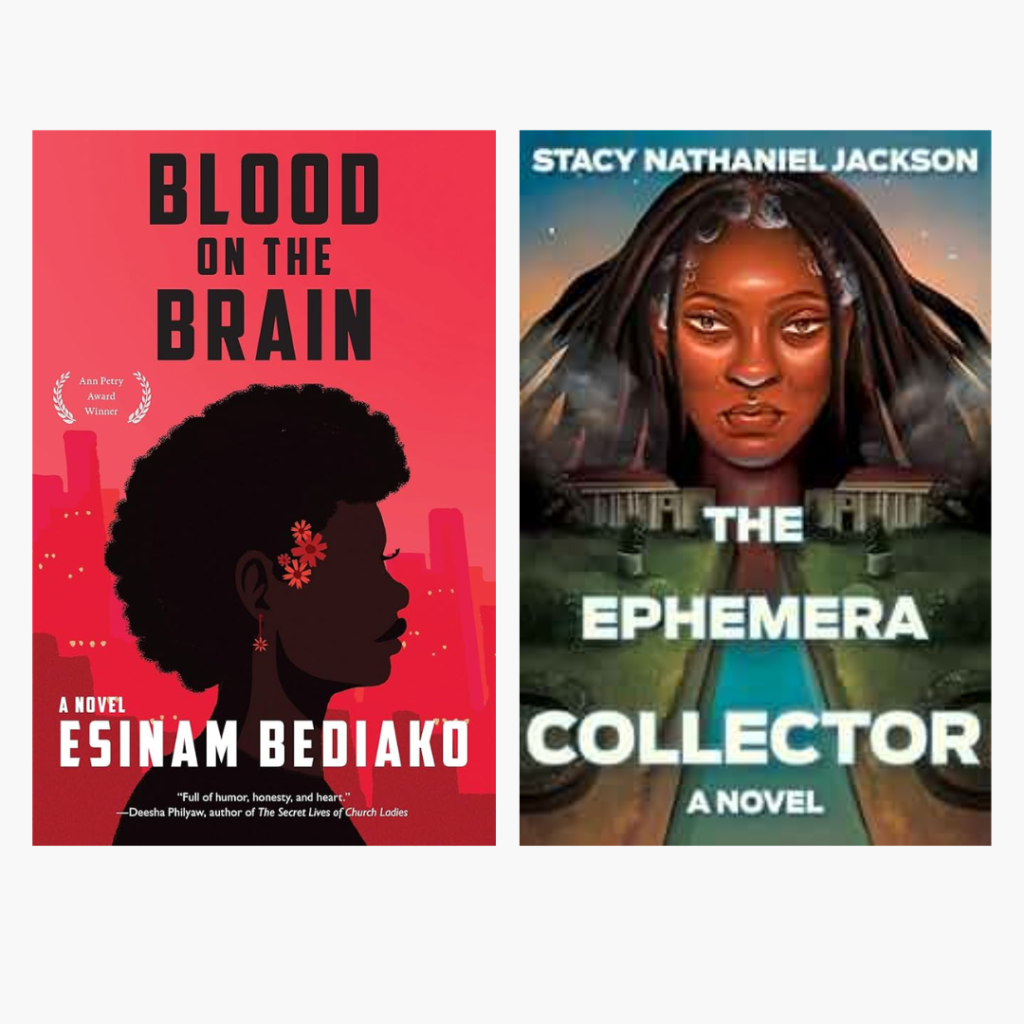
I ended up reading Esinam Bediako’s Blood on the Brain and Stacy Nathaniel Jackson’s The Ephemera Collector back-to-back, and it felt like sitting with two different kinds of damaged nervous systems. One is a sudden blow to the head, the other a slow, viral fog. What joined them, for me, was not just that they “include” concussion or Long COVID, but that these conditions impacted everything from plot and pacing to sentence shape and chaptering. Everything seemed to take orders from the body.
With Blood on the Brain, the first thing that stuck with me wasn’t the injury itself; it was the ordinary moment when the injury started taking effect. We meet Akosua in the campus library, fingers grazing the edge of the information desk, thinking hard about how to turn her crush on Daniel into an actual date. The flirting is awkward and funny, full of small humiliations and haunted by unwanted motherly advice—on “good Ghanaian men,” on how a daughter ought to move in the world. Even before Akosua’s brain-altering accident, she seems off-balance: a twenty-four-year-old Ghanaian American woman in Detroit trying to juggle grad school, family expectations, and a messy romantic life. Trying and not quite succeeding. When the concussion finally arrives, there is no blockbuster, slow-motion description of the incident. It arrives almost as an inevitability, a symptom of her tangled-up life. She falls, hits her head, comes away with a not-quite-right feeling that she tries to wave away. Later, when she’s in the hospital and a nurse dims the overhead light because her head is pounding and the room is too bright, I felt Akosua’s “photophobia” in my own eyes: every small stimulus is suddenly too loud, too sharp. Then there’s the doctor with the checklist voice, running through the possible after-effects: headaches, dizziness, nausea, trouble concentrating, mood changes. It reads like one of those concussion pamphlets you get in an emergency room, but inside Akosua’s head, everything is happening all at once.
The plot, on paper, is linear: Akosua is dealing with her estranged father’s sudden return from Ghana, her relationship with Daniel, her complicated history with her ex, and her own sense of worth. But the way time actually moves in the novel does not feel linear at all. Scenes from the past keep bursting, uninvited, into the middle of something else. One moment Akosua will be trying to handle a conversation, or walking across campus, or lying in bed with a headache, and then the novel will cut to a childhood party, or a fragment of a phone call, or a moment with her father so sharp it feels like a blade. These jumps often happen at points of stress. Whenever Akosua gets close to something unbearable—anger at her father, shame about her performance at school, fear about the extent of her injury—her mind skids away to another time. As a reader, I kept having to ask myself: Where are we now? When is this? What does this scene have to do with the one I just left?
Encounters with her library crush, Daniel, are another source of heightened emotion. Early in the novel, when Akosua attempts to steer their usual polite banter in a more personal direction, the novel’s present timeline wobbles. She’s there, alive in the moment, but then the moment collapses into another, a memory of a phone call with her mother. “I’m crying,” the narrator admits. “I’ve been crying without realizing it.” And before we know it, we’ve rolled into yet another memory. Akosua is a young girl again: “The last time I saw my father I was seven,” she recalls. The past intrudes on the scene as if these stout memories have been waiting on the other side of a curtain all along.
That same pattern shows up later at home, after the head injury is no longer just a worry but a daily problem. Akosua is trying to explain herself to her mother, and the conversation keeps heating up. “As soon as I say ‘voices,’ my mother is on her feet,” the narrator tells us. And suddenly, the tenor of the scene changes, the prose becomes crowded. Akosua’s thoughts scatter. She can no longer produce a smooth sentence. “She’s saying I need to lie down, that I hit my head and that the doctor gave so many possible symptoms and mood swings is one of them. She wants to put me to bed immediately. I will obey.”
In some way, this is what it means to be in the moment with this character: she is constantly reorienting herself. It’s an experience that many people with post-concussion syndrome describe, where days don’t feel like straight lines anymore, where the mind is filled with memory holes.
Akosua is uncertain about how significant the damage is. The syntax of the novel suggests that the concussion’s effects are severe and persistent but variable. When Akosua is caught up in banter with friends, or flirting with Daniel, or fantasizing about who she could be, her sentences stretch out. Her thinking is more complex and involved. She describes a crowded scene in a single, vivid sweep: “Standing in the kitchen feels like standing in the oven: the heat suffocates me, and the smell of various foods cooking churns the acid in my stomach. It’s almost too much, every burner on the stove occupied by a bubbling pot, the oven stuffed with a turkey, a ham, and baked fish, the counters covered with bowls and trays of side dishes African and American.” By way of contrast, there are moments like her call to the college’s peer counseling hotline, where Akosua’s narration feels jagged and rushed:
This girl seems eager to hear me vent . . . So even though I don’t have to, I tell her my name. I tell her my age and my farce of a position as a graduate history student. I tell her about how I hit my head two weeks ago. I tell her the doctor’s diagnosis, post-concussion syndrome, and that so far I’ve suffered from some of the symptoms the doctor warned me may or may not occur: headaches and migraines, difficulty concentrating, depression, trouble sleeping, too much sleeping, sometimes dizziness and disorientation and blackouts. Erratic behavior.
In the scenes where the concussion presses the hardest, we get short sentences, abrupt turns, repetitive phrasing (“I tell her . . . I tell her”), and fragments that feel like disjointed, incomplete thoughts.
Bediako has talked about Akosua’s concussion speeding up a kind of decompensation already under way. One thought that Akosua can’t seem to escape from is “the weight of how much I don’t add up to anything.” The concussion doesn’t produce that feeling, but it makes it harder for her to outrun it. She used to be able to perform a competent version of herself: busy, sharp, functional. After the injury, she simply doesn’t have the cognitive energy to keep the performance going. The structure of the novel—faltering, wobbly—reflects the breakdown of this careful balancing act.
What I love is that the book lets the concussion be both literal and metaphorical without ever flattening it into just one thing. On the literal side, there are the classic post-concussion markers: headaches that won’t quit, sensitivity to light and noise, problems focusing on her reading, a sense that her old multitasking brain has slowed down. On the metaphorical side, the scrambled brain gives Bediako a way to show how migration, racism, family secrets, and romantic disappointment were already fragmenting Akosua’s sense of self. The head injury itself is traumatic, but it exposes a fracture that already existed.
When I turned to The Ephemera Collector, I thought I was moving into totally different territory: new author, new coast, near-future, AI-riddled Los Angeles, an archivist protagonist, a climate change angle. But within a few pages, I had that same feeling: The character’s nervous system was quietly bossing the book around. Where Akosua’s concussion scrambles time, Xandria Brown’s Long COVID and overlapping illnesses thicken it, slow it, and spread it across the page like fog. The novel builds this from its very first structural choices. The table of contents seems less like a list of chapter titles than like a finding aid: “Scrap-Book Volume I,” “Appendix Folder 2,” a list of dated sections and chapters marked with specific times, like “Chapter 2. 8:30 a.m. Pacific Standard Time,” and so on. I felt like I was logging into an archive management system rather than opening a novel. And this tendency toward lists only grows once you enter the story, which overflows with transcripts, emails, catalogue entries, social media-style posts, and visual notes.
Xandria is an archivist at the Huntington, and she tends the Diwata Collection, an archive containing material about a Filipina scientist whose work has become a kind of radical blueprint for survival. Jackson’s novel makes this archive feel alive; it’s not just boxes and files, it’s a kind of extra brain she has learned to rely on. At the same time, Xandria’s own brain and body are under siege. She has Long COVID. Her eyes are inflamed. She is short of breath. She has to monitor air quality, and on bad days she pulls on a full-face respirator just to move through the building. Her adaptive tech, like her screen readers, bots, digital workarounds, are constantly chattering in the background, reminding her to rest, nudging her about eye strain, warning her when she’s overdoing it. But like Akosua, Xandria’s relation to time is warped by her affliction. “Focus can fool,” the narrator tells us. “Trick. Minutes can melt into hours without anything to show for it.” That’s a Long COVID sentence if I’ve ever seen one. It captures the way attention feels slippery, how you can sit in front of a screen and then realize nothing stuck upstairs. Lost in time, Xandria ignores the computer health bot that tells her to stop. No, the text doubles back: She didn’t just ignore it, she forgot. “She didn’t listen. Correction. She forgot.” That little self-correction reminds us that the problem isn’t necessarily willpower, it’s literal gaps in memory.
Formally, the book keeps following that logic. Every time Xandria’s body intrudes, like when she’s too tired to keep walking across campus to the stacks, when a symptom flare hits, when bad air turns a simple errand into a health risk, the narrative does something similar. It breaks, or slides sideways into a document, or jumps back to a transcript from some future interview, or forwards into a different medium entirely. The Diwata Collection itself is written into the book in these other voices and formats: catalogue entries, summary drafts, even what looks like a scholarly essay titled “Can Machines Feel?” So while Xandria feels her own working memory faltering, the novel builds an elaborate external memory around her. The archive functions as a prosthetic brain. The past of Diwata and her comrades is stored there, but so is Xandria’s time, labor, and care. When she worries that her life’s work is in danger—when Huntington goes into lockdown, or when she realizes someone may be trying to manipulate or erase parts of the collection—it doesn’t feel abstract. It feels like someone is sawing away at an extra lobe of her brain. That’s especially true in the way the narrative jumps between years and contexts: We get timestamps from 2035, 2288, 2085. Near-future tech jargon and climate catastrophes are tangled together with very intimate bodily details. Xandria’s brain and the archive are both time machines, and both of them are sick.
Sickness confers on these novels a form of unreliability. With Akosua, I always felt that the unreliability came from two places: her concussion, and her tendency to avoid looking directly at painful truths. With Xandria, the unreliability feels more like a condition of her life and work. She’s an archivist, which means she is professionally trained to know that any record is partial. She’s disabled in multiple ways, which means her own internal sense of time and effort is distorted. She may feel as if she has done “nothing” for hours, when in fact she has been doing the tricky, exhausting work of staying alive and functional. She’s also living in a near-future landscape where AI systems and human institutions are intertwined in opaque ways. All of that makes the question “what really happened?” less straightforward than it would be in a conventional novel.
Instead of giving a clean answer, the book offers folders and voices. The reader must piece together Xandria’s story from transcripts, emails, catalogue fragments, narrative episodes, visual scraps. The sheer variety of forms means we are constantly shifting reading modes, just as she is constantly shifting cognitive gears to manage her day. When I got to the more speculative sections, like the interviews conducted long after Xandria’s lifetime, where the Diwata Collection is discussed as if it were already a canonical, world-shaping archive, I felt that strange, almost dizzy double vision you get when you look at a person and at the story that will eventually be told about them at the same time. That doubleness is a kind of brain fog, too: life as it’s lived versus life as it’s stored.
Putting these two novels next to each other, the differences are obvious. Blood on the Brain feels closer to a traditional coming-of-age story: It follows a twenty-something protagonist in a recognizable contemporary city; it’s full of humor and vivid social observation; and it keeps returning to the knot of family, romance, and identity. The Ephemera Collector is weirder on the surface: near future, genre-bending, soaked in climate anxiety and AI questions, structurally experimental. But a common theme and structural logic are obvious here as well. Both books rethink what an unreliable narrator can be. We’re used to unreliability that stems from malice, from deliberate deceit. Here, unreliability is a side effect of living in a body that can’t guarantee its own clarity. Akosua genuinely can’t remember parts of what happened around her injury, and she genuinely can’t always tell when she’s being guided by present perception versus old stories she’s been told about her father, her Ghanaian roots, or her own worth. Xandria genuinely doesn’t always know what she has done versus what she planned to do, what she read versus what was merely recommended by an algorithm, what’s in the Diwata boxes versus what she has imagined into them.
That doesn’t mean either woman is passive. Akosua still makes choices. Those choices range from terrible and impulsive choices to brave and tender ones. Xandria still acts, hides things, shares things, makes political and ethical decisions about who gets access to what. But their capacity to tell the story of their lives in a neat, confident, straight-line story is compromised by their nervous systems. The books don’t treat that as a flaw to be overcome. They treat it as a constraint to write inside.
I found that strangely hopeful. There’s a temptation, when we talk about illness and disability in fiction, to treat the body as either a tragic backstory or an inspirational obstacle course. These novels do something else. They anchor their most interesting formal moves in the realities of concussion and Long COVID. In Blood on the Brain, that means letting an injured brain dictate an out-of-order timeline, a staccato syntax, and a pattern of repetition and delayed revelation. In The Ephemera Collector, it means letting a fogged brain lean on machines and archives, creating a hybrid narrative that feels half human and half filing system. These books come together to imply that a brain that doesn’t work “normally” is not the end of literary possibility; it’s a new starting point.
Amoye Favour is a poet, a freelance writer and a lover of humanity. A writer by heart, Amoye Favour loves to write on topics that have humanity as its center. When he is not writing scripts, essays, or articles, he is somewhere playing chess. He is a lover of God and is currently based out of Lagos, Nigeria. He can be reached out via X at his handle- @amoyef.
This post may contain affiliate links.