


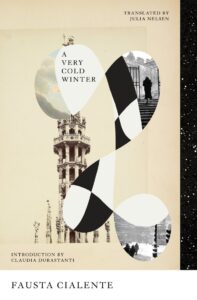
Tr. from the Italian by Julia Nelsen
[Transit Books; 2026]
As I watch the crumbling of US politics and the increasingly vitriolic and revanchist gender politics that are a unique part of class warfare here, I am reminded of fascist Italy: the creepy gaze of an ineffective head of state (Mussolini, obviously) and his regime’s expectations of women. War, and its constitutive masculinism, threatens everyone’s dreams, chances, and sense of selves. Living the legacies of fascism, I wonder: What are we losing? What will it take to get it back? What might be different?
Fausta Cialente’s A Very Cold Winter shows us some of this fascist wreckage, but also tells us that all historical moments come to an end. Originally written in 1964, A Very Cold Winter is a timely addition to Italian feminist works in English. Julia Nelsen’s translation, her first book-length project, is beautiful, full of descriptive prose. Cialente’s style as rendered by Nelsen has a centrifugal quality. Instead of a fast-paced plot, Cialente’s language propels the reader forward. Novels that eschew plot for emotion and still keep a reader riveted are quite rare, working through the interiority of characters to keep us immersed. She attends to the conflicts of the characters’ lives and constructs their interior worlds with care. Events rarely unfold on the page in real time. They are often remembered or, more accurately, felt. When the big events of the novel do occur, they are sudden, disorienting, and never narrated directly. Cialente directs our attention to how characters think about and feel their way through these events.
Cialente is not well known, even within the field of women’s literature in the US (she was last included in a Bloosmbury print anthology in 1992). Claudia Durastanti, a feminist Italian-American novelist herself, in her introduction to Cialente’s work and context, places her at the vanguard of the feminist movement. Cialente’s writing preceded the full swing of Italian feminism in the late 60s and early 70s but she was a contemporary of Carla Lonzi, another woman whose feminism was deeply influenced by her experience with fascism. Like other feminists of her generation, Cialente was engaged with left-wing politics, joining the Communist Party (PCI) within its women’s wing, Unione Donne Italiane (UDI). Cialente saw how the world made by war and fascism was cold, devoid of opportunities for connection, and a place where women are left with tattered social scripts that care nothing for them.
Cialente’s title both refers a literal winter within the novel and is symbolic of the time between the war’s end in Italy in August of 1945 and the founding of Italian democracy on June 2, 1946. The novel follows Camilla, her children, and other found family members as they try to survive this wasteland, living in a freezing attic with very little money. These constraints cause each of them unique hardships. While the novel includes multiple points of view, Camilla, the mother, is the anchor. Her experience of this winter of loss, tragedy, and renewal is bracing.
A major theme of the novel is Camilla’s stuckness and all its conditions and causes: the poverty of the period after the war; the hideous effects of years of fascist propaganda about “the good woman” who is self-sacrificing and reproductive; her missing husband; the chill of winter. Trying to make a life for her ragtag band of mostly relatives, she is subject to social judgment and doubt:
Ringing in her ears, over and over, was the tacit accusation people make to a woman whose husband left her on her own: that an abandoned woman’s useless, even to her children, a good-for-nothing who can’t accomplish anything in life, a wreck. Milena, for instance, would never let a man leave her—easy enough, of course, with a man like Arrigo. But to deal with the likes of Dario!
Dario, Camilla’s missing husband, hovers like a ghost over most of the novel, his return another blow against Camilla’s sense of self. But what is important here is how viciously Camilla’s relative independence is attacked by others, even imaginary others. A woman on her own, in this particular society is “useless.” Women’s value is tied to their marriage status, not their creativity, ingenuity, or fortitude. This sounds disconcertingly familiar.
Lalla, Guido and Alba are Camilla’s children; Arrigo, her nephew and his wife, Milena; Regina, her son’s widow and Nicoletta, her baby; and Enzo, a neighbor that becomes part of the family. Criticism about feminist literature often reduces the field to novels that focus solely on women’s perspectives, often autobiographical or in a single point-of-view novel. Cialente’s inclusion of multiple points of view more effectively elucidates the world women live in, as war and patriarchy have far-reaching consequences. Even Enzo, the supposedly radical outsider, has some truly hair-raising thoughts about and interactions with women throughout the novel (his “seduction” of Regina left me nauseous). Arigo doesn’t seem to care much about his wife, Milena. Guido, the youngest child of Camilla, finds himself in a hostile world as a young man devoted to the arts, surely a subjectivity that the fascist ideology of masculinity would have stamped out. Often, we forget something important: we all live with the effects of patriarchy and misogyny, even if that lived experience looks different. Feminist literature continually reminds us of that social fact: it sets out a space to explore the continued relevance of feminist critique in times and places when feminist mobilization—like in Camilla’s moment, like in Cialente’s—is minimal. In order to remind us, literature has to find ways around our typical interpretive protocols. The form, the exploration of complicity, and Cialente’s style, so attentive to emotion, hold up the world to an unbearably bright light.
A Very Cold Winter holds out very little hope for transformation in women’s lives. Camilla’s widowhood comes with poverty (at least until the death of her mother leaves her with a country house). Alba turns, we are lead to believe, to prostitution and becomes involved with a controlling man. (Sex work is only suggested in the book, not depicted.) Lalla’s attempts to become a writer are thwarted by an author who tries to assault her. Regina decides to marry Enzo in a rather unconvincing love plot. The bleakness occasionally had me gasping for air, searching for any crumb of hope for these women. This absolute commitment to criticizing every dead end in women’s lives anticipates many of the critical moves in Italian feminism in the 1960s and 1970s. These criticisms have since been revived in the fictional works of Elena Ferrante and Giulia Caminito, among others.
Cialente’s vision of women’s oppression is near total and sometimes devastating in its details, which she handles most carefully in Alba’s arc. Alba hates the attic and her mother, wanting a very different life for herself. Her desire and ambition lead her to put her faith in a woman who is most likely a prostitute. She leaves home based on a promise that she won’t constantly be scrabbling for money. She ends up in an abusive relationship with a controlling man hellbent on “saving” her from sex work. They die together, but the event is narrated obliquely and its senselessness reverberates. Camilla’s somewhat belated response to her daughter’s death is chilling but indicative: “‘Alba went searching for luxury, and it killed her,’ Camilla hissed through clenched teeth.” In a convenient mental sleight of hand, Camilla would rather blame Alba for her own death than recognize the straitened circumstances they find themselves in. This is a rare moment of ugliness from a woman who is largely admired, a paragon of self-sacrifice who will lose everything by the end of the novel.
Cialente’s pessimism may have been warranted. Under fascism, women have children and maintain the family in the name of the state, always occupying a subordinate position. No education, no careers, no independence—you get the picture. While Catholicism also demanded subordination within the family, fascism exaggerated gender disparity in service of state violence and male privilege. In Caroline Moorehead’s historical account, A House in the Mountains: The Women Who Liberated Italy from Fascism, even women’s participation in fascism’s combat wings took place under incredibly condescending and infantilizing logic. Women had to maintain beauty and deference because they were auxiliaries, not subjects in their own right. Women’s active role in the liberation movements worked against this sexism, certainly, but did not significantly displace the expectations and roles set out for women in the culture at large.
Once fascism had ended, the alternative gender roles provided by anti-fascist struggles faded. Italian civil society was now marred by the gender retrenchment of fascism and the lack of material support for women’s independence. According to feminist scholar Maud Ann Bracke, the particular mix of precarity in the job market, reinforced family roles, and the influence of the Catholic Church meant Italian women did not see the same gains as women in other countries after WWII. In other words, while the women of Moorehead’s account may have liberated Italy from fascism, they didn’t necessarily cure it of its misogyny.
I make this point because the vision of women’s lives in A Very Cold Winter finds an important corollary in another, recently released work about Italy in 1946, Paola Cortellesi’s 2023 film There’s Still Tomorrow. The film follows a different mother, Delia, leading up to the 1946 enfranchisement of women. The June 2, 1946 vote between democracy and monarchy entailed universal suffrage, and the people would ultimately vote for democracy. Cortellesi’s film imagines democracy as central to transforming the terrible condition of women’s lives under patriarchy and fascism—very different than the current feminist imagination that relies on individual empowerment and policy. Cortellesi uses strong, decisive images to upend stereotypical story lines and flat characterizations of women in those times. Cortellesi’s film represents hope, political connections between mothers and daughters (not just sentimental ones), and is presentist in its assessment of democracy’s possibilities and failures. I point to this film to underscore that Cialente’s work is relevant to our times and is also part of a contested interpretation of the end of the war and women’s lives afterward.
Cialente does not share Cortellesi’s hope nor her nostalgia, but the end of A Very Cold Winter does give us a glimpse of a different future. The novel ends with Camilla walking on the final snow of the season. Winter is ending, and with it, the heaviness of Camilla’s losses, those caused by the war, and those not. The first democratic vote of Italy’s history is still months away, but is foreshadowed as winter gives way to summer. Camilla has a disorienting vision of history as she considers the meaning of her experience. Having moved out of the Milan attic and to her mother’s countryside house, she reflects:
Yes, she had cut the cord that tied her to those bitter experiences, but that didn’t mean she’d forget the living and the dead. With each slow step in the sunshine—the snowmelt trickled into a cold stream—she sensed Alba and her mother standing behind her, in the distance, and saw the gleam of Lalla’s blue hat, half-hidden by the peach trees in bloom. Like it or not, she was part of a ceaseless flow—a ceaselessness that was eternal.
Camilla sees her dead behind her, while Lalla represents Camilla’s future. Through Camilla’s subtle transformation, Cialente valorizes every day life as a site of struggle, too, a place just as world-historical and worthy of our attention as war or political history. Through that transformation, too, Cialente offers the slightest chance that, from this place, something else might grow.
Kaelie Giffel is the author of University for a Good Woman: Reflections on Gender, Labor, and Class in American Higher Education from Lived Places Publishing. She writes about feminism, literature, and travel. You can find her at kaeliegiffel.com.
This post may contain affiliate links.