


This essay was first published last month in our subscriber-only newsletter. To receive the monthly newsletter and to support Full Stop’s original literary criticism, please consider joining us on Patreon.
Daniel M. Lavery, Jordy Rosenberg, and I are trans men of a similar age, and we have each written novels set in New York City— all of them about difficult older women named Barbara. Coincidence or psychic convergence, I cannot say. A baby name that reached peak popularity in the 1940s-50s, “Barbara” may be our shorthand for our mothers’ generation—our first role models for the womanhood we turned away from. Transition further complicates the antagonistic process through which the mother socializes her child into gender norms that she herself resents, yet out of this intractability, both comedy and tragedy are made.
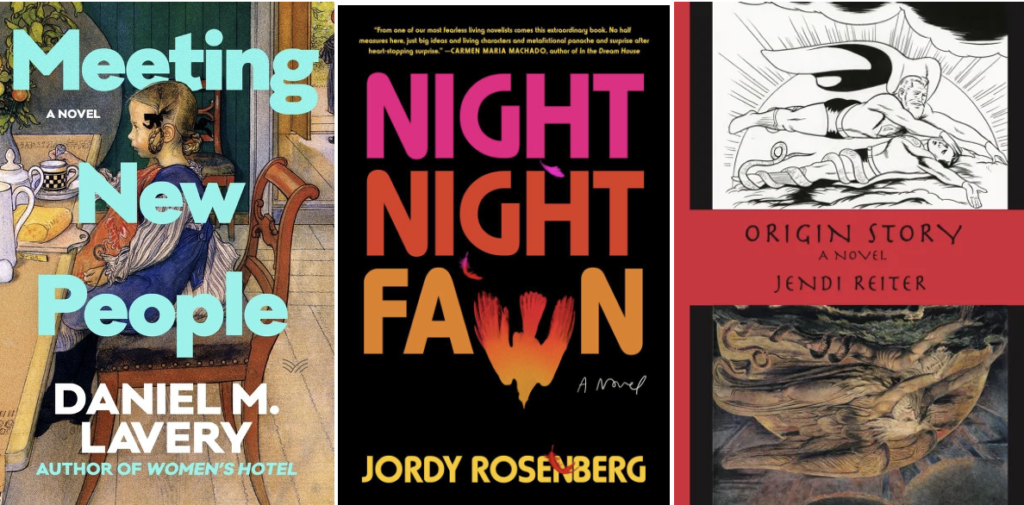
The protagonists of Lavery’s Meeting New People (HarperVia, 2026) and Rosenberg’s Night Night Fawn (One World/Penguin Random House, 2026) are facing a similar existential crisis. Though obsessively diligent, even ruthless, about performing the cis-het social roles that were supposed to guarantee their security, they find themselves alone and disappointed in the latter years of their lives. Both are husband-less (one widowed and the other divorced), and both have a strained relationship with their adult child. Each novel is framed as one Barbara’s attempt to analyze why her strategy failed.
From the perspective of genre, however, the authors’ respective ideological commitments lead them in quite different directions. Lavery’s is a domestic comedy that takes a turn into a spiritual examination of conscience and flirts with a 12-Step sort of conversion story, while Rosenberg combines horror with an anti-Zionist satire of the 20th-century Jewish-American novel.
A twice-divorced genteel lady working in food service, Barbara Foerster needs to meet new people now because she has broken up with, or been dumped by, nine successive best friends. This strikes her as a good time to take an inventory of the many ways her relationships went wrong, but her chatty mental monologue frequently veers off into such topics as the best way to make a celery salad, or what amount of fuss about your birthday is tasteful after forty. She declares all of this with the brisk, cheerful authority of Miss Manners, setting up a comedic contrast with the fact that her “rules” of domesticity and decorum are hardly self-evident, even to other women in her cohort.
In Night Night Fawn, Barbara Rosenberg (yes, the auto-fiction is intentional) is dying messily of cancer in her Upper East Side apartment. High on painkillers, she believes she is being cared for by her estranged queer child who is also transforming into a giant bird of prey. To counter its Marxist judgment on her soul, she launches into a caustic, self-justifying account of her life, which doubles as a portrait of the status anxiety of her postwar generation.
Both Barbaras are high-masking in their own way, carrying out a never-ending self-surveillance that, while exhausting for them, supplies an exquisite feast for the reader, creating well-observed depictions of each woman’s time and place. Trans men will recognize this constant interior monologue of second-guessing the social messages sent by your every word of small talk, consumer purchase, recipe choice, or footwear. But to some extent, isn’t that self-monitoring demanded of cis women and girls in general? Does “womanhood” come naturally to anyone? Perhaps the tension of that unanswerable question is the queer subtext for these novels that are otherwise preoccupied with the travails of resolutely heterosexual relationships.
Of course, dysphoria and sexism don’t exhaust all possible reasons why one’s life might feel like an ill-fitting high-heeled shoe. Barbara Foerster of Meeting New People gives me strong neurodivergent vibes, from her special interest in gourmet cooking to her repeated bafflement when close female friends suddenly cut her off because of unspoken grievances. If only she could find the right category to fit everyone into, the proper gift or perfectly timed text message or casually thrown-together bit of French cookery to share, maybe this time she would pick a companion who’d put up with her till one of them died. And what could be more American: just try harder.
While I was moved by the way that Lavery’s Barbara stumbles into real self-assessment and repentance without losing her acerbic wit about everything cringey connected with church, I also felt that twinge of discomfort that I get from people who 12-Step a little too hard. Sometimes the problem is you and other people; in other words, check yourself, but also consider whether the role you’re trying to play is unmanageable because oppression makes it so, or because other possible roles have been concealed or foreclosed in advance by society. Women’s friendships under patriarchy, for instance, are strained by the contradictory demands to out-compete one another while not appearing ambitious. Neurodivergent women particularly struggle to read subtext from peers who have been socialized not to express their negative emotions directly. Maybe, Barbara, you need to look for your friends at Dungeons & Dragons game night as well as Episcopal coffee hour…
Barbara Rosenberg, meanwhile, has a gender pessimism that sinks lower than dysphoria, because dysphoria at least envisions alternative possibilities, even if you personally can’t see a way to realize them. For this Barbara, being a woman, a Jew, and working-class are identities essentially constituted by suffering and humiliation, justifying any ruthless action to transcend them. If Livia from I, Claudius were a Baby Boomer yenta, she would be this Barbara. She sees no contradiction between her militant Zionism and molding her resentful “daughter” (the butch lesbian proto-transmasc “Jordana Rosenberg”) into a clone of the WASP girls at her Upper East Side private school. Judaism serves her when it lets her position herself as a righteous victim, or as the star of the Exodus movie playing in her head. Rather than inspiring solidarity with other outsiders, her marginalization is what entitles her to assimilate into and champion American success. It’s payback time.
In my own novel, Origin Story (Saddle Road Press, 2024), the narrator’s mother, Barbara Hauser, is a social worker and former kibbutznik, and she shares Barbara Rosenberg’s uneasy mix of oppressed and privileged identities. The liberal New York Jewish community could still tiptoe around this contradiction in the 1990s, when the book is set, but the suppressed guilt of the expulsion and ethnic cleansing of Palestinians was no less real for being offstage. As my protagonist, Peter, starts to recover his childhood memories of abuse by writing a gay superhero comic book, he is forced to question the ideal of “home” that his mother and her version of Judaism represented. Meanwhile, through her diary entries and archival documents interspersed throughout Peter’s narration, readers get hints of Barbara’s own traumatic history as well as her blind spots about her white savior complex and unhealthy enmeshment with her son.
For a writer, the craft pleasure of a great interior-monologue novel lies with maximizing the intimate, secret thoughts of a character while ensuring she remains opaque to herself—and the reader—in important and interesting ways. The narrators of Meeting New People and Night Night Fawn have both bought into an individualist self-improvement program that Jordy Rosenberg, a Marxist, would call a dangerously wrong tool to address the structural forces that warp his protagonist’s character—sexism, capitalism, colonialism, and the post-Holocaust tension within Judaism between “Never again for anyone” and “Never again for us.” Rosenberg has said in interviews that he deliberately wrote an anti-redemption narrative for his Barbara so that we would stop wasting energy on humanizing or persuading people whose beliefs endanger our lives.
But in creative works that truly come alive, the characters also exceed what the author knows or intends for them. When Peter in Origin Story begins writing his comic as relief from the serious social work job his mother steers him into, he has no idea that his narrative brainstorming will unlock truths that will sever him from his family. Nor did I anticipate, when my characters first demanded to be heard, that writing fiction about gay men would turn me into one.
I would not want to be Barbara Rosenberg’s “daughter,” because I already was. Yet reading Night Night Fawn did allow me to indulge in a little nostalgia for the sound of my estranged mother’s voice, at the safe distance afforded by fiction and death. After all, there is an uncanny resemblance between Rosenberg’s Barbara and my late mother. Thwarted dream of being an actress? Check. Pierre Deux quilted bags stuffed with free gifts from department-store cosmetics sales? Ditto. One-day trip to Israel? Weirdly, also yes, though by her own account, my mother didn’t turn tail because of the 1967 al-Naksa, in which Israel displaced over 300,000 Palestinians and brought historic Palestine under military occupation. No, she simply changed her mind as soon as she got off the plane, returning home the next day.
In short, I understand why a certain scene towards the end of Night Night Fawn is meant to be so damning, yet it struck my heart with a pang of unwanted empathy instead. We learn that for many years, Barbara has been buying feminine clothes and jewelry as gifts for the absent “Jordana,” making up stories for the sales clerks at Bebe and Eileen Fisher about her daughter and even a nonexistent granddaughter. She is painfully aware that her child will never use them, not only because of gender and estrangement, but because of another late-revealed twist I won’t spoil.
I know the pain of having your mother love a fantasy version of yourself, erasing the real you. Mine wished for 40 years that I was a two-year-old Victorian child in a pinafore. Why did Barbara Rosenberg’s confession about the gifts move me, then? Because it was the only thing she’d ever done that was not calculated for its effect on someone else. It had no strategic value. It was the closest she could come to love and mourning. And that, whatever else it may be, is heartbreaking.
This kind of raw candor, at once unreliable and emotionally honest, is why we lend an ear to the Barbaras of literature, even when we might not want to get that close to them in real life. They can voice the pet peeves and clever criticisms that we keep to ourselves, to mitigate the irritation of needing other flawed human beings.
“Any friendship that comes together over a mutual dislike of a third person is the best kind,” Lavery’s Barbara muses. Of course, that means “you’re probably going to be very mean to each other at the end of things. But so what?…In the meantime, you’ve had a hell of a lot of fun.”
Jendi Reiter is the author of five poetry books and chapbooks, most recently Introvert Pervert (The Word Works, 2026); the novels Two Natures and Origin Story, both from Saddle Road Press; and the story collection An Incomplete List of My Wishes (Sunshot Press). They are the co-founder of the writers’ resource site WinningWriters.com.
This post may contain affiliate links.