



[Heydey; 2026]
It’s fire season in Los Angeles. Whenever the wind bats the palms in my yard, my stomach drops. Hot, gusty days fray my nerves. Only a year and some months ago the LA Wildfires ripped through Altadena and the Palisades, destroying homes, schools, and communities. Many of those who lost homes are still displaced today. While the immediate impact of fires is often local, the ongoing aftermath is broad. Smoke and ash enter the atmosphere, blanketing skies. People far from the burn inhale tainted air and spit it back out. The aftershocks of the 2025 wildfires continue to ripple into the present. In Pasadena, which borders Altadena, the city council struggles to pass affordable housing for Eaton fire survivors due to opposition from local residents. In the Palisades, Spencer Pratt, a former reality star who lost his family home, announces his plans to run for LA Mayor at an event called “They Let Us Burn!” In news interviews, Pratt’s anger over the fires cuts through the camera. I feel it. “These people let my house burn down,” he says.
If I feel the heat of his grief, others will too. It smolders alongside their own. His fury at the fire’s destruction is understandable even as it rhetorically masks his more problematic MAGA-infused ideas about homelessness and gun ownership. While fires themselves can be contained and extinguished, their aftereffects rage on. The Palisades fire that burned Pratt’s house was caused by extremely dry conditions for the season and unusually strong Santa Ana winds. The fire’s unusual timing contributed to its terror. It was not fire season, but January, one of the least likely months for wildfires, at least historically. These fires woke many up to the reality that disasters are no longer once-in-a-generation events, but are increasingly embedded in our everyday lives.
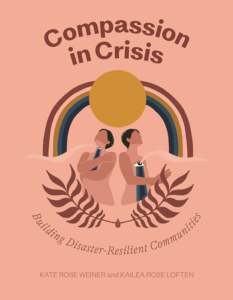
Watching the mayoral candidates on the campaign trail, my mind kept looping back to the concept of disaster companionship. Amidst the current climate crisis, we are increasingly forever companions to an ongoing disaster. I had recently encountered the term while reading a conversation between artists Jiordi Rosales and brontë velez. Compassion in Crisis is a slim pink paperback, easy to carry around in my purse.I read snatches of conversations between the editors, Kate Rose Weiner and Kailea Rose Loften, and other artists, ecological stewards, and healers, in the mornings before work and between meetings. Despite the weighty topics of disaster, loss and grief, the book’s warm, non-academic tone was urgent but encouraging. Even as different folks offered critiques, the implication burning behind their appraisals was that there is always another way of doing it. Something else could be done, possibly by you.
Designed as a grassroots guidebook to building disaster-resilient communities, the first portion provides insights into different approaches to collective crisis preparedness through interviews, while the second and third sections offer tangible advice, check lists, prompts, and recipes for herbal first aid.
In one prompt, somatic healer tayla shayne offers readers a chart to help track their emotional landscape. By charting our emotions and responses, we gain insight into how we’ll react in times of crisis. Will we react by fighting or freezing? We will numb out? The greater our awareness of our triggers — and our default survival responses — the more resilient we become.
Much of the practical advice in the book’s final sections exists elsewhere online. I often encounter earthquakes and other prep videos on TikTok and scroll past them sometimes before I’ve even realized what they were about. But, here, the advice is placed within the broader context of collective care. In this context, a water purification checklist becomes something casual readers like me might actually pay attention to. Alongside the checklists are prompts for somatic practices to calm activated nervous systems, advice for avoiding burnout for relief workers, and recipes for teas and tinctures to soothe smoke-sore throats.Readers are encouraged to gather together to make the herbal recipes. Within the pages of Compassion in Crisis, the practice of working together across differences is an art.
Collaboration is never romanticized. A constant that rings through all the conversations is the difficulty of building and maintaining relationships. As artist and organizer LinYee Yuan shares early on, “Anybody who has ever been a part of an organization before, whether it’s professional or personal or spiritual, knows that it’s not the work that’s hard, it’s the being together.” For Yung, how we work together and problem solve are essential tools for ecological resilience.
Traditional disaster preparedness focuses on individual action. A single person or family plans and purchases food, fuel, respirator masks to store. But resilience invites us to imagine not only survival but recovery. For the book’s editors Kailea and Kate, “Resilience isn’t so much about ‘bouncing back’ as it is an invitation to continually prototype possibility in the face of polycrisis.” Mutual aid and gift economies thrive in the wake of disasters. By reframing recovery as a time of imagination and possibility, the book asks us to question how we want the future to look. Each new conversation I read widened the frame of what it means to be truly prepared for a disaster.
One of the things I appreciate most about the book was its raw recognition that building and sustaining relationships is hard. By acknowledging this challenge, the authors offer a shot of something more powerful than ease: hope. As the Kailea and Kate note, “Ours is a culture that lacks a genuinely healthy relationship to conflict.” In these conversations, the ability to sit with conflict — hold opposing feelings, ideas, beliefs systems — is usefully framed as a skill that can be cultivated, a way of being present in the world, alive to its multiplicity. Hope hinges on possibility. The book shines a light for us: it’s always possible to reimagine one’s relationship to conflict. It’s always possible to say hello to your neighbor today even if you did not on Monday, or Tuesday, or any day before.
To be comfortable with conflict isn’t just a useful interpersonal skill, it’s also a survival tool. In times of crisis, communities benefit from individuals who can sit with disagreement without needing to resolve it right away. These individuals bring people together so that they can better support each other, often in the absence of institutional help. Mutual aid thrives during crises out of necessity.
In the months after the Eaton Fires, I watched how crucial community is to surviving and enduring traumatic events. The nonprofit I work for has built and managed edible gardens at Title I schools across Los Angeles for over 20 years, and one of our oldest gardens, Mary W. Jackson Elementary in Altadena, survived but suffered extensive damage from smoke and ash. School parents teamed up with staff and over 60 community volunteers from across the city to refurbish the garden. Together, they learned how to properly use PPE gear and how to safely remediate soil and spaces used for food production after wildfires. They removed over 10 trash bags of ash, replacing top soil, mulch, and pruning fruit trees. As they planted new seedlings, they learned about drought-tolerant California native plants and how to use bioswales to prevent flooding. For students the restored garden told a powerful story about collective healing and resilience while providing a space to slow down and be with their feelings.
Even in a major city like LA, connecting with the earth can help us cultivate individual and collective presence. In a conversation with relational educator Lauren Hage, she argues that intimacy with the earth builds the groundedness we need to make quick decisions under pressure. The practices she offers readers are designed to help us forge an intimate relationship to the earth. “Intimacy is a closeness born of attention,” Lauren says. In “A Practice for Composting Grief,” we are instructed to dig a face-shaped hole in the ground, then to lay down so that our face is over the hole, and speak directly into the earth our fears, our grief, our wishes, whatever we feel. When finished we are encouraged to leave an offering. By communing with nature, we cultivate attention, and in Compassion in Crisis, attention is a supreme act of care.
Many of us live in worlds that fracture our attention. Notifications flash across screens, deadlines pile up. Attention may very well be the hardest survival skill for us to tap. In a moving passage, brontë reminds us that “the traditional role of a prophet wasn’t necessarily to prepare or foretell, but to pay attention.” brontë asks us to consider how paying attention helps us nurture a sense of wonder. Like the tingly curiosity I feel while writing at my desk: it isn’t the finished piece that thrills, but the deep state of concentration I enter while making it.
Brontë’s conversation, like all the conversations, resonated with me more than the later prompts and guides. Perhaps because of how I read. Often I read silently next to my wife or people at coffeeshops, over cups of strong espresso, or in the eggy light of late afternoon during work breaks. Reading took on a ritualistic vibe. I often felt like I was communing with the book more than merely reading it. Yet I kept returning to the fact that its impact came from reading and not from scrolling past a video of the same conversation on my phone. I thought of something brontë has said — how time is shaped through our attention. When we pause to watch birds wheel, time shifts. When we slow in the morning to observe what’s happening in our bodies, when we listen to palm trees shaking, when we sit down and read, we are bending time with our attention.
As the mayoral race unfolded, I found myself comforted by what I read in these pages. Opening the book was one way of being present. Starting my morning with their words shaped the day’s course. Its lessons rippled out, beyond my couch, to shift how I related to other people in my life. While reading Compassion in Crisis, I was also planning a trip home to Atlanta to see my family. In the nearly fifteen years I’d lived in LA, I had only flown home a handful of times, and each visit had ended in an emotional blowout, usually patched up with all of us in tears in a Delta terminal. During the planning process, conflict flared over where I’d stay. But I reminded myself: we’re not well-trained at sitting with conflict. But we could be. The small crack opened by the promise that we could mattered. It was everything. I booked a room equidistance from everyone, a two mile walk along the Beltway in each direction. The walk was now essential to my survival plan, inspired by tayla’s charting practice: listen to the grass, track the birds, commune with the rats and the dandelions.
What makes Compassion in Crisis worth carrying around in your purse is that its wisdom doesn’t stay on the page. It echoes into how you move through the world, how you care for the earth, your neighbors, the strangers you pass on the street. Even your mother and sisters. “Here lies the most sacred responsibility of all,” write Kailea and Kate, “the practice of showing up.”
Elizabeth Hall is the author of Season of the Rat (Cash4Gold Books) and I Have Devoted My Life to the Clitoris, a Lambda Literary Award Finalist. Read more about her and her work at www.elizabeth-hall.com.
This post may contain affiliate links.