


[University of North Carolina Press; 2026]
In a semiquincentennial year fated to incite fresh contests over American corporate identity, the two most consequential political movements before the Fourth of July have focused more on foreign-born migrants than citizens. The first of these, MAGA, has been using the federal government’s plenary power over immigration to target millions for expeditious deportation, undermining the constitutional standard that noncitizen persons may at least expect procedural due process and the equal protection of the laws. In the federal courts, meanwhile, MAGA has been challenging the constitutionality of birthright citizenship as part of its effort to construct a new legal concept of legacy citizenship premised on multigenerational lineage. According to the Vice President of the United States, a “Heritage American” is someone who may trace an uninterrupted bloodline as far back as the Civil War (an example that manages to code citizenship as generically white while avoiding hard questions about Unionists and Secessionists, Freedmen and Natives). Implicit in this redefinition of Americanness as a white inheritance is a zero-sum economic logic that pits new migrants’ interests against citizens’. For example, the Vice President’s past claims about the deleterious social impact of the Haitian residents of Springfield, despite being patently false, signaled to Ohio’s Heritage Americans that they – as the state license plate reads – are the true “Heart of It All.”
It could be a coincidence that MAGA’s nativism bleeds reddest in regions that experienced the largest domestic outmigrations of rural poor during the twentieth century. Between 1900 and 1975, tens of millions of Southern Americans relocated to Northern cities like Minneapolis, Chicago, Cincinnati, and Detroit in search of better life prospects. Among them were legions of black citizens who continued the Emancipation journey in flight from Jim Crow. Many millions more were poor whites whose racial advantages could not guarantee survival in a regional economy that stayed depressed long after 1929. As coal mines closed and farming machines replaced farming hands, white Appalachians in particular suffered a colorblind immiseration that threatened their inherited folkways. Rather than perish at home, they ventured the “Hillbilly Highway” all the way to “Hillbilly Heaven” – the common midcentury euphemism for the overcrowded slums and iniquitous taverns of poor neighborhoods like Chicago’s Uptown. The material challenges faced by “urban hillbillies” were not so unlike those of the black and Puerto Rican domestic migrants who settled across town from them. They, too, crowded three-generation families into dilapidated one-bedroom apartments; they, too, worked contractless, high-risk jobs for pittance wages; they, too, received disproportionate police surveillance. Indeed, white Southern migrants were but the palest shade in a technicolor rainbow of American-born rural poor who tried to make places like Chicago their new homelands.
Over the last fifty years, global migration flows have diffused more evenly across the United States, such that Southern states now import more migrants from abroad than they produce from within. The MAGA base’s rejection of these (lately, Latin American) newcomers disregards the migratory history of the region’s poor – a history into which the Vice President once conspicuously narrated his own autobiography. Yesterday’s hillbilly migrants might hear a truer elegy for their troubles in the other major movement of our semiquincentennial year – the ICE OUT protests of Chicago and Minneapolis. These radical uprisings assembled from the remnants of the 2020 Movement for Black Lives in response to Immigration and Customs Enforcement deploying thousands of agents across the Midwest to terrorize the foreign-born residents of progressive cities. By the end of the initial deployments, Minneapolitans had more success than Chicagoans in rebuffing ICE’s backstreet barbarism. Yet the multiracial self-defense networks that formed across both cities honored their histories as arrival zones for poor migrants of all backgrounds. In the twentieth century, these two cities received many Southern Americans, black and white, from the aforementioned Great Migration, and in more recent decades, Minneapolis has been a resettlement site for tens of thousands of East Africans, while Chicago has been a hub for hundreds of thousands of Latin Americans. ICE OUT ranks human dignity above cultural heritage and legal status. Because poor migrants have long contributed to heartland cities as workers, consumers, students, and friends, many local citizens have come to regard migrants’ fates as their own personal fates, embracing a cosmopolitan politics that affirms the welfare rights of all human beings against a global system that criminalizes poverty.
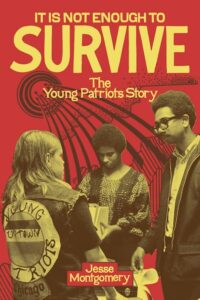
As summer ushered in the 250th Fourth of July, the collision of MAGA and ICE OUT raised anew the question of whether there could be a corporate American identity that somehow reconciles the nation’s tradition of reactionary heritage politics with a universalism of the migrant poor. Jesse Montgomery’s new book It Is Not Enough to Survive: The Young Patriots Story finds one neglected precedent in the tale of a radical group of poor white Southerners that activated in Chicago’s Uptown in the late 1960s. Called the Young Patriots Organization (YPO), the group was part of a “Rainbow Coalition” of justice activists that focused on Chicago’s multiracial poor. Among their compatriots were the local chapter of the Black Panther Party (BPP), the nationwide self-defense group whose Chicago leader Fred Hampton coined the term “Rainbow Coalition”; the Young Lords Organization (YLO), a Puerto Rican street gang founded by Cha-Cha Jimenez; and other groups like Rising Up Angry (RUP) that steered disaffected street toughs toward socialistic causes. The context for the Young Patriots’ emergence, and for the Rainbow Coalition’s more generally, was the collision of domestic mass migration with the Civil Rights Movement. Chicago’s migrant population needed shelter, food, healthcare, and employment, yet neither Congress’s recent recognition of universal civil rights, nor the War on Poverty’s meager benefits programs, could deliver these goods at scale. Once they became aware of each other’s presence, Chicago’s Rainbow radicals compared notes from their neighborhood struggles, discovering a citywide opportunity to empower poor people to solve survival problems without the help of national political parties, the absent labor-union establishment, or even the more sympathetic Students for a Democratic Society (SDS), a university movement that wanted to grow participatory democracy within Chicago’s working class. Of, by, and for the city’s migrant poor, the Rainbow Coalition spearheaded political pressure campaigns against local real-estate developers, launched neighborhood-based “survival programs” to fill in the gaps left by government welfare, opened night schools for adults seeking remedial or continuing education, and planned cultural events rooted in migrant folkways. Two convictions guided their multifarious activities: first, that domestic migrants experienced a common class immiseration that transcended racial difference; and second, that a hyperlocalized mobilization of poor people around everyday survival issues was the most effective form of nonviolent fightback against the global capitalist system.
Author Jesse Montgomery is Assistant Professor of English at Berea College, an institution that commissioned some of the first formal studies of Southern outmigration patterns back in the 1960s. It Is Not Enough to Survive is Montgomery’s first scholarly book and the first full-length academic treatment of the Young Patriots Organization. The early chapters detail how the YPO burst onto the Chicago scene during a year of turmoil that produced the political assassinations of RFK and MLK, the Poor People’s Campaign in Washington, D.C., the police crackdown at the Democratic Party’s presidential convention in Chicago, and Tricky Dick’s landslide election. Moved by the electrified national mood, the YPO distinguished themselves from other Sixties radicals by their vigilant localism, focusing their efforts on the unmet social-reproductive needs of Uptown’s white migrants. Housing, healthcare, and hillbilly culture were the core tenets of their activism. In housing, they resisted developer plans to turn Uptown into a gentrified college area while offering blueprints for a just neighborhood revival. In healthcare, they recruited sympathetic young doctors to provide free primary care at popup clinics in crumbling tenements. In culture, they arranged country-music nights at corner taverns to build community around “Hillbilly Nationalism.” For the span of their active period (1968-1973), the organization endured surveillance from local and federal police who viewed their Rainbow alliances and self-organized welfare system as threats to public order. Despite the negative attention from the government, the Young Patriots forged partnerships with other community unions that took an interest in their antipoverty programs. Jesse Jackson’s Operation Breadbasket, Jane Addams’s Hull House, numerous churches and charities, and most famously, the Black Panther Party, funneled resources from around the city to help grow their initiatives. Montgomery argues that toiling among the poor without state support enhanced the Young Patriots’ understanding of the bourgeois basis of participatory citizenship, for the city’s government was not merely unhelpful but actively hostile to their efforts at self-uplift. Moreover, hyperlocal organizing revealed to them that there was leverageable political power in the everyday lifeways of poor migrants to whom society refused to grant survival as a basic right. An early manifesto expresses YPO’s “universalism of the poor” rather pithily: “We believe that to fight only for the interests of your close cultural brothers and sisters is not in the interest of all the people, and in fact perpetuates racism. We understand that our struggle is a class struggle. All power to poor and working people!”
Montgomery’s book deserves acclaim for its subtle treatment of the Young Patriots’ pairing of multiracial solidarity with Southern heritage politics. From its earliest days, the organization’s youthful leadership adopted a neutral outlook toward white Southern identity, judging that cultural artifacts like country music and hillbilly dialect had no ideological orientation, and so might express progressive ideals just as well as reactionary ones. For example, when the Young Patriots presented their neighborhood revival plans to Uptown’s redevelopment council, they envisioned a public-housing village named after the legendary migrant singer Hank Williams. And the live-music scene they nurtured in corner taverns consciously refused the Nashville culture industry’s conservative cowboys, uplifting in their place the nameless wandering troubadours who comprised the tradition’s populist vanguard. Whereas Chicago’s high-minded aesthetes regarded the sentimental lyrics and saccharine melodies of Southern popular music as low art, the Young Patriots heard a record of working-class thought attempting to comprehend the present epoch of proletarianization across the American South. To them, language was a democratic commons that provided a mode of renewable pleasure for everyone, and the hillbilly vernacular was as valid a source of exalted lyric as middle-class English. As Montgomery summarizes: “[Hillbilly song’s] commingling of Spanish idioms, street slang, Appalachian nostalgia, and militant bravado insisted on a civic reality that many would rather ignore and fixed it in language…And underwriting all of this was a desire for self-expression, a need to speak and be heard.”
Several Young Patriot leaders tested the boundaries of Southern self-expression by appearing at Rainbow Coalition events with Confederate flag patches sewn onto their organizational jackets, and by marking YPO’s agitprop materials with the Rebel stamp. In his patient analysis of this misguided practice, Montgomery reports that the flag was so present in Uptown establishments that it was almost invisible to white Southerners, bannering their tenement living rooms, barrooms, and even their personal attire. The Young Patriots had mixed reasons for drawing on the flag’s supercharged symbolism. On the one hand, they wanted to signal their affiliation with the social group for whom it was an identitarian icon; on the other hand, they wanted to subvert its traditional meaning by integrating it into the Rainbow Coalition’s shared iconography. Next to the Confederate patches on their denim jackets, they pinned FREE HUEY buttons (a reference to Huey Newton, the imprisoned co-founder of the Black Panthers) and displayed the Rainbow Coalition’s solidarity stripes. For them, the willed fusion of these incompatible symbols showed that the flag’s bloody history of racist sedition did not have to define white Southern identity, and that it was even possible for expatriated urban hillbillies to create new progressive meanings out of it. Montgomery’s judgment here is level:
While the Young Patriots were able to build a political style out of common cultural signifiers, their attempt to repossess the symbol of the Confederacy and realign it with a radical politics was ambiguous. In one sense, its historical meaning proved too fixed and too widely understood to be resignified…, and once it became an obvious impediment to solidarity, it was retired. But in retrospect, it is also clear that the decision to bring the flag into the symbolic field of the Rainbow Coalition did more to stress the surprising nature of [poor people’s] solidarity than perhaps any other. In this sense, we can read the Young Patriots as being possessed by the symbol, forever tethered to it in the historical imagination.
One of Montgomery’s testimonial sources, former YPO member Hy Thurman, now regrets the group’s short-lived appropriation of the Rebel flag. Still, Thurman observes that, because uprooting and nostalgia were so integral to domestic migrant experience, the Young Patriots Organization could not but have experimented with Southern cultural signifiers as it developed its “universalism of the poor.” As organizers learned the hard lesson that some heritage markers simply cannot withstand critical scrutiny, they found empathic resources within white Southernness, such as practices of mutual aid and hospitality, that surprised their diverse coalition (and sometimes even themselves). In Montgomery’s telling, these enlightened hillbillies became the unwitting heirs of Antonio Gramsci and the prescient harbingers of Stuart Hall—“organic intellectuals,” in other words, who endeavored to politicize their culture instead of culturizing their politics.
The Young Patriots Organization started to dissolve in 1973 after five years of tireless agitation in Uptown’s Hillbilly Heaven. A number of national and local factors contributed to their dissolution: years of warrantless harassment and intimidation from the neighborhood police and the FBI; the high-profile assassination of Black Panthers leader Fred Hampton, an event that divided the nonviolent left from more violent factions like the Weather Underground; the loss of charismatic leaders like Bill Fesperman, a soapbox preacher who wanted to nationalize the urban hillbilly’s cause; and some devastating political defeats inside the neighborhood, including the forced closure of their popup health clinics and the rejection of their plan to build a “Hank Williams Village” in Uptown. Surveilled from the start, their migration-centered radicalism never had a chance to breathe in the open air, yet their hyperlocalized politics left some important legacies for future migrant movements. Among them Montgomery counts the union they discovered between cultural and social-reproductive issues. For all their Southern bombast, the Young Patriots delivered a lot of vaccines to needy babies, a lot of free lunches to hungry schoolchildren, a lot of soul-soothing music to exhausted workers. And they might have done even more, had fortune favored them better. Proof of this came over a decade later in the stunning electoral victory of Chicago mayor Harold Washington, a black politico cut from the Rainbow cloth, and in the back-to-back insurgent presidential campaigns of Jesse Jackson, who repurposed Chicago Rainbow rhetoric for the nation at large. “My constituency is the desperate, the damned, the disinherited, the disrespected, and the despised,” Jackson said at his 1984 presidential convention speech, and their will was to “to feed the hungry; to clothe the naked; to house the homeless; to teach the illiterate; to provide jobs for the jobless; and to choose the human race over the nuclear race.”
Montgomery’s epilogue projects that the One Big Beautiful Bill Act of 2025, with its massive cuts to public welfare and upward redistribution of wealth, will sow fresh seeds of misery among the multiracial poor that will sustain the need for localized self-defense movements that merge class universalism with colorful cultural politics. Chicago-based congressional candidate Kat Abugazaleh recently responded to this emergent need with a campaign that fed and clothed many of its own constituents while protesting ICE’s violent incursions into migrant neighborhoods. And the February 2026 passing of Reverend Jesse Jackson rekindled public reflection on the epoch that produced the first technicolor vision of American corporate identity. Times have changed since 1968, and yet times are the same as they have always been. Global migration has changed. Given the precarious residency status of today’s multiracial migrants, it is no longer viable for would-be Rainbow radicals to focus exclusively on the survival issues of the American-born poor. Migration struggles today are inherently federal, and thus national and international, issues, so self-defense mobilizations like ICE OUT cannot but reflect that fact. That said, migration remains unchanged in other respects. It is still an everyday survival struggle that reveals how important cultural self-formation is for poor people’s social reproduction. In these migratory times, we cannot avoid a reckoning with American corporate identity any more than the original Rainbow Coalition could have done. Neither can we compromise with MAGA’s reactionary heritage politics in the process of this cultural reckoning. Instead, we might do as Jesse Montgomery suggests in his excellent book, following the Young Patriots in their wiser moments, when they discerned the cosmopolitan ideal that infuses every human culture seeking to become enlightened. As the nation turns now toward its tricentennial, the hillbilly’s elegy must be for the Haitian and the Honduran as much as the Heritage American.
Kelly M.S. Swope is Assistant Professor of Philosophy at Thomas More University in Covington, Kentucky, where he teaches social and political philosophy.
This post may contain affiliate links.