


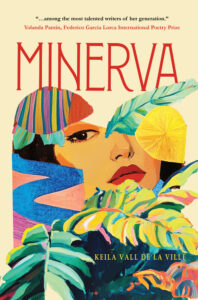
[Regal House Titles; 2026]
Minerva smiles in the window of her subway car: “What race are you? Medical questionnaires, insurance companies, dance institutes, universities. They all want to know.”
This gesture—smiling at herself in the window’s reflection—is the opening image for Keila Vall de la Ville’s coming-of-age novel Minerva, translated into English this year. Vall de la Ville has published novels, short story collections, poetry collections, chronicles, essays, and has edited a number of poetry anthologies. Her novel Animal Days received an honorable mention for best Novel in English from the International Latino Book Awards in 2018. Animal Days was translated by Robin Myers, who also translated Minerva. Myers is an accomplished poet and Spanish-to-English translator who has translated prominent writers like Pulitzer-Prize-winning Cristina Rivera Garza. Myers was most recently awarded the 2025 National Book Award in Translated Literature and was longlisted for the 2026 International Booker Prize for her translation of Gabriela Cabezón Cámara’s We Are Green and Trembling. It’s a treat to access Vall de la Ville’s work through Myers’s lens.
In Minerva, a girl grows up in Caracas, Venezuela, in the 1990s-2000s in a polyamorous family. Though home is full of love, Minerva is ostracized by more conventional society, ultimately forced to switch schools. As living conditions worsen in Caracas, Minerva emigrates to New Jersey, where she works at a yoga studio, keeping things in order, sewing silk eye covers, dancing in the empty studio when she gets a chance. She stays with Aura, who used to work for Minerva’s family as a domestic worker until Aura got documentation to immigrate to the United States. In exchange for a place to stay, Minerva helps Aura with meal prepping. Minerva gets a scholarship for dance school in New York City, where she poses nude to make ends meet and rent an apartment of her own. In her apartment, there’s a ginkgo tree she inherited from the previous owner and a box her parents mailed her from Venezuela—a box she refuses to open until she can’t hold off any longer: her mother Lissa is in danger in Caracas and Minerva has to fly back to confront the reality that awaits.
When Minerva smiles in the subway car, we get a sense of her mischievousness, her confidence in who she’s become. Growing up, she didn’t always feel that way. As a child, Minerva is bothered by what her classmates have to say about her unconventional family:
Papa Martín looks like a woman, says my friend Javi on the bus when he wants to bother me. And it does bother me. I’d like to tell him: You haven’t seen anything.
Javi, her classmate, comments on her father’s appearance not knowing that Papa Martín also crossdresses as La Mimí. Minerva has three parents: Lissa, Minerva’s “center,” a fashion designer; Diego, Minerva’s “home,” a university sociology professor who escaped Franco’s dictatorship after being imprisoned for his sexual orientation; and Martín, “the energy that moves [Minerva],” an art director at the theatre where Minerva dances and a performer himself, when he crossdresses as “La Mimí,” who, in a way, is Minerva’s fourth parent: “La Mimí. La Mimí has no limits.”
Vall de la Ville portrays the complexity of child and adolescent psychology through short excerpts of family life. Walking in on your parents is an experience that, like Minerva, most of us would rather forget. And yet Vall de la Ville writes about it beautifully:
I approach the beveled-glass doors. I can barely make out what’s happening on the other side, but I see clothes on the floor and movement on the leather sofa. Martin’s feathered suit. Lissa’s black blazer. Diego’s silk shirt. All scattered on the rug. They’re laughing.
“Yes, like that, love. Like that, Diego.”
They say this and other things I don’t want to remember, have already forgotten. Like that, love. I cover my ears with my hands, hard. Hearing the roar of the sea under my palms.
This scene masterfully captures the disorientation, the fear, and a child’s search for comfort after waking up in the middle of the night only to walk in on a scene she doesn’t fully understand but that she intuits she’s not meant to witness. Each item of clothing further characterizes Minerva’s parents, and their laughter, what they say to each other, grounds their relationship in love.
Yet, as Minerva grows, so does her frustration. Her classmate Javi is pulled out of the school play when his family learns that Minerva has the other leading role; people tell her she looks like her father Martín when she’s out with Martín and like Diego when she’s out with Diego. By the time she’s a teenager, Minerva’s need to know who her real father is becomes irrepressible. Vall de la Ville narrates with unflinching honesty how Minerva’s need to know—to deal with what makes her family different from her peers’—almost draws the family apart. Yet she never fails to portray Minerva’s parents’ unflinching support and love as Minerva works through these feelings, ultimately arriving at acceptance.
Vall de la Ville also captures Minerva’s budding and evolving sexuality, from the eagerness and awkwardness of her first love, to the differences and nuances in having a same-sex partner, to the spiritual connection she forms with another partner later in life. In sex scenes, Vall de la Ville is explicit when the work calls for it without sounding obscene or forced; she takes leaps, leveraging the tools only available to the written word, like unexpectedly switching point of view during one of the encounters to more effectively put the reader in scene:
You traveled my chest with your fingertips, traced down to my belly, lower, felt me wet, sensing me taut, knowing we were ready […] My hands roamed your back, wanting to touch all of you, have you right away, learn your body, feel mine responding to your every gesture, to have you now, now, right now. To feel your wanting in me.
This switch to second person at the beginning of the chapter distinguishes this lover from Minerva’s other lovers—he’s the only one that gets this perspective switch. This formal choice also creates an intimacy between the narrator and the reader: we’re suddenly implicated, put in scene, doing what Minerva says we’re doing, which only heightens the sensuality of the passage. Vall de la Ville’s rendering of sexuality is what I most admire about this book, putting her alongside authors who are masterful in how they write about sex and desire like James Baldwin in Another Country, Justin Torres in We the Animals, and Angie Cruz in Dominicana.
The structure of this book resembles that of Sandra Cisneros’s The House on Mango Street. Minerva is divided into very short chapters—161 in total—the longest spanning a couple of pages and the shortest a few lines. They are not in chronological order, and the resulting structure is a kaleidoscopic image—or an origami, as Minerva calls it—of this character’s life. One of the ways Vall de la Ville creates this kaleidoscope is through stillness, using Minerva’s meditative states as a vehicle between past and present:
I’d stretch out on the floor with my eyes wide open, not blinking, my back flat against the granite, polished ocean, a galaxy of tiny hazy shapes, dark and pearly, floating embedded ad infinitum. I’d spend endless minutes lying completely still. Feeling the cold in my legs, my ass, my arms.
This passage from when Minerva is a kid represents how her awareness of her body, her ability to be still, allows her mind to travel. Later, when posing naked as an adult in New York City, Minerva practices the same stillness:
Resting on one elbow, the angle of a lacquered black cube jutting into my lower back, I speak to my calf: don’t cramp. Minerva, think about something else, leg don’t cramp […] I’m not rage anymore, but I remember it. They were right in the end, my parents, I think in a rush of unease. We really were invincible. In our way, we still are. I change position. I rest my elbows on my crossed legs. I use the forearm for support, chin in my hand. I stare at nothing. How can you stare at nothing? By erasing yourself.
Minerva’s ability to be still allows her mind to wander, to travel to memories she suppressed or thought she left behind in her home country.
Vall de la Ville’s experience as a poet shines through her use of white space: after a (relatively) longer chapter, she’ll interlace short, touching vignettes or lyrical verses—some more successful than others. The most successful ones capture a specific scene, like little Minerva at bedtime, asking her father Martín to tell her the story of the time he asked her mother Lissa to marry him. Through the use of white space, Vall de la Ville isolates that father-daughter moment and brings us to treasure it before going into the actual story on the next page.
By contrast, the use of white space is least successful when Minerva is given a poetic voice. There are fragments I like: “Dance your fear, hummingbird.” Others, not so much: “From the white canvas, principle and cause, I am reborn. / I am / Minerva.” The issue lies in the inconsistencies in Minerva’s voice as a first person narrator. Sometimes observations or statements of truth seem to come from a near-omniscient point of view very close to the author’s, which makes the transitions into a narrative scene especially jarring. Take, for example, this spiel on authoritarianism:
It doesn’t matter who sits in the chair or who aims the gun; what matters is the chair. And that the person sitting there, refusing to get up, is the one who cocks and aims the weapon. In a dictatorship, left-wing or right-wing or any wing at all, the dictator’s name doesn’t matter. They all follow the same script. And if they’re military, then it’s everyone for themselves. That’s what Di says and I believe him.
Because we’re not grounded in a specific scene, it makes it hard to believe that it’s really Diego saying this, and Minerva recounting it, and not the author putting forth her own views. Even if we may agree with these views, it breaks the spell of fiction. In other instances, Vall de la Ville uses one of these more observational, lyrical passages to introduce a scene:
I never felt Latina. I felt Venezuelan. You discover all this stuff a little bit at a time. At first you only see the Bermuda Triangle and the people living inside it, with you. That’s all you see. All that matters is feeling safe inside. Soon you learn that outside, though, it’s the other way around.
“The Bermuda Triangle? I’ve heard enough. We’ve lost her,” Di said.
Though Minerva is making beautiful observations about what it’s like to be an immigrant—so beautiful and lyrical in fact, that it’s hard to hear it in the character’s voice—we then learn the observations are made in the middle of a phone call to her parents, which makes the transition from general observations to specific scene disorienting.
Poets are particularly good in using a part to represent a whole: the wheel for the car, the crown for the monarchy. They’re able to capture immense truths and vast experiences in a fraction of the space. I think this is true for how Vall de la Ville captures Venezuela’s deterioration. As Venezuela deteriorates, so does the Teresa Carreño, the theater where Minerva dances and Martín works. Ballerinas start leaving, emigrating to countries in Latin America and Europe; the theatre falls into disrepair:
The broken air conditioners were never fixed. The blown-out lights were never replaced. Now, when it rains in Caracas, it also rains inside some of those offices. And since there are no bilge pumps or dehumidifiers, the seepage has rotten out walls, partitions […] The floorboards of the stage began to swell from the flooding.
Martín is badly and repeatedly beaten outside the theater and Minerva is threatened, a deterioration and insecurity that ultimately drive her out of the country.
Vall de la Ville writes about Venezuela’s decline beautifully and honestly, just as she writes about Minerva’s changing identity as an immigrant:
In Venezuela I’d call my backpack a morral instead of mochila, like most other Latin Americans say. Here, if you say morral, no one knows what you mean, or they give you a weird look. So you say mochila instead, and that’s how you become a little more like everyone else, like other Latinos whose lives resemble yours but who have nothing to do with you, and so, little by little, you mysteriously become a stranger to yourself.
Though I’d read about many aspects of migration before, I had never considered such an astute observation on language—on how making concessions, even on the words we use, slowly warps our identities.
A country has a sound, a taste—one that is forever elusive, changing. While in New York, Minerva searches for home in music—salsa, merengue, reggaeton, even the music she didn’t usually listen to when she was in Venezuela. She searches for home in food—a Toronto, a dense chocolate-covered hazelnut melting in her mouth, and yet home for Minerva also becomes more nuanced; by the end of the book, home is also the small white apartment in New York City she’s eager to return to. Minerva takes us on a journey of a woman coming into her own: from the young girl who’s bothered by what her classmates say about her family to a teenager made irascibly mad by the differences that distinguish her from others to a young woman forced to confront those differences abroad and let her identity be molded by them. In the end, she can be confident enough in who she is to smile at society’s need to pin her down:
What race are you? I ask my reflection.
Human, I respond on certain occasions. Dancer, on others.
I’m the dancing race.
Que yo traigo la salsa de verdá.
Cristina Herrera Mezgravis is a writer and educator from Valencia, Venezuela. She graduated from Stanford University with awards in both fiction and nonfiction. She worked in the tech and college prep industries in Silicon Valley and in Lima, Peru. She currently lives in Austin, Texas with her husband and their tabby cats, Lima and Austin. As an MFA candidate in Fiction at the Michener Center for Writers, Cristina is working on a coming-of-age novel about Venezuelan migrants. She writes in both English and in Spanish. You can find her at herremezcristina.com.
This post may contain affiliate links.