


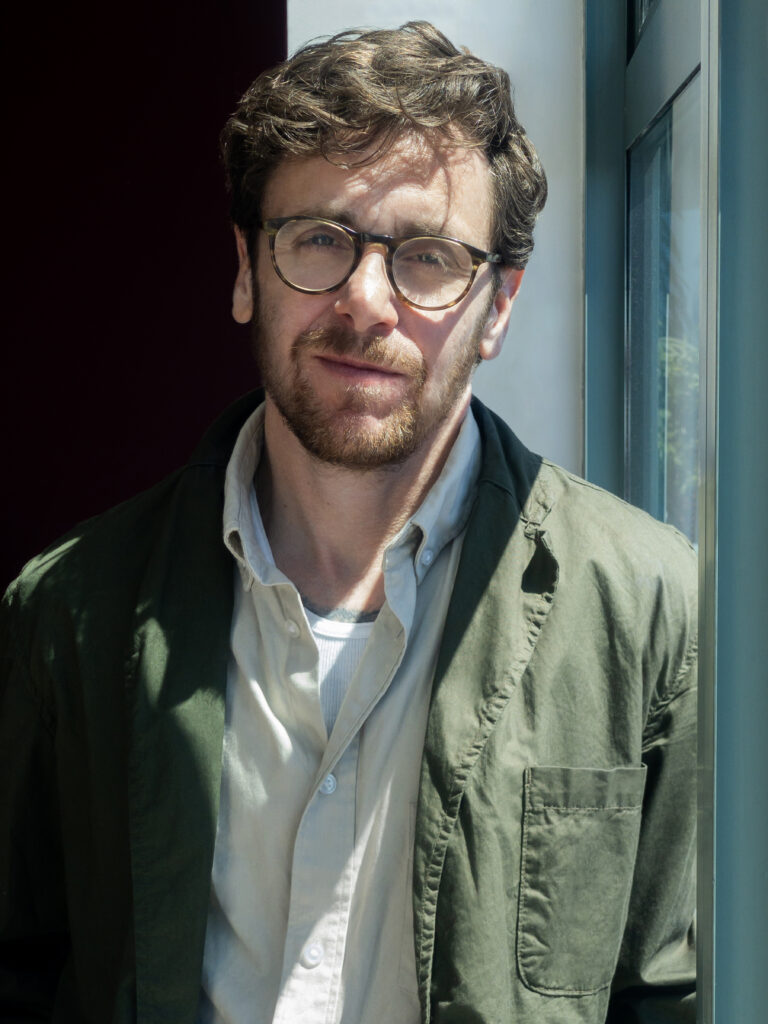
I first encountered Jordy Rosenberg’s work as a young twenty-something a couple of years away from transition. His first novel, Confessions of the Fox, was one of the first books I read after I lost my bookstore job in mid-March 2020. I’ve been eagerly awaiting his follow-up ever since.
Like Confessions, Night Night Fawn (out now through One World) is singular in its experiment with form, its meld of genres, and its incisive political critique. As I’ve come to expect of Rosenberg’s writing, it is also unbearably funny. We spoke over Zoom to bridge the distance between New Zealand (Rosenberg) and New York (me). Our conversation has been edited for clarity and length.
Sam Karagulin: This novel has taken many different forms over the years. I first heard you ventriloquize the character of Barbara in 2019 at a reading with Ross Gay. A lot of the novel’s DNA can be found in your essays “The Daddy Dialectic” and “Gender Trouble on Mother’s Day.” In Night Night Fawn’s acknowledgments, you write that you made fundamental revisions to the novel. Can you tell me about the development of Night Night Fawn and how it transformed over the years?
Jordy Rosenberg: In a kind of a fugue state while I was taking care of my estranged mother when she was dying, I ended up writing a couple of essay/memoir-type pieces. It wasn’t a form that I had intended to write in. It just kind of happened, and people responded really well to them. I had no intention of writing a memoir or writing anything from my own perspective. I always want to do these really weird projects. Some people respond to them, and some people are like, “What the fuck is this?” So I thought, but people seem to really like these essays. Maybe the people know better than I do.
I came up with a framework for it as a memoir, essentially, and sold it as a memoir to my imprint at Random House. But then, I just couldn’t. Lots of people write great memoirs, but it wasn’t a form that I could really find my way into, that I could be creatively in love with. And so it started to take a hybrid form. And it alternated back and forth between these fictionalized sections that were from the perspective of a mother character, and then these remnant essay sections from the memoir. Then I did a manuscript workshop with Carmen Machado, Torrey Peters, Andrea Lawlor, and Michelle Tea and they were super helpful. And of course, all those writers are boundary-pushing in one way or another. All of them encouraged me to go with the weirder version, and Andrea, in particular, licensed me to let go of those memoir sections, which felt like a huge relief.
The project became much more interesting to me as a novel, as satire, and as something with a lot of psychoanalytic dimensions, around the melancholic incorporation of voices of people whose politics we deeply reject. Questions around reactionary and right-wing psyches. Those were questions I never really intended to ask, but they came up in the course of writing it.
That’s a much stranger path than I would have expected, and it makes sense that the structures of memoir wouldn’t work for this project.
For a long time I had a really deep self-critique around those memoir-essays that I had published, because I felt like that form—verging on auto-theoretical, going back and forth between memoir and Marxism and memoir and psychoanalysis—was, in that moment, being most interestingly expanded by graduate students and other people who had a precarious relationship to academia, and who were, of necessity, either developing publishing outlets that were fostering that kind of work or writing that kind of work, or both. I felt like I was tailing that movement. I was very amazed by Andrea Long Chu’s breakthrough work at that time. And Kay Gabriel’s, though it is very differently organized. Jackie Wang, in that period. I felt like those were the people in certain positionalities and in a general milieu who were working with this form in a way that was more interesting to me than my own engagement with it. I wanted to, for myself, leave that form behind.
That reminds me of something that you’ve talked about in the past: the suffering bildung often demanded of trans writers. Maybe this can get us to the question of genre. I really should have expected you to employ genre trickery, but I was still really surprised when I read Night Night Fawn. I’d read the excerpt published in The Paris Review, and expected the rest of the novel to be similar. And in the novel itself, there’s this rug pull, this genre shift, which I now think of as very you. When I read Confessions, I had a similar experience. Can you talk about your relationship to genre, specifically as a trans author?
I need to think through the trans part. I mean, I love genre. I love reading genre. I love trying to write in genre, though I seem to always be doing it in a hybridizing way. Why can’t I just write a straightforward, one genre book?
What’s clarified itself to me retrospectively is that I was very inspired by trans horror writing. I was really influenced by Jewelle Gomez’s The Gilda Stories in the 90s. When Gretchen Felker-Martin’s Manhunt came out, that was the kind of book where I felt jealous, where I was like, “Oh, oh, we’re just doing this. We’re just going there.” I want to just go there too. Then Grace Byron’s Herculine, more recently.
There is a strong horror element in Night Night Fawn. I wanted to make it scary and ominous on a certain level. A lot of that has to do with writers finding creative ways around certain demands, not just the suffering bildung, but also respectability politics. And the book is overarchingly, very strongly satirical, which isn’t only a trans-derived form for me. I think of satire and horror as very proximate forms in terms of the way that they can both develop an over-excited affect in the reader. They’re very libidinal forms. And I was trying to combine a satire which itself is drawn to some extent from, or is like a perverse twisting of Rothian traditions, of ‘70s and ‘80s Jewish American literary traditions. I am certainly not the first trans author to be influenced/really aggravated by Roth’s self-congratulatory, so-called “scandalizing” eroticism, his erotic satire, and just be like, “All right, we’re going to do this our way.”
For a while, I thought this project is just rewriting Portnoy’s Complaint as trans memoir. Early on, I was rereading a lot of Roth, and I was like, “This is so fucking trans, Portnoy’s Complaint is so fucking trans.” But it’s just the psyche on a certain level. There’s a specificity and there’s a universality. The things trans people deal with are, to some extent, universal, though they have specificity.
Once I decided that, okay, I’m writing this satire from the perspective of a transphobic mother, it became very cathartic and entertaining to me to think about pushing that as far as I could go. Sophie Lewis gets at it so well in Enemy Feminisms when she talks about the development of a proto-TERF-y mentality. This is a huge paraphrase, but she says that it’s entirely possible to be both oppressed as a woman and to channel that actual oppression into a “restrictive pessimism” about what it means to be female. It was very, very entertaining to me to think about writing 99% of the queer and trans sex scenes in this book from the perspective of someone who has this restrictive pessimism about the world, and to push that into the place of horror that it occupies for TERFs. If the worst thing that this mother character can imagine is gay sex, her trans son having sex next door as she’s dying, I wanted to imagine, what does that terrifying sex look like to her? I wanted to write that. I wanted to treat that within the horror genre. What does she think that’s about?
I love the invocation of Lewis here, and also found that book really helpful. On the topic of pleasure, I was curious what pleasures writing this novel offered you, especially given that it deals so much with family and the wounds of the family.
I mean, it was very hard to write this book because of having to occupy the worldview of a character who has an incredibly dystopian outlook. It was pretty bleak. The satire, in many ways, was the compensation for the dystopia. Driving a lot of that character’s imaginary to its most ridiculous and yet not unreal, in terms of how TERFs and transphobes actually operate, to its most ridiculous conclusions, did offer some element of cathartic pleasure. I did try to make the book funny/very funny.
In writing Confessions, for example, you’re developing a world that you want to imaginatively revisit. There was a utopian horizon to that book. Night Night Fawn was not a book that I enjoyed imaginatively revisiting at all. And of course, it is based in, but definitely fictionally departs from, my own experience of caring for an estranged parent. So it’s not something I enjoy revisiting at all. But like I said when I was talking about the roots of the novel in memoir writing, a lot of it came from a compulsive need to revisit it, maybe to make sense of it, or, I don’t know, expunge it.
And then, of course, this character is a Zionist, and so it was extremely difficult to constantly occupy the spaces of her imaginary. This changed a lot, how I felt at any moment, but at a certain point, I committed to exposing the violent contours of the way in which colonial projects perpetuate themselves through the nuclear family. I started this project on some level in 2014, in a different historical moment. By the time this book is coming out, I don’t think anybody needs anybody to expose how violent the contours of that are. Because there’s a mass movement for Palestine solidarity, and because the Palestinian people have been documenting their own genocide. So it’s not really necessary to pull the veil back on anything. It’s satire and it’s fiction, but as with much of satire and fiction, it is sometimes more possible to tell certain truths through those genres. So while it may not be necessary to expose anything, I hope it just tells the truth.
I found the novel very, very funny. And when my partner read The Paris Review excerpt, they came away feeling disgust and horror towards Barbara.
I didn’t want to make her a sympathetic character. Sophie Lewis’s analysis helps me understand that there are things this character undergoes that are politically salient, around sexism, around class, but that doesn’t make her a sympathetic character. She’s funneled her experiences into really reactionary ideological commitments.
Both of your novels can be described as historical fiction. And in both, you use very specific vernaculars. In Confessions, there’s 18th century London thieves’ slang and in Night Night Fawn, there’s the voice of the yenta, of Yiddish-inflected Jewish New York. I would assume, given your biography, that you have much more ready access to Barbara’s vernacular. What research did you do to access that voice and the particularities of mid-century Jewish New York?
This is funny. It reminds me of something Andrea Lawlor said a lot when being interviewed about Paul Takes the Form of a Mortal Girl: “You know, it wasn’t historical fiction to me when I started writing it in the 90s.” So, to me, it doesn’t feel like historical fiction, because it’s something that my own life has touched on experientially.
The earliest period of the character Barbara’s life that we’re really looking at is when she’s a receptionist for a garment trucking business in Manhattan in the ‘60s. So I did go down certain rabbit holes or historical research around the development of garment trucking, and the role that the garment industry played in the development of labor unions, in the city, in the U.S. and also in terms of Jewish assimilation and Jewish cultural life. And the world of tri-state logistics, where textile manufacturing is, how it’s moving around the city, and then they’re exurbing it, or moving it out to Pennsylvania.
Then in the 80s, we’re touching down on Barbara as a receptionist at a mid-level plastic surgeon’s office, a surgeon whose main job is boob jobs for the mistresses of the Brighton Beach Bratva. That’s also drawn from some personal history, but I was really interested in questions of the character of those non-unionized clerical offices, and then movements around clerical unionization in what were described as the 9to5 movements immortalized in the Dolly Parton and Lily Tomlin movie of the 80s. What’s it like working in a non-unionized office where you’ve absolutely no control over your conditions of labor? In what ways do you try to assert control? I was interested in those granular dynamics for that character: what were the historical forces on her?
The question of vernacular was something that came up for me when deciding to write Confessions. I was interested in certain issues, historically, politically, that had to do with the history of death penalty law. I could have, and I did start out thinking I would address those questions through an academic monograph, but it was hard to have a utopian relationship to the archive.
A better archival researcher probably could have derived the history from below. Peter Linebaugh, for example, has done just that. Instead, I developed an investment in approaching these questions from the perspective of certain vernaculars. On the one hand, that has to do with developing lexicons. On the other hand, it had to do with writing these questions through the form of novels which are, to my mind, more accessible to people. Developing certain political questions in a vernacular language of fiction — that’s what is interesting to me.
In Night Night Fawn, it also had to do with the shift from memoir to fiction. In those memoir pieces that you referred to, there’s a pretty academic tone of voice because I’m writing from my own perspective about Marxism and whatever. I wasn’t so interested in that tone of voice, that hypereducated language. I was interested in getting at some of these questions through speech histories lived in the vernacular. And I’m not saying there’s no space for academic work. I actually strongly believe that we need to preserve these spaces, but you know, your own project has to be something that you’re going to sit down to every day. And the project that I kept sitting wanting to sit down to every day was addressing the questions that were coming up for me around, for example, histories of Zionism, histories of the nuclear family, McCarthyism and the appearing and disappearing language of Marxism over the 20th century. All from a more vernacular place.
When I first read Confessions, it felt like a breath of fresh air, because it had this political critique within it. Your new novel insists that the readers situate what they’re reading within the context of the Naqba and the genocide of Palestinians. I really love that your fictional work lets you theorize as a Marxist, and lets you theorize a liberatory position that is also funny and sexy and compelling. That’s a really hard needle to thread, I think. And I was going to ask: how do you do it? But you already answered that.
I feel so excited by all the many different ways in which writers are more robustly engaging with the political in fiction these days. Recently, I found myself incredibly comforted rereading Trotsky’s Literature and Revolution at MacDowell. It’s so relaxing how polemical and snarky 20th century Marxist writers are. Trotsky says, and this is a paraphrase, that there is no non-political art. For him, there’s only non-revolutionary art and revolutionary art, and even though non-revolutionary art will try to occlude its political character, it’s still political. Teaching in an MFA program, there’s a lot of desire now, which I love, on the part of students, to write political novels. Sometimes I think it’s not so helpful to think about novels as political and non-political. I see all literature is political, just some of it is bourgeois.
These political questions have reentered literature. Eman Abdelhadi and M. E. O’Brien have been trying to get together an even more collective writing project where a bunch of other writers are continuing the world that they established in Everything for Everyone. I was working on my contribution to that, also in December. It’s given me extreme pleasure. That in particular has been an amazing project, a different way of approaching questions of the political in literature, because basically all the writers are getting together and talking about the content of your stories. I found it to be an incredibly difficult assignment, mostly because it demands a certain utopian worldview, which, of course, I have had in the past. But I was so inside the bleakness of finishing up Night Night Fawn that it was really hard to drag myself out of it and get to a different place.
You’ve written a novel suffused with the language of movies. Part of that is because the character, Barbara, wants to be an actress. What role did film, and particularly this era of film, play in writing the novel?
Barbara is erotically attached to film. That’s her primary erotic attachment. I’m certainly not the first person to talk about this. Michael Rogin, in his book Blackface, White Noise, talks about Jewish assimilation through film in the early, early part of the 20th century, earlier than Barbara, especially the ventriliquization of Blackness. Barbara’s assimilative journey is through this relationship as ego ideal to the noir film femme fatale.
There’s this amazing book by Theodore Martin called Contemporary Drift. Maybe some of these things are just known, but I was really taken with his argument about voiceover, the way in which voiceover comes from outside of the frame. In Sunset Boulevard, the film is narrated by a character who’s dead. They’re inhabiting a place that’s outside of where the action is happening, but this isn’t felt as a contradiction to the viewer. Before digital film, Martin says that voiceovers would suture across gaps, and that suturing across gaps is part of the process that we incorporate with pleasure. So on the one hand, I wanted to explore the significance of noir as a genre for the character’s world. And Martin’s analysis of Sunset Boulevard gave me license in terms of literary form to think about taking risks with contradictions and trusting the reader.
There’s also the movie, Exodus, which plays a pretty big role in the novel, and there’s a long, extended scene that I won’t give any spoilers about, where the main characters go to a viewing of Exodus at the King’s Theater in Flatbush. I was interested there in narrating something that the scholar Amy Kaplan wrote about really well in Our American Israel. She talks about the role that Exodus played as propaganda in developing a story for diasporic audiences about what the Israeli state project is purportedly about. At one point she quotes the head of Israel’s Ministry of Tourism, who says “we could have thrown away all promotional literature we printed in the last two years and just circulated Exodus.”
By the way, I didn’t start out trying to write a book about Zionist psyches. I really was not interested in that. But once you start developing a fictional character, there are certain questions that come up. This goes back to your question about political fiction. Yes, I’m writing political fiction. But do I think exploring the Zionist psyche is a is a political exploration? I don’t actually think so, because I don’t think we need to know anything about it to have a position on the settler colonialism, on the colonization of Palestine. That said, it’s a novel. So I was interested in the novel in this question of: how did American teenagers who are interested in teenager-y things, get interested in colonizing Palestine? How did they get interested in statecraft? This is a character, Barbara. She’s not interested in statecraft. She’s not going into State Department work. She’s not a political theorist. She’s an American teenager who loves movies. I was interested in narrating, in fictional form, that process of libidinally attaching to colonialism.
Alberto Toscano has described the way in which fascism appeals to people in the contemporary world through the promise of unfettered libidinality, or unfettered libidinal forms of speech. Film is a location for the development of libido in American culture. And I was interested in that, both in terms of noir and in terms of the particular role, though not a noir film, that Exodus played in capturing a certain imaginary.
I was rereading “The Daddy Dialectic” and reading about the Amherst hawk, and I was wondering, is the bird…
Yes.
…in Night, Night Fawn, is it that hawk?
Yes, it is. I mean, yes. Instead of writing about my own libidinal attachment to this hawk, I thought, I’ll just make this character. That’s the thing you can do with fiction, right? It does all these incredible compressions, almost in a psychoanalytic, Freudian sense.
Though the bird is described from the perspective of Barbara, it reminded me of my own personal experience of looking at my face as I’ve transitioned. Seeing how my nose has changed and how my face has changed. There were periods of time when I didn’t recognize myself. And it wasn’t quite horror, but it was strange and not necessarily pleasurable. It was interesting for me to lay that experience over the transphobic horror montage of Barbara’s psyche.
This goes back to respectability politics, right? We’re only allowed to talk about, “Finally, I became myself.” There’s no Lacanian mirror stage anymore after transition, you can never have misrecognition or uncanniness. And that’s fucked up in its own way. Leaving room for the continuation of having a psyche after transition is important.
Sam Karagulin is a writer, translator, and critic. He works as an assistant editor at The Yale Review. He lives in New York with his cat, Blue.
This post may contain affiliate links.